
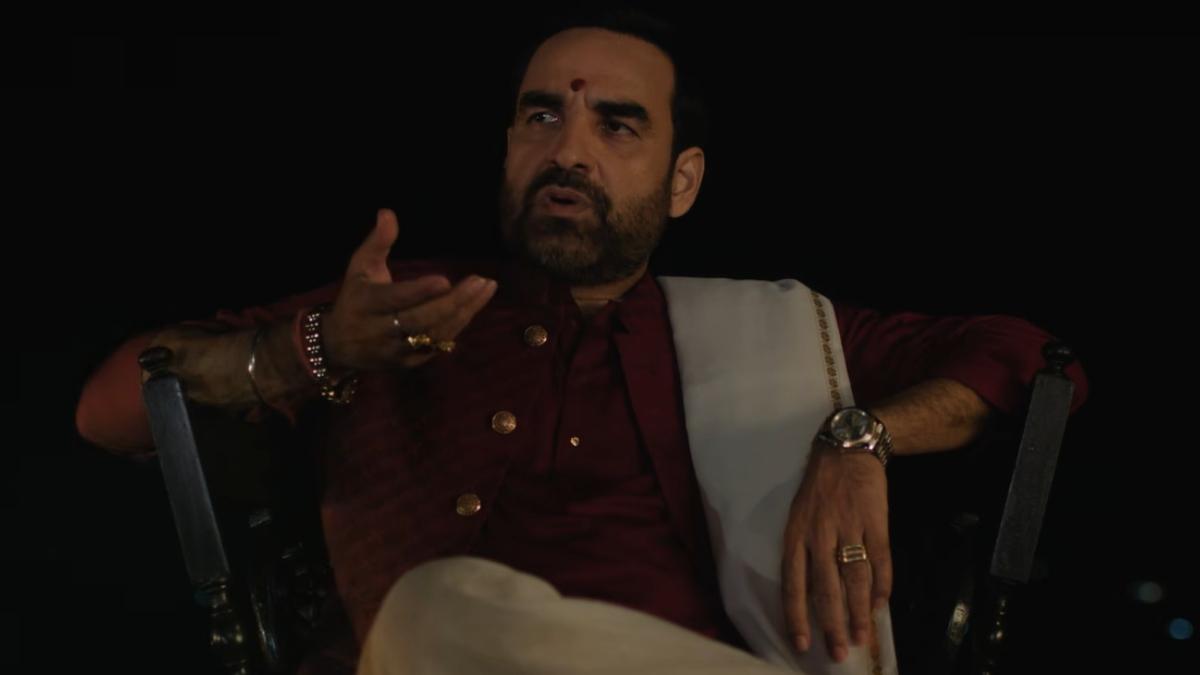
There is an old saying in the film trade that in Indian cinema, audiences can forgive a weaker plot if they fall in love with the people inhabiting it. Much like Ramesh Sippy’s Sholay and Aditya Dhar’s Dhurandhar, the plot of Gurmeet Singh’s Mirzapur is ultimately just scaffolding; the characters are the architecture, and the dialogues lend it vibrant color. You don’t merely watch the characters, you develop a deeply personal, at times toxic, yet fiercely loyal bond with them. The plot occasionally wanders into generic gang-war territory, but we stay glued because of Akhanadand Tripathi, aka Kaleen Bhaiya’s (Pankaj Tripathi) cold pauses and crisp one-liners, Munna’s tragic yet explosive desperation for love, winsome Guddu’s (Ali Fazal) terrifying, unpredictable rage, and Bablu’s (Jitendra Kumar is not as effective as Vikrant Massey) dilemma between a book and a gun.Munna and Guddu are on different sides of the social divide, but they mirror each other. Both seek their father’s approval, and both fight for what was denied to their mothers. They are psychological twins born on opposite sides of a broken socio-political fence. Much like the charismatic Jai, Veeru, and Gabbar, these are characters who have broken bones and the law. Yet, the writing humanises their moral decay so effectively that you gladly step into the grey zone with them and find yourself rooting for competing factions at once.Mirzapur The Movie (Hindi)Director: Gurmeet SinghDuration: 197 minutesCast: Pankaj Tripathi, Ali Fazal, Divyendu, Ravi Kishan, Jitendra Kumar, Rasika Dugal, Shriya Pilgaonkar, Shweta Tripathi, Sheeba Chaddha, Kulbhushan Kharbanda, Abhishek Banerjee, Rajesh Tailang.Synopsis: The film chronicles a fierce struggle between bahubalis and their political masters for absolute supremacy over the Purvanchal underworld.Opening a cinematic chapter somewhere in the middle of the first season of the series, Gurmeet unleashes a different beast that retains the defining characteristics of its parent. Within the initial ten minutes, the screenplay sheds its episodic skin, and the tonal shift from an OTT series to a feature film doesn’t feel jarring. Relying on the audience to connect the dots to the source material, writer Puneet Krishna ensures the characters’ core motivations—why someone is doing what they are doing—are never lost in transition. In fact, some character insights are spelled out more clearly. For instance, the role of Guddu’s mother, Vasudha Pandit (Sheeba Chaddha), in his psychological transformation into a gangster is clearer. Similarly, it deepens Beena Tripathi’s (Rasika Dugal) survival trajectory among the Tripathi men and the scars behind Munna’s (Divyendu) misplaced machismo. While the men in Mirzapur are trapped in a cycle of destructive, often predictable machismo, the women drive the plot’s real undercurrents. Divyenndu in ‘Mirzapur The Movie’ | Photo Credit: Excel Movies Sanitising the narrative for a wider theatrical audience, Puneet cuts down on the profanity and overt sexual politics that defined the OTT series. This restraint does not dilute the film’s impact. Instead, it sharpens it as he embellishes the narrative with potent metaphors of the heartland. Drenched in rustic wit, the dialogues function as a high-stakes psychological game. The spoken word sounds humorous but instantly becomes a matter of life and death. The cinematic format amplifies the pregnant pauses and the low, menacing whispers of Kaleen Bhaiya in the theatre, leaving the audience hanging on every word, for a single verbal misstep can trigger a bloodbath.As for the world-building, perhaps the most politically telling aspect of the film is its deliberate restructuring of Purvanchal’s criminal landscape. Driven by what appears to be current political expediency, the makers ground the narrative within a specific historical window of Uttar Pradesh’s political timeline, completely bypassing the Muslim and Thakur ganglords of the region. Instead, the film seems to reframe the entire power struggle as a Yadav vs. Brahmin war for absolute supremacy in Purvanchal politics. The OBC group represents the political class, while the upper-caste group leads the underworld. If one wants patronage, the other seeks funds. The film doesn’t explore what the Yadav party’s political rivals are up to when it patronises one section of Bahubalis. While the series largely balanced the representation of different caste groups, the film flattens it as sophisticated feudalism versus crude, power-hungry interlopers. Ali Fazal in ‘Mirzapur The Movie’ | Photo Credit: Excel Movies Integrating actor-politician Ravi Kishan into the Mirzapur universe brings the required colour, meta-context and political patronage in a State that is, of late, very conscious of its image on screen. As a kind of feminist Bahubali, Ravi embodies the region’s posture and linguistic rhythm with inimitable, chameleonic flair. Pramod Pathak matches him as an opportunistic, sleazy politician.Once again, Pankaj Tripathi as Akhanda emerges as the lifeline. He lives the written word and the subtext, navigating a complex emotional matrix where dominance and fear, lobh (desire) and lalach (greed), constantly bleed into one another. Ali Fazal becomes a Dharmendra-type vulnerable brute from the heartland whose violence is not calculated but an emotional tempest fuelled by raw passion. As Munna, Divyendu gets the best punchlines but has the craft to showcase the vulnerable side of an unhinged monster.Unlike the dialogues, the songs and the sound design take time to grow on you. With over three hours of runtime, some of the desert sequences in the second half feel stretched, but in a post-Dhurandhar world, filmmakers are eager to indulge, knowing that telling the story in more than one installment is no longer a box office risk. Overall, it is an engaging experiment. Next, one would like to see Srikant Tiwari on a Family trip!Mirzapur The Movie is currently running in theatres.
‘Mirzapur The Movie’ review: New beast, same pulse
Full Article
Original Source
Read the full article at Thehindu →KhanList aggregates and links to publicly available news content. We do not host full articles from third-party sources. Always verify important information with original sources.