
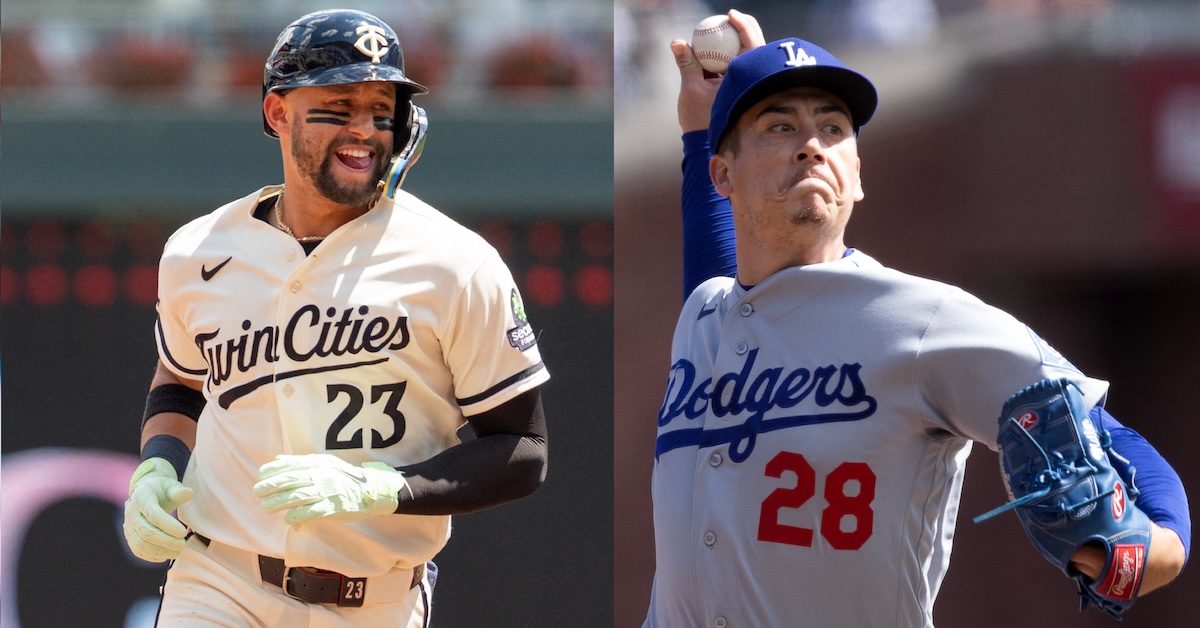
Matt Blewett and D. Ross Cameron, Imagn Images Here’s a very niche thing I find extremely funny: When someone gets out of a long-term relationship and immediately takes up with someone who looks exactly like their previous partner. On Friday, the Dodgers plucked Royce Lewis off the Minnesota Twins’ non-tender candidate list, sending Bobby Miller and minor league catcher Francisco Espinoza northeast in exchange for the 2017 no. 1 overall pick. It figures. Dodgers president of baseball ops Andrew Friedman loves himself a utilityman. I get it. His first great Rays teams owed a lot to Ben Zobrist, whose ability to provide middle-of-the-order production at any position other than catcher made it possible to construct a consistent contender on a shoestring budget. Since coming to Los Angeles, Friedman has continued to value positional flexibility, even though he has more resources to play with. So much so, I’d argue, that he’s created such flexibility by force of will: Chris Taylor, Gavin Lux, Enrique Hernández, Tommy Edman, Miguel Rojas. He even moved Max Muncy and Mookie Betts the wrong way down the defensive spectrum to the middle infield in their 30s. Over a long enough timeline, the meme goes, all animals will evolve into crabs. Similarly, all Dodger position players will eventually split time between second base and left field. This isn’t how anyone wanted the Twins’ relationship with Lewis to end, but it had its high points. A high school shortstop out of southern California, Lewis worked slowly through the minors, finally arriving in Minnesota in 2022, whereupon he tore his ACL 12 games into his career. Lewis hit .309/.372/.548 upon his return to the majors in 2023, amassing 2.3 WAR and hitting 15 dingers in just 58 games. That’s ridiculous enough, but Lewis’ penchant for making his homers count will keep him in cult hero territory far into the future. Lewis’ first career big league dinger, in 2022, was a grand slam. Then, in 2023, seven of his 15 home runs came with at least two men on base. That included a major league-record four grand slams in the span of just 18 games. That’s announcing yourself with authority. Unfortunately, the first five weeks of 2023 were the high-water mark of Lewis’ career, at least to date. Oblique and hamstring injuries wiped out most of the second half of his rookie year and he watched the bulk of the next two and a half seasons with some part or other of his body on ice. Between July 1, 2023 and July 1, 2025, Lewis made six discrete trips to the injured list for strains, sprains, or pulls to soft tissue in his obliques, left hamstring, right quad, adductors, left knee, and left hamstring again. This trade is probably going to put at least one Twin Cities orthopedist out of business. But since mid-2025, Lewis has mostly been healthy. “Mostly” is doing a lot of work here; as a rookie, Lewis was a shortstop with a plus run tool. Now, at age 27, he’s a corner infielder with average sprint speed and below-average defensive range. His draft position and genuinely tremendous third of a season in 2023 paint the picture of a player who’s one good stretching routine away from becoming at least a first-division regular, but I’m not sure. In 912 big league pate appearances over the past two seasons, Lewis has hit .231/.285/.384, with 28 homers and an equal number of stolen bases. He’s walked in 6.9% of his plate appearances and struck out in 23.0% of his plate appearances. That’s acceptable production for a backup infielder; for a corner guy projected to make $5.1 million in his third year of arbitration, less so. Perhaps because they sank so much draft capital into Lewis, the Twins gave him plenty of rope. Eventually you just have to acknowledge it’s not working and move on. This isn’t strictly relevant to the trade, but whenever a former top draft pick or top prospect gets moved, it’s natural to be curious about the road not traveled. I don’t know how comforting this is for Twins fans, but this isn’t a Danny Hultzen-over-Francisco Lindor situation, where it was a coin flip between a would-be bust and a future Hall of Famer. The 2017 draft wasn’t the smoking crater that the 2016 draft had been, but it hasn’t produced any real stars. A decade out from that draft, only 20 players who signed out of that class have gone on to produce five or more WAR in the big leagues. (Unsigned draftees include Drew Rasmussen, Cade Smith, and Garrett Mitchell; still not exactly a 2005 or 2011 class.) The Best Signees from the 2017 Draft I’m sure the Twins wished they would’ve taken Hunter Greene, the other serious contender to go first overall, but Lewis still ended up having a legitimate big league career. And thanks to Brent Rooker and Bailey Ober, the Twins might’ve ended up with the strongest class in this draft anyway, even with Lewis’ struggles. If there’s anything left in Lewis’ tank, the Dodgers will surely try to find it. Unfortunately, I don’t see an obvious place for him to improve. Lewis’ swing is already pretty well-optimized for power; he posted 86th-percentile bat speed in 2026, with a GB/FB ratio of 0.64. And his zone contact rate was a career-low 81.7% in 2026, which is on the low side of normal. It’s good to know that Lewis still has plenty of bat speed, but if he’s going to contribute for Los Angeles, he’s going to have to do a much better job of putting it to work. Lewis’ fit on the Dodgers’ roster is pretty convenient. With Rojas’ retirement and Hernández’s departure in free agency, there’s an obvious need for a right-handed bat with some defensive versatility. Lewis posted a wRC+ of 77 against right-handed pitchers in 2026, but he held his own against lefties, to the tune of a 104 wRC+. And while I wouldn’t put him at shortstop, he can play the other three infield positions just fine. I joked about Lewis ending up in the outfield, because that’s what happens to every Dodgers utility infielder; that’s not going to be Plan A in the short-term. The Dodgers currently have a surfeit of corner outfielders, with Kyle Tucker in right and a combination of Teoscar Hernández and Josue De Paula in the other corner. The Dodgers also brought back lefty-killer Alex Call, and can use Edman in the outfield should the need arise. But it’s difficult to describe Teoscar’s outfield defense accurately without either sounding cruel or resorting to euphemism. And across 15 total games in the majors, De Paula played just six innings in left field in 2026. The kid can rake, but he plays the outfield like he’s wearing a welder’s safety equipment. If Lewis can still run even a little, Dave Roberts could give him a spin in left. Ultimately, Lewis is the Chrysler of post-hype utility guys — expensive, not that reliable, but with a certain verve you can’t get on the minimum salary. The Twins might not be willing to earmark $5 million, give or take, to run Lewis out every day, but the Dodgers can spend that on an experiment. Lewis, of course, also cost the Dodgers Espinoza and Miller. I’ll deal with them in that order to get Espinoza out of the way. The 19-year-old catcher from Venezuela put up impressive on-base numbers in 32 games at Low-A this season, hitting .296/.383/.330. But the offensive environment in the California League answers the question of what the Steroid Era would’ve been like if it had taken place on the Moon, so a .383 OBP isn’t that impressive, and a .330 SLG is downright dire. Espinoza didn’t feature, even as an honorable mention, on either last season’s Dodgers prospect list or the midseason update, which went 60 deep. Here’s an updated report from Eric Longenhagen: Espinoza’s underlying contact data (70%) is much worse than his surface stats because he ran a BABIP just under .400 across two levels in 2026. That contact rate is also much worse than his 2025 mark. It seems as though he tried to trade contact for power (his hard-hit rate, for instance, was way up this year), but Espinoza is so often late to the contact point that he drives the baseball into the ground (he had a 60% groundball rate this season). On defense, his pop times (2.03 on average) and framing (especially at the bottom of the strike zone) were both below average. He’s a big, fairly athletic kid who plays an in-demand position, but he’s more the sort of player you’ll find in the honorable mentions section of a prospect list. Espinoza will keep the ball from hitting the backstop somewhere in the Twins’ minor league system; anything beyond that is gravy. Miller is the key player here. Just like Lewis, he’s a former first-rounder from an awful draft class (29th overall out of Louisville in 2020) whose career has been derailed by injuries. As a rookie in 2023, Miller made 22 starts and posted a 3.76 ERA, while averaging 99 mph with his fastball. His hard slider and slow curve didn’t generate a huge number of whiffs, but his four-seamer/sinker combo got him everything else you’d want from a pitcher: lots of groundball and soft contact, very few walks and home runs. Miller started the 2024 season as the Dodgers’ no. 4 starter, and in his first game of the year, he struck out 11 Cardinals over six scoreless innings while allowing just two singles and a walk. Two weeks later, he went on the IL with shoulder inflammation. Since then, it hasn’t been awesome: Bobby Miller Since the First Shoulder Injury Name W L G GS IP K% BB% ERA xERA FIP xFIP WAR Bobby Miller 14 8 40 36 192 2/3 22.6% 8.3% 5.37 4.54 4.69 4.08 1.9 In 2026, Miller made just three appearances, all in September and all in relief. His fastball velocity has declined two to three ticks since 2023. In the meantime, the average fastball velocity has gone up about a mile per hour over the past three seasons, so that once-elite velo is now more like above-average with total dead zone four-seamer movement. If we’re going to tease the Dodgers for making the Chris Taylor trade twice, we can tease the Twins for making another Chris Paddack trade. Oh, right, that’s what happened to Brent Rooker. Technically, it was the now-departed Derek Falvey who pulled the trigger on that deal, but current Minnesota GM Jeremy Zoll was part of the front office brain trust at the time, so there’s enough continuity to make the bit work. In this swap of post-hype sleepers, the Twins save a few million dollars by trading Lewis for the pre-arbitration Miller. That isn’t a season-changing amount of money, even for the Twins, but it’s not nothing. In terms of fit, I’m not exactly enamored with any of Minnesota’s incumbent infielders — Kody Clemens, Ryan Kreidler, Kaelen Culpepper, and Brooks Lee — so Lewis will likely need to be replaced. That said, they’ve already seen what he’s capable of and it was nowhere near good enough. Giving Lewis a third season to make good is just throwing good money after bad; if Miller stinks the joint up, at least it’ll be novel. And as much as the Twins need infield help, they can also use all the live arms they can get. With the surprise return of Sonny Gray, the Twins have a very good top three — Gray, Joe Ryan, Taj Bradley — but at the moment Dean Kremer is penciled in as the no. 4 starter. That’s obviously an area that could stand to improve. So too the bullpen, which gets iffy pretty quickly after Jeff Hoffman. And while Lewis has struggled to be healthy and good at the same time, the Twins have had a few successes getting value from late-round picks and reclamation projects on the pitching staff: Ober (himself non-tendered on Friday), Bradley, Griffin Jax, Louis Varland, and so on. In short, the odds of Miller being healthy and effective are still pretty long, but I feel better about the Twins coaxing some production out of him in 2027 than I would Lewis. Trades like these happen all the time as front offices get their 40-man rosters in order and figure out who’s worth taking to arbitration and who isn’t. This one’s just more conspicuous because of the name recognition of the players involved. Will either Miller or Lewis make good on the promise they showed years ago? Probably not. But it’s nice that they’re both getting a clean slate.
Minnesota Rolls Royce to Los Angeles in Swap of Former First-Rounders
Full Article
Original Source
Read the full article at Blogs →KhanList aggregates and links to publicly available news content. We do not host full articles from third-party sources. Always verify important information with original sources.