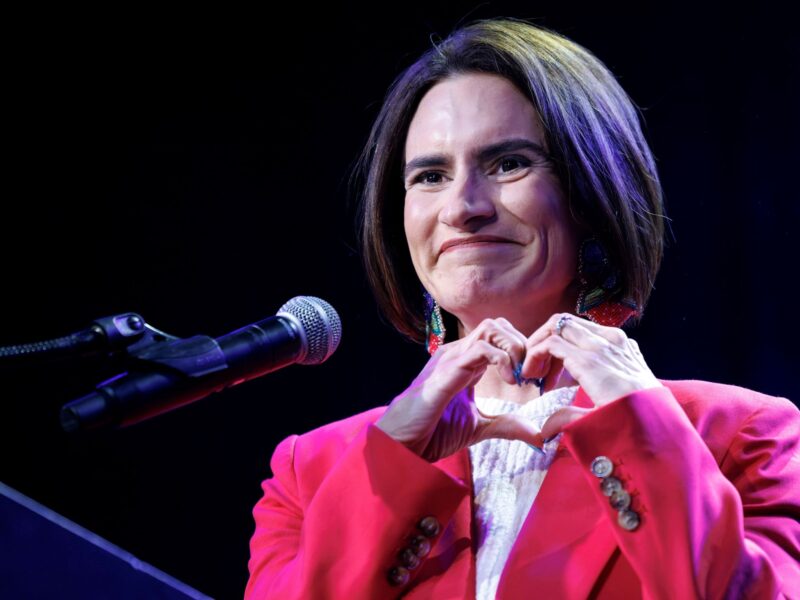
MINNEAPOLIS (CN) — A record-breaking primary election in Minnesota drew over 1 million voters Tuesday, capping a year of fierce political turmoil and locking in a slate of high-stakes fall matchups.The high turnout across the state reflected an electorate deeply motivated by recent debates over state fraud, federal immigration enforcement and government oversight as voters on both sides of the aisle signaled a clear appetite for change.The results expose distinct midterm challenges for both parties. Experts note Democrats must unify a diverse ticket anchored by both progressive and established moderate strength, while Republicans must rally party factions behind a message focused on state oversight and government accountability.U.S. SenateIn the race to succeed retiring Democratic Senator Tina Smith — the first U.S. Senate election in Minnesota without an incumbent since 2006 — Lieutenant Governor Peggy Flanagan secured the Democratic-Farmer-Labor nomination over U.S. Representative Angie Craig in a closely watched contest that highlighted the fractious Democratic Party.“I think that’s the story, it’s the transformation of the Democratic Party electorate in Minnesota as a result of Metro Surge,” said David Schultz, a professor of political science at Hamline University. “Peggy Flanagan took all the things that were Angie Craig’s assets at one point and turned them into liabilities.”Flanagan captured 59% of the vote compared to Craig’s 39%, pulling away with a stronger-than-expected victory as many polls predicted a toss-up.“I’m honored by the trust Minnesotans have placed in me,” Flanagan said in a news release, saying Minnesota deserves a senator who will stand up to Trump and solve affordability issues. “Now, it’s time to come together, move forward as one team, and win in November.”Craig, a four-term U.S. representative, had a substantial financial advantage but fell to the Democratic-Farmer-Labor-backed progressive Flanagan.“Money isn’t the be-all and end-all,” said Dan Hofrenning, a political science professor at St. Olaf College. “Angie Craig had a lot more money than Peggy Flanagan, and she lost.”Craig’s vote in favor of the Laken Riley Act — one she has voiced regrets over — may have hurt her. That was especially true in the Twin Cities area, scarred by the Trump administration’s immigration enforcement push, where Flanagan dominated.Hofrenning said Flanagan will need to continue avoiding some of the extreme views that hampered progressive candidates in other states to win over centrist voters in November’s general election.On the Republican side, political newcomer Michele Tafoya emerged victorious from a crowded conservative primary with 52% of the vote, defeating GOP-endorsed Adam Schwarze, a former Navy Seal who secured 24%, and former NBA player Royce White, who finished a distant third.Tafoya, a former NFL sideline reporter, claimed victory early in the night, and signaled her fall campaign will focus on tackling fraud and increasing accountability.“Minnesota is going 100 miles an hour in the wrong direction after years of single-party rule,” she said in a news release. “They’ve turned our state into a national embarrassment … I will not sit by and let the state we call home become a laughingstock.”Experts expect Tafoya will push Flanagan hard on state agency fraud during her tenure as lieutenant governor.“What it does now is force Democrats to defend a seat that should easily be their seat,” Schultz said, noting the Democrats’ path to recapturing the Senate is now more complicated.GovernorIn Minnesota’s first open governor’s race in eight years, U.S. Senator Amy Klobuchar swept the Democratic-Farmer-Labor nomination with 90% of the vote. Governor Tim Walz decided not to seek a third term amid ongoing fraud concerns.Progressive-backed Kobey Layne took 5% of the vote. Pollsters and experts predicted a landslide victory for Klobuchar, though Layne’s push alongside Flanagan’s victory highlights the party’s complex ideology.“You’ve got Klobuchar and Flanagan at the head of the ticket,” Schultz said. “You’ve got both the progressive wing and the centrist wing having gotten the nominations. … Does this suggest a party that is divided or confused?”In a post-election statement to Courthouse News, Klobuchar reaffirmed her bipartisan efforts in the Senate, and told Minnesotans she will take on the “hard fights for our state,” including affordability and fraud.“We need a governor who is going to put Minnesotans first, not be a rubber stamp for Donald Trump or anyone else,” she said. “I’m running for the people of Minnesota, and I’ll govern for the people of Minnesota.”Minnesota House Speaker Lisa Demuth won the Republican nomination in the gubernatorial primary with 43% of the vote, fending off challenges from political outsiders and businessmen Mike Lindell and Kendall Qualls.Trump endorsed Lindell, the MyPillow founder and election conspiracy theorist, who took about 32% of votes despite leading in polling.“I think he relied on Trump’s endorsement and his name recognition,” Schultz said. “He never had the support of the Republican Party, which actually is interesting now, because does this suggest limits to Trump’s reach in the state of Minnesota compared to other states?”Demuth’s legislative leadership and conservative priorities set up a November showdown with Klobuchar that will test the Republican party’s ability to break its two-decade statewide losing streak.“I have a feeling that if Lisa Demuth knew that Amy Klobuchar was running, then she would not have run,” Hofrenning said. “She thought she was running against Walz, and that seemed like a good race.”Demuth said Klobuchar would be “more of the same” in a state that needs a shift in leadership.“We began this campaign nine months ago, and the thing I’ve heard over and over from Minnesotans from all walks of life is that people are ready for a fresh start,” she said in a press release — adding she will reach across the aisle and listen to all Minnesotans.Regardless of November’s outcome, Minnesota will have its first female governor in state history.With record-breaking primary turnout signaling high voter engagement across urban, suburban and rural precincts, both parties face an intense sprint to Election Day on Nov. 3.“I think there’s evidence that Metro Surge really motivated people,” Schultz said. “It’s a combination of competitive races, Metro Surge, anti-Trump fervor, a lot of things kicking in that produce the turnout we saw.”Subscribe to our free newslettersOur weekly newsletter Closing Arguments offers the latest about ongoing trials, major litigation and rulings in courthouses around the U.S. and the world, while the monthly Under the Lights dishes the legal dirt from Hollywood, sports, Big Tech and the arts.Additional Reads
Minnesota primaries reveal parties grappling with shifting voter priorities
Full Article
Original Source
Read the full article at Courthousenews →KhanList aggregates and links to publicly available news content. We do not host full articles from third-party sources. Always verify important information with original sources.