
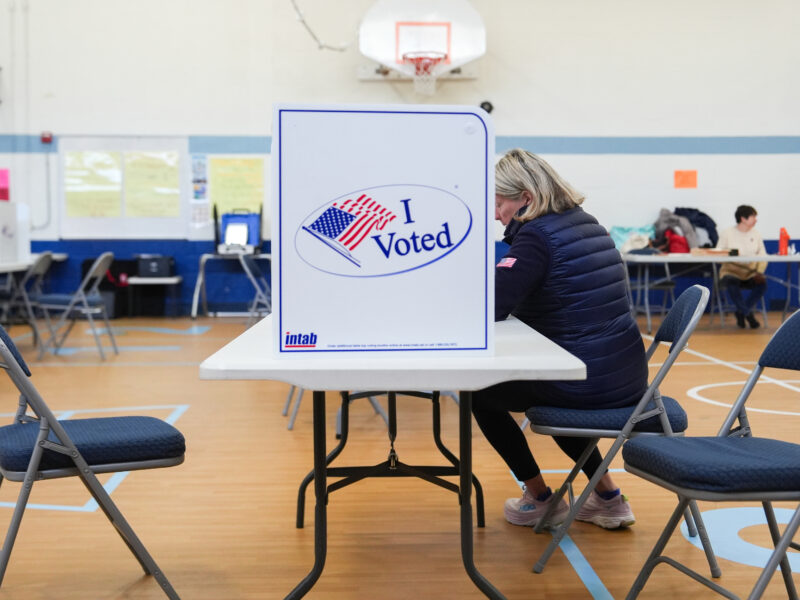
State and county officials claim cities have no authority over roster decisions for statewide elections.ST. PAUL, Minn. (CN) — Whether an outer-ring municipality in the Twin Cities metro area can reject electronic voter books and return to paper rosters for the upcoming election came before the Minnesota Supreme Court Tuesday.At issue is whether individual municipalities like the city of Oak Grove retain statutory authority to choose their poll book formats for statewide elections, or whether county and state attempts at electronic uniformity override local decisions.Oak Grove contends that, because cities bear the primary responsibility for operating polling places in their precincts, they hold final say over voter roster formats, while state and county officials argue authority goes to the county auditor for federal, state and countywide elections.“For city elections where voters are drawn from a single city, then Oak Grove is right,” Assistant Anoka County Attorney Jason Stover said. “In a statewide election, where voters are drawn from the entire county, it’s the county head elections official who makes those decisions.”The justices struggled to see where the Legislature identified that.“Why wouldn’t the Legislature have made it more clear that the head election official and the person who got to make the call in statewide federal elections was the county auditor?” Justice Theodora Gaïtas asked, to which state officials only said the statute’s structure implies it.The legal battle stems from a series of decisions dating back to 2018, when Oak Grove originally contracted with Anoka County to adopt an electronic voter roster system.Six years later, in 2024, the Oak Grove City Council unanimously passed a resolution declaring its intent to return to paper books — a notice later rejected by the Minnesota Office of the Secretary of State this year.The city, which filed a petition in May to reverse the state’s rejection, points to the risk of electronic poll book failures and community concerns regarding election security and transparency as primary reasons for the attempt to return to paper rosters.Minnesota law generally grants municipalities the authority to operate their own polling places and specifies that a county, municipality or school district “may use electronic voter rosters or paper voter rosters in any election.”Oak Grove contends the statute explicitly preserves a city’s right to choose paper rosters, while state and county officials argue elections concerning areas outside city boundaries give county officials final approval authority.“These county auditors are the head election officials in the county for such elections because they provide rosters to polling places, they receive returns and county boards are the ones to canvass the results,” Assistant Attorney General Allen Cook Barr said on behalf of the secretary of state. “A city has no authority to overrule the county auditor’s decision."While state and county officials argued uniformity as one of the main reasons why cities should not be allowed to determine voter roster formats, the justices pushed back, noting uniformity isn’t guaranteed when county officials can still decide formats arbitrarily.“One could make the argument that uniformity is better, but that doesn’t seem to be the choice the Legislature made,” Chief Justice Natalie Hudson said, echoed by Justice Karl Procaccini.“That person could say ‘eeny meeny miny moe, we’re going to use electronic here and paper there,’” he said. “Your argument is one for collaboration and coordination, but I don’t see that in the statute.”Oak Grove argues its broad statutory authority over local elections — including setting up polling places, hiring election judges and drawing precinct boundaries — gives the city ultimate control over voter-roster formats.“If the county auditor were always the head election official for every election in the county, then cities would never get to decide anything, school districts would never get to decide anything,” Oak Grove’s attorney, Nicholas Nelson, of the Upper Midwest Law Center, said.However, the justices struggled to accept Nelson’s argument that cities are the only entities that “use” voter rosters and complete the vast majority of election work.“What about all of the things that county auditors do, from making sure the absentee votes are counted correctly, I mean just the list, aren’t they using it too?” Hudson said. “You’re discounting all of these very important functions that we hope the county auditors are doing.”Questioned on the state’s concerns that paper rosters can lead to longer wait times and decreased voter participation, Nelson didn’t budge and said there are always risks in an election but that there’s a reason all municipalities are required to have paper backups.“The maximum disruption to a voting day experience that you could imagine would come from electronic rosters that would crash,” he said.Hudson expressed overall doubt over both parties’ readings of the statutory language, questioning whether this issue was as clear-cut as city and state officials claimed.“I really wondered at the end of the day whether the Legislature ever even contemplated the dispute that we have here now,” she said. “I don’t know that the legislative mind was really trained on what this dispute is about at all.”The justices noted the case’s urgency as the general election nears, saying the court would issue a ruling as quickly as possible.Subscribe to our free newslettersOur weekly newsletter Closing Arguments offers the latest about ongoing trials, major litigation and rulings in courthouses around the U.S. and the world, while the monthly Under the Lights dishes the legal dirt from Hollywood, sports, Big Tech and the arts.Additional Reads
Minnesota city urges state Supreme Court to allow return to paper voter rosters
Full Article
Original Source
Read the full article at Courthousenews →KhanList aggregates and links to publicly available news content. We do not host full articles from third-party sources. Always verify important information with original sources.