
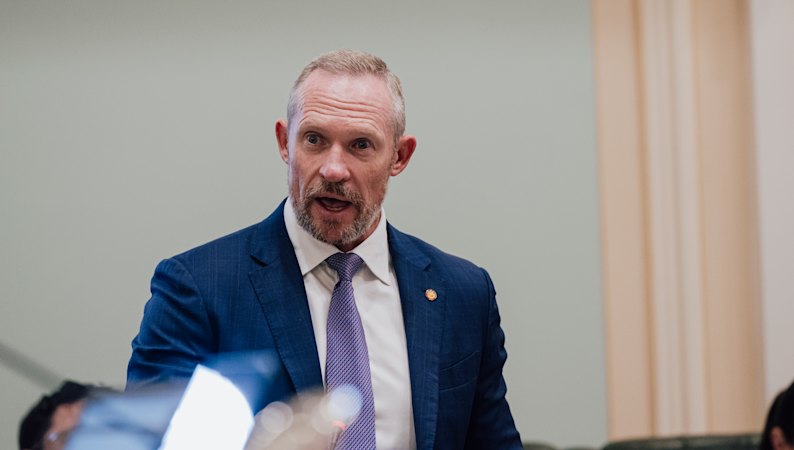
November 26, 2026 — 5:15pmFormer housing minister Mick de Brenni was effectively “everywhere” in the Queensland Building and Construction Commission’s decision-making, despite no formal ministerial directions ever being issued, an ex-senior building watchdog executive told the CFMEU inquiry on Thursday.Former QBCC licensing director Ian Grant said then-commissioner Brett Bassett described his relationship with de Brenni to him as “one of plausible deniability” – a comment Grant said was made in front of several witnesses.Grant said that culture permeated the upper echelons of the QBCC, in which de Brenni’s name was barely mentioned.Former Labor minister Mick de Brenni.Jamila FilipponeInstead, references were made to “the person whose name we cannot mention” and “our political master” – a practice championed by then-deputy commissioner Philip Halton and sometimes adopted by Bassett.Asked to explain “plausible deniability”, Grant said: “That the minister’s involved, but it’s plausible that you can deny involvement.”“The minister could only direct a commissioner to do something by putting it in writing and tabling it,” he said.“That never occurred, but the minister is everywhere here.”In his witness statement, Grant said Halton, de Brenni’s former chief of staff, advocated wider use of licensing conditions to produce faster regulatory outcomes than traditional enforcement.The most serious allegations centred on a 2019 meeting about possible action against tier-one contractor Watpac, then embroiled in an enterprise bargaining dispute involving the CFMEU and subcontractors over the North Queensland Stadium in Townsville.Grant said Bassett opened the meeting by saying words to the effect that “the only reason we are here is because an EBA has not been signed”.Grant said he understood the remark as an acknowledgement the QBCC was being drawn into – or “weaponised” in – an industrial dispute.According to Grant, Bassett told him he was pressured from “the very top” to impose a special licence condition forcing Watpac to engage an independent assessor to audit whether all of its subcontractors were appropriately licensed. Grant said he understood “the very top” to mean de Brenni.Former Queensland Building and Construction Commission licensing director Ian Grant giving evidence on Thursday,Commission of InquiryGrant said he opposed licence conditions on Watpac because the statutory threshold had not been met and told Bassett he could exercise the power himself.Instead, Grant said, Bassett declined to make the decision personally, saying it “wouldn’t look right” and whoever signed off on it would need “top cover” because “it’s going to blow up”.“It felt like he was giving assurance that he was going to give me top cover, but I was not buying it,” Grant said.While the QBCC fined PJ Walsh $2611 for earlier unlicensed concreting work – a charge director Patrick Walsh rejected after being told twice by the regulator that his builder’s licence covered the work – no regulatory action was taken against Watpac.Later, Walsh told the inquiry he initially did not intend to tender for a stadium contract, as it would have been a union job.“Everyone’s aware in the industry of the fear and intimidation the CFMEU can do to people,” he said.But tender they did after a Watpac representative assured him it was not a union job, and Walsh said they came to regret it – a campaign of union harassment was to come his way.Walsh’s company already had an enterprise agreement with its workers, he said, to which the CFMEU was not a party and had signed a variation under the state government’s Best Practice Principles policy to pay higher state-funded rates without signing a union EBA“My employees were egged on to put pressure on me to pay them the uplifted wages, or sign the CFMEU EBA agreement,” he said.In July 2020, the Federal Court found the CFMEU and organiser Grant Harradine had organised an illegal four-day walkout by Walsh’s workers in March 2019 to coerce him into signing a union agreement, imposing civil penalties.In his witness statement, Walsh said the union’s complaint over his concreting licence came less than two weeks after he obtained a Fair Work Commission order halting the strike, leaving him feeling the QBCC was “doing the CFMEU’s bidding” while senior union official Jade Ingham sat on its board.Walsh said the situation deteriorated to the point where he feared for his safety.“One afternoon a private number came up on my phone and I answered it,” he said.“He said he was a detective … and that on a phone-tap they picked up that a hit was being organised on me, and that I should be vigilant about that.“I asked them what they were going to do about it, and they said that they were going to do nothing because they were working a drug case that was unrelated.”Commissioner Stuart Wood asked how Walsh could try to remain vigilant about a potential hit.“Drink more and try to forget about it and pretend it wasn’t happening, but that only leads to one place,” Walsh replied.Walsh said he has since stayed away from government-funded jobs through fear of union involvement.Grant also told the inquiry a formal QBCC risk-register entry warning of “regulatory capture” was stripped out in 2018 shortly after since-removed CFMEU Queensland assistant secretary Ingham and National Fire Industry Association president Andrew Hickman were appointed to the expanded board.Grant said Halton summoned him to his office, said the entry was “inappropriate because of the current composition of the board”, ordered it be removed and instructed him to ensure the words “regulatory capture” no longer be used in general communications.There was also a push to strip builders of their licences on fit-and-proper-person grounds over multiple minor workplace safety improvement notices, Grant said – a move he and assistant commissioner Kate Raymond warned was legally unworkable and would have given the union “incredible leverage” to force directors off company boards.Grant resigned in July 2021 after, he said, he was told he and Raymond were on a “hit list” of executives to be removed before Bassett left office and felt senior leadership had betrayed frontline staff.Raymond was scheduled to give evidence on Friday.Get alerts on significant breaking news as happens. Sign up for our Breaking News Alert.More:CFMEUBuilding BadMick de BrenniWatpacTownsvilleFor subscribersFrom our partners
Minister was ‘everywhere’ inside building watchdog, inquiry told
Full Article
Original Source
Read the full article at Smh →KhanList aggregates and links to publicly available news content. We do not host full articles from third-party sources. Always verify important information with original sources.