
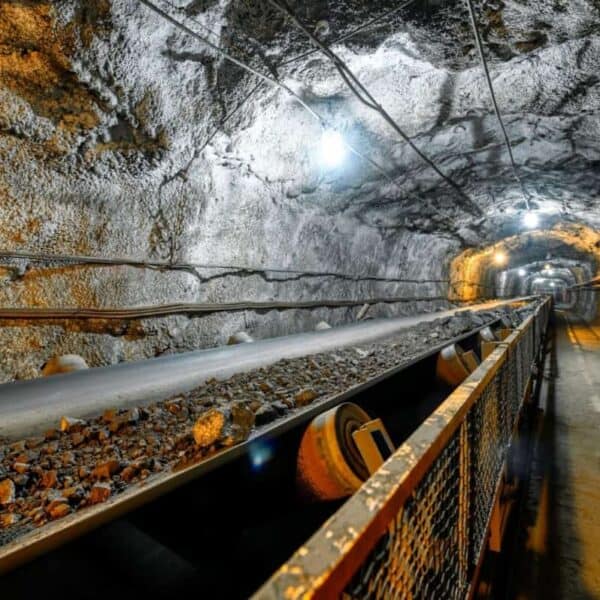
Mineral beneficiation is not merely an alternative industrial policy, it is an existential imperative for our sovereignty. The Northern Cape holds some of the richest and largest operating mines in South Africa and mining contributes 19% of the gross domestic product (GDP) of the province. It has the best ore deposits in the country, such as iron ore, manganese, copper, lead, zinc and many other base metals. These high-grade reserves anchor the province’s economy and fuel international exports. Presently, however, the province serves largely as an extraction centre, the raw and dusty periphery, with less than 5% of local mineral beneficiation taking place. This trend of exporting raw ore and minerals gives birth to poverty, unemployment and underdevelopment. This is a common trend across all post-colonial countries and is colloquially called the resource curse. In May 1992, the ANC formally adopted its seminal framework document, Ready to Govern: ANC Policy Guidelines for a Democratic South Africa. This policy included “encouraging beneficiation and the creation of a world-class mining and mineral processing goods industry”. Beneficiation is fundamentally about adding value to what is embedded in the rich soil, which are raw minerals, semiprecious minerals, ore bodies and agricultural products. According to data compiled by the Minerals Council South Africa, the localised value-add rate for platinum group metals varies at a mere 3%, iron ore stands at 11% and manganese hovers at 14%, while the tracking data for chrome remains notoriously shaky. The single sector where the democratic state performs adequately is coal, sitting at a 69% domestic usage rate, which is directly consumed in local power generation, industrial chemicals and synthetic fuel production via the Sasol value chains. However, on all other critical, high-value minerals, South Africa is not doing well. In reality, the situation regarding mineral beneficiation is even worse across the continent. The move towards green transition technologies such as electric vehicles (EVs), renewable energy grids and advanced microprocessors has created a historic opening for African resource nationalism. Global demand for critical minerals like lithium, cobalt, nickel, manganese, copper and platinum is projected to increase exponentially over the next decade. This creates an unassailable strategic leverage for African states and provides transformative macroeconomic opportunities. The first opportunity is the reshaping of globalisation. Traditional 20th-century industrial policies, such as inward-looking import substitution industrialisation, failed because they tried to isolate national economies from global trade behind high tariff walls, resulting in costly inefficiencies and foreign debt traps. Modern mineral beneficiation does not retreat from globalisation, it reshapes it. By refusing to export unrefined ore, African states can compel multinational corporations to relocate the high-value, downstream stages of production such as smelting, component manufacturing and final assembly, directly onto African soil. The second opportunity is technology transfer and skills dividend. When the state mandates that minerals must be refined locally, it forces a direct technology transfer from foreign monopolies to domestic enterprises. This demands the training of a sophisticated generation of African chemical engineers, metallurgists, data scientists and industrial technicians. The third opportunity is operationalising the African Continental Free Trade Area. The historical integration of Africa has been paralysed because intra-continental trade remains stubbornly low, hovering beneath 15% of total commerce. This is because African nations produce similar raw materials and sell them to the same Western and Eastern markets. By establishing a regional division of labour, individual states can build interdependent supply lines. For example, Zimbabwe’s lithium, the Democratic Republic of the Congo’s cobalt and South Africa’s manganese can be pooled into a single, unified regional value chain to manufacture electric vehicle batteries in the subcontinent, creating a massive and captive internal market of over 1.4 billion people in Africa. But, the primary constraint facing mineral beneficiation is that refining and smelting are exceptionally energy-intensive operations. The extraction of raw lithium or manganese requires minimal local power, but turning those ores into industrial-grade concentrates or components demands a stable, uninterrupted and massive supply of electricity. Across many parts of the continent, national energy grids are under severe strain or near total collapse due to decades of underinvestment and institutional mismanagement. Another challenge is the imperialist countermeasures and tariff escalation. Developed economies have designed international trade architectures specifically to penalise African beneficiation through tariff escalation. Under Western and Eastern tariff structures, unrefined, raw African minerals are allowed to enter foreign markets with zero customs duties to feed their own factories. However, the moment an African state attempts to export refined metal sheet, copper wire, or processed component, the destination markets slap massive import taxes on them. In the ’60s and ’70s, genuine attempts were made in Ghana, Uganda, Egypt, Tanzania and Kenya to develop the continent through import substitution. This failed because Africa did not possess the internal capacity to produce the heavy machinery needed to run its factories, creating a dependency on Western capital goods. Mineral beneficiation is not merely an alternative industrial policy, it is an existential imperative for our sovereignty.
Mineral beneficiation tackles poverty
Full Article
Original Source
Read the full article at Citizen →KhanList aggregates and links to publicly available news content. We do not host full articles from third-party sources. Always verify important information with original sources.