
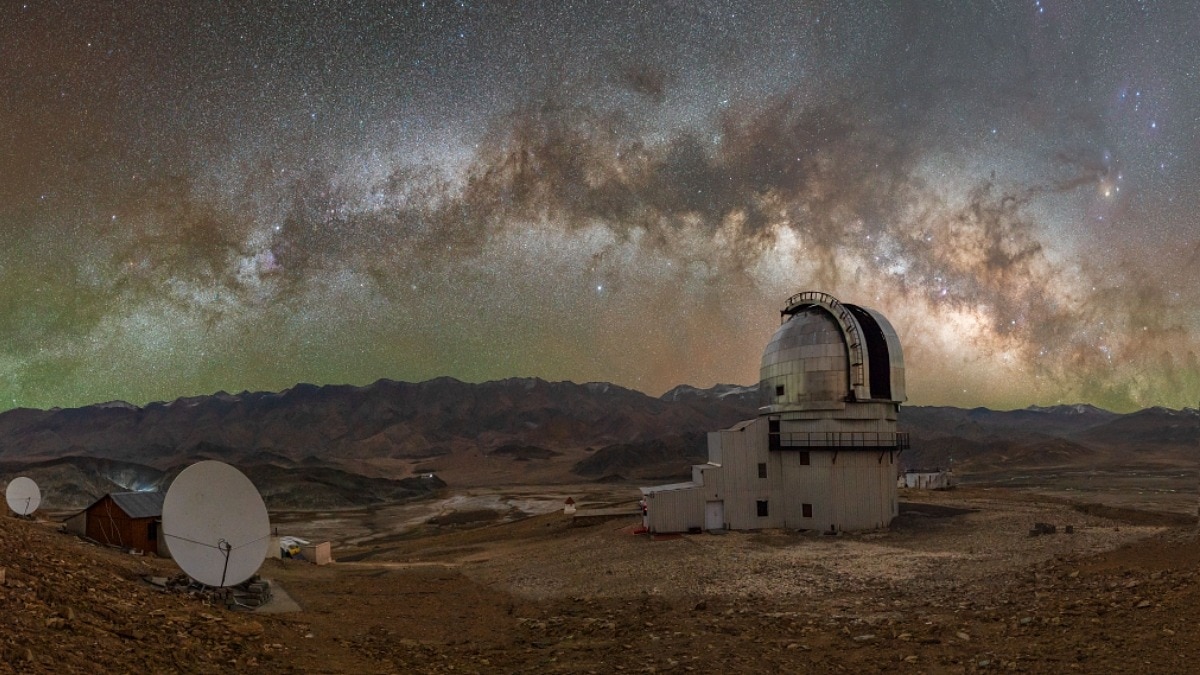
Astronomers have uncovered evidence of an ancient encounter that changed the Milky Way, revealing how our galaxy began assembling itself in the early universe.A space observatory is seen in Hanle, India, with the Milky Way stretching across the sky. (Photo: Dorje Angchuk)The Milky Way did not grow into the vast galaxy we see today on its own.Our galaxy swallowed a smaller galaxy about 11.8 billion years ago, marking the earliest major merger yet identified in the Milky Way’s history, new research has found.The galaxy that became a meal was named Low-energy-Kraken-Heracles (LKH) and contained stars with a combined mass roughly equivalent to 50 crore Suns, or about one-quarter that of the young Milky Way. An artist's concept of a smaller galaxy being eaten by the Milky Way. (Photo: Reuters) The finding pushes the known merger history of our galaxy back to a remarkably early period, when the universe was less than 2.1 billion years old at the time, which is about 15% of its current age of around 13.8 billion years. AN ANCIENT FEASTThe event happened about 1.5 billion years after the Big Bang, when the Milky Way itself was still taking shape.Rather than observing the collision directly, astronomers reconstructed it from the remains it left behind. They studied ancient globular clusters, which are tightly packed groups of very old stars, in the inner regions of the Milky Way. Using observations from the Hubble Space Telescope and the European Space Agency’s (ESA) Gaia mission, researchers examined the clusters’ ages, chemical composition and movements. The Milky Way is captured as it stretches across the night sky. (Photo: AP) These clues revealed a distinct population of stars that could not have formed as part of the original Milky Way alone.The researchers concluded that these stars were deposited by the LKH galaxy during the merger.WHAT DID EATING A GALAXY DO?A galaxy merger does not mean stars simply smash into one another as the distances between stars are enormous. An image shows various galaxies imaged by the Euclid mission. (Photo: ESA) Instead, gravity pulls the galaxies apart and mixes their stars, gas and dark matter.In the LKH event, the stellar merger was relatively gentle, but the interaction between gas clouds is thought to have triggered fresh star formation.The smaller galaxy also left much of its material in the Milky Way’s inner region, helping shape the galaxy that developed later.The discovery shows that the Milky Way’s growth was driven not just by stars forming within it, but also by smaller galaxies being absorbed.THE MILKY WAY'S CANNIBALISMLKH was not the last galaxy to become part of the Milky Way.The Largest and Sharpest Image of the Andromeda GalaxyThis is the largest image ever released by the Hubble Telescope, showing over 100 million stars and thousands of star clusters within a section of the galaxy's disk spanning more than 40,000 light-years. pic.twitter.com/Y7bbtAqKm3— Black Hole (@konstructivizm) August 19, 2026Gaia has revealed evidence of other mergers, including Gaia-Sausage-Enceladus, which collided with the Milky Way roughly 10 billion years ago and significantly changed its structure.The Sagittarius dwarf galaxy is also still being torn apart by the Milky Way’s gravity.These discoveries are helping astronomers reconstruct the Milky Way’s family history and understand how it grew.- EndsPublished On: Aug 19, 2026 17:04 IST
Milky Way is a cannibal: When Akashganga ate an entire galaxy and didn't burp
Full Article
Original Source
Read the full article at Indiatoday →KhanList aggregates and links to publicly available news content. We do not host full articles from third-party sources. Always verify important information with original sources.