
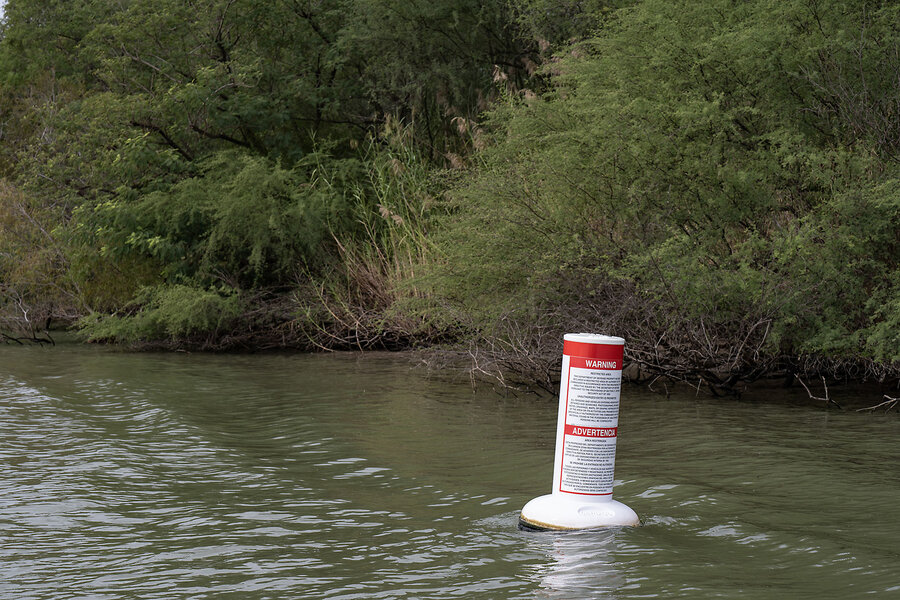
Across hundreds of miles of barren scrubland, the U.S. military has occupied vast stretches of the southern border for over a year.The military, pushing the bounds of its legally limited domestic role, detains suspected trespassers in these patrolled military zones created by the Trump administration. Now, the administration is arguing that the armed forces can stop such people “just outside” those zones as well.A Justice Department opinion released this month gives that green light. Meanwhile, the potential for more military arrests within the United States has alarmed immigrant advocates and some legal experts. They question the administration’s legal logic and point to confusion around the physical boundaries of the military zones. Why We Wrote This President Donald Trump’s use of the U.S. military to aid his immigration crackdown has pushed boundaries and raised questions, because the military has limited domestic law-enforcement authority. A new legal opinion means the armed forces could play an expanded role. “National defense areas” cover somewhere between one-third and one-half of the length of the 2,000-mile U.S.-Mexico border.President Donald Trump ordered the creation of these areas last year. Still, they’ve drawn far less scrutiny than National Guard surges to cities like Washington, a move the administration justified as a way to combat crime. Joint Task Force-Southern Border, which operates in the zones, referred an interview request to U.S. Northern Command. The command declined to comment.What are “national defense areas”?Patrolled by the military, these zones abut the southern border and range from 64 to 250 miles long. Troops have detained people there for unauthorized access.These areas are part of President Trump’s immigration crackdown. U.S. Border Patrol encounters, a proxy for illegal border crossings, spiked to historic highs under the Biden administration. Yet by the time Mr. Trump returned to office last year, illegal crossings were lower than when he left in 2021.Still, on his first day back in January 2025, Mr. Trump claimed an invasion and declared a national emergency at the southern border. He ordered the Pentagon to help secure it and to create military zones through the transfer of federal land. Government Accountability Office analysis of Department of Defense information (text) and Map Resources (map) The United States has created national defense areas along the southern border that prohibit unauthorized entry, and migrants have been prosecuted for allegedly crossing into them. National defense areas – also called NDAs – span public borderlands in California, Arizona, New Mexico, and Texas. Along the Rio Grande in Texas, parts of the zones extend into the river, where the international boundary between the U.S. and Mexico lies.The Posse Comitatus Act, passed in 1878, generally prohibits the use of the military as law enforcement in the U.S. The Pentagon has claimed authority to detain suspected trespassers in NDAs temporarily, and then hand off the migrants to law enforcement agencies, like the Border Patrol.The Pentagon doesn’t appear to publish a record of NDA detentions. But Joint Task Force-Southern Border has reported making 161 “temporary detentions” in NDAs, according to CBS News this month. That’s a speck compared with the Border Patrol, which made around 9,300 apprehensions in July alone. The military’s expansion there coincides with the buildup of the largest Border Patrol force in history.Meanwhile, the Justice Department has prosecuted migrants for their alleged entry into NDAs. They have faced military trespass charges, in addition to the more traditional charge of illegal entry into the U.S.What are arguments for and against these zones?Troops have supported Department of Homeland Security border missions before. But Mr. Trump is asking for more: He says the armed forces must now “prioritize the protection of the sovereignty and territorial integrity” of the country along its borders. Supporters of NDAs argue they’ve helped deter border crimes like illegal crossings.Defense Secretary Pete Hegseth touted the new NDA plan at an Army War College address in Pennsylvania last year. Troops can turn people over to Customs and Border Protection, he said, “instead of just looking at the border with binoculars and wondering who that person is and hoping CBP interdicts them.”Some former defense officials challenge the premise of the NDAs.Even if arrests are lawful outside military zones, the Trump administration wrongly conflates illegal immigration with a national security threat, says retired Army Lt. Col. Dan Maurer, an associate professor at Ohio Northern University’s law school and a former judge advocate in the Army.He disagrees with declaring “swaths of the border that have never been militarized as suddenly a new military installation, because you want to use the military to enforce immigration law.” That at least “violates the spirit” of the Posse Comitatus Act, he says.Beyond legal concerns about the Pentagon’s creeping domestic mission, locals – including local law enforcement – have been confused about the boundaries of NDAs in rural areas, and the risk of accidental entry. The military has posted signs in Spanish and English that warn against trespassing and unauthorized photography, note-taking, drawings, and maps. Still, courts have thrown out many of the military trespass charges on the basis that migrants didn’t knowingly enter those unauthorized zones.The NDAs are “a huge black hole, in terms of implementation and transparency,” says Becca Sheff, senior staff attorney at the American Civil Liberties Union of New Mexico.She warns that the Trump administration has previously exported border policies to the interior, such as aggressive immigration arrests on city streets. As the military exerts broader power at the border, “we need to be really watchful as a society,” says Ms. Sheff.What’s changing?In April 2026, according to the Justice Department, the Pentagon asked the DOJ for a legal opinion on whether military arrests outside an NDA’s boundary would violate the Posse Comitatus Act. The DOJ’s Aug. 14 response says such arrests would be lawful.The department cites past cases in which the military pursued suspects off base for crimes that had some tie to a military site. “An arrest of a fleeing suspect that takes place just outside of the NDA serves the same ‘military purpose’ as an arrest within the NDA,” wrote William Hyde, deputy assistant attorney general.The opinion mentions possible arrests “just outside” an NDA. But it doesn’t specify time or distance limits for those actions.The actual activity that the opinion claims to authorize is “relatively minimal,” says Chris Mirasola, assistant professor at the University of Houston Law Center. But the legal reasoning is “incorrect” and “dangerous” for how it might scale beyond the border, he says.Letting the Pentagon define which activities amount to military purposes also lets it decide the “scope of the Posse Comitatus Act,” says Professor Mirasola.Retired Army Lt. Gen. Jeffrey Buchanan, a former U.S. Northern Command Joint Force Land Component commander who also led military support for the Border Patrol, says that clearly explaining to troops the rules for the use of force will be key.“If the rules are changing, if they have different authorities, then they actually have to train their guys so that they can operate in accordance with those laws,” he says. “I’m confident that they’re doing it.”
Military’s arrest power at southern border grows. What’s behind the change?
Full Article
Original Source
Read the full article at Csmonitor →KhanList aggregates and links to publicly available news content. We do not host full articles from third-party sources. Always verify important information with original sources.