
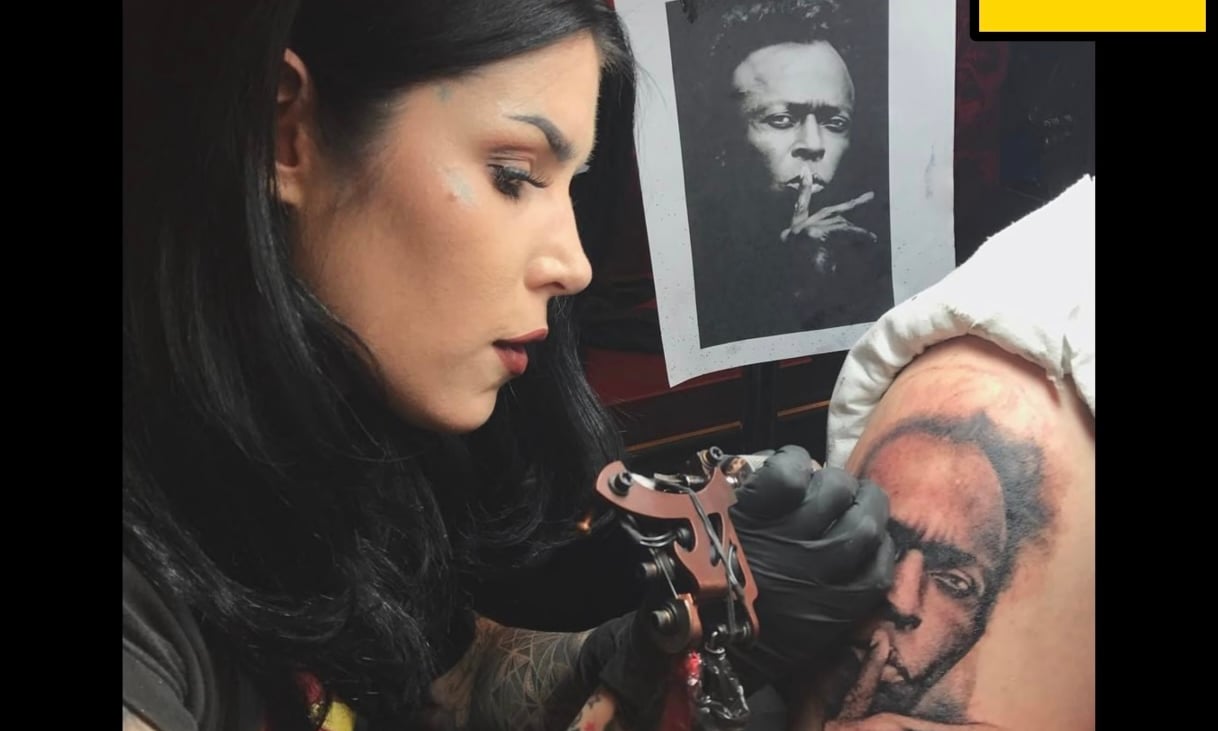
The Ninth Circuit uses two tests to determine copyright infringement tests, one of which relies on the subjective "total concept of feel" between two works.(CN) — The Ninth Circuit on Tuesday debated whether its longstanding test for establishing substantial similarity in copyright infringement lawsuits needs to be overhauled in the wake of a jury verdict that cleared celebrity tattoo artist Kat Von D of illegally copying a photograph of Miles Davis.The hearing before an en banc panel of 11 judges in San Francisco centered specifically on the subjective, so-called intrinsic test, where a jury looks at the “total concept of feel” of a work to determine whether it infringes another work.It’s distinct from the extrinsic test for substantial similarity which looks at the objective similarities between two works.To prevail on a copyright infringement claim in the Ninth Circuit, a plaintiff has to establish substantial similarity on both the intrinsic and extrinsic test.The 2024 jury verdict found the tattoo Von D inked on the arm of a friend with Miles Davis raising his finger to his lips in a “shush” gesture wasn’t substantially similar to the photograph of the jazz legend taken by Jeff Sedlik.But in a January decision now vacated by the en banc panel, U.S. Circuit Judge Kim McLane Wardlaw, a Bill Clinton appointee, and U.S. Circuit Judge Anthony Johnstone, a Joe Biden appointee, wrote concurring opinions saying the extrinsic-intrinsic analysis the Ninth Circuit has been using to decide copyright infringement disputes had outlived its use and distorts copyright law.Bill Patry, Sedlik’s attorney, urged the court to abandon the intrinsic test and replace it with a simple objective test that looks only at the elements of the works that are protectable under copyright law.“An objective test would allow exclusion of non-protectable elements such as concepts and feelings while still preserving the author’s creativity according to the specific genre of the subject matter as well as the author’s individualized expression in that subject matter,” Party argued.The court struggled, however, to fully grasp what such a new test would like given that Patry said his proposal wasn’t just to lob off the intrinsic test and leave the existing extrinsic test.“What do you think the jury’s charge should be?” U.S. Circuit Judge Morgan Christen, a Barack Obama appointee, wondered. “Clearly it’s not the intrinsic test.”Patry suggested the jury should make an objective, side-by-side comparison of the elements the trial judge has identified as protectable under the law.Even if the appellate court were to end up vacating the jury verdict on subjective similarity, it won’t mean an automatic win for the photographer because the jury never got to decide whether Von D’s tattoo was fair use of Sedlik’s photograph.And while Patry maintained his client was entitled judgment as a matter of law on the fair use question, since he said the tattoo wasn’t a “transformative” expression, U.S. Circuit Judge Daniel Collins, a Donald Trump appointee, pointed out that at best he could get a new trial on fair use because Sedlik had procedurally defaulted on that issue.Allen Grodsky, the attorney for Von D, or Katherine Von Drachenberg, said the intrinsic test shouldn’t be abandoned since it’s not inconsistent with U.S. Supreme Court law.U.S. Circuit Judge Ryan Nelson, a Trump appointee, asked why the court shouldn’t discard a test that’s been discarded pretty much by every other circuit in the country.Grodsky insisted even if the court decided the intrinsic test needs to be modified or discarded, it wouldn’t effect the jury verdict in favor of his client.“One of the big errors that have been made in this case is the suggestion that the jury decided this based on the intrinsic test,” he said. “There’s just no reason to believe that that is the case.”The jury found no substantial similarity between the tattoo and the photo, and the court should infer the jury decided both the intrinsic and extrinsic test in Von D’s favor, according to Grodsky.In this regard, the attorney noted the evidence at trial revealed many dissimilarities between Sedlik’s photograph and Von D’s tattoo.But “everyone that looks at the photo and looks at the tattoo is like ‘it looks just the same,’ ‘it’s got to be a copyright violation,’” U.S. Circuit Judge Consuelo Callahan, a George W. Bush appointee, noted. “If that’s the case, they must have been told the wrong law.”Wardlaw participated on both the original appellate panel and the en banc panel. Alongside Christen, Collins, Callahan and Nelson, she was also joined Tuesday by Chief U.S. Circuit Judge Mary Murguia, an Obama appointee, alongside Obama appointees Jacqueline Nguyen and Michelle Friedland; Mark Bennett and Eric Tung, Trump appointees; and Jennifer Sung, a Joe Biden appointee.Subscribe to our free newslettersOur weekly newsletter Closing Arguments offers the latest about ongoing trials, major litigation and rulings in courthouses around the U.S. and the world, while the monthly Under the Lights dishes the legal dirt from Hollywood, sports, Big Tech and the arts.Additional Reads
Miles Davis tattoo calls Ninth Circuit’s infringement test into question
Full Article
Original Source
Read the full article at Courthousenews →KhanList aggregates and links to publicly available news content. We do not host full articles from third-party sources. Always verify important information with original sources.