
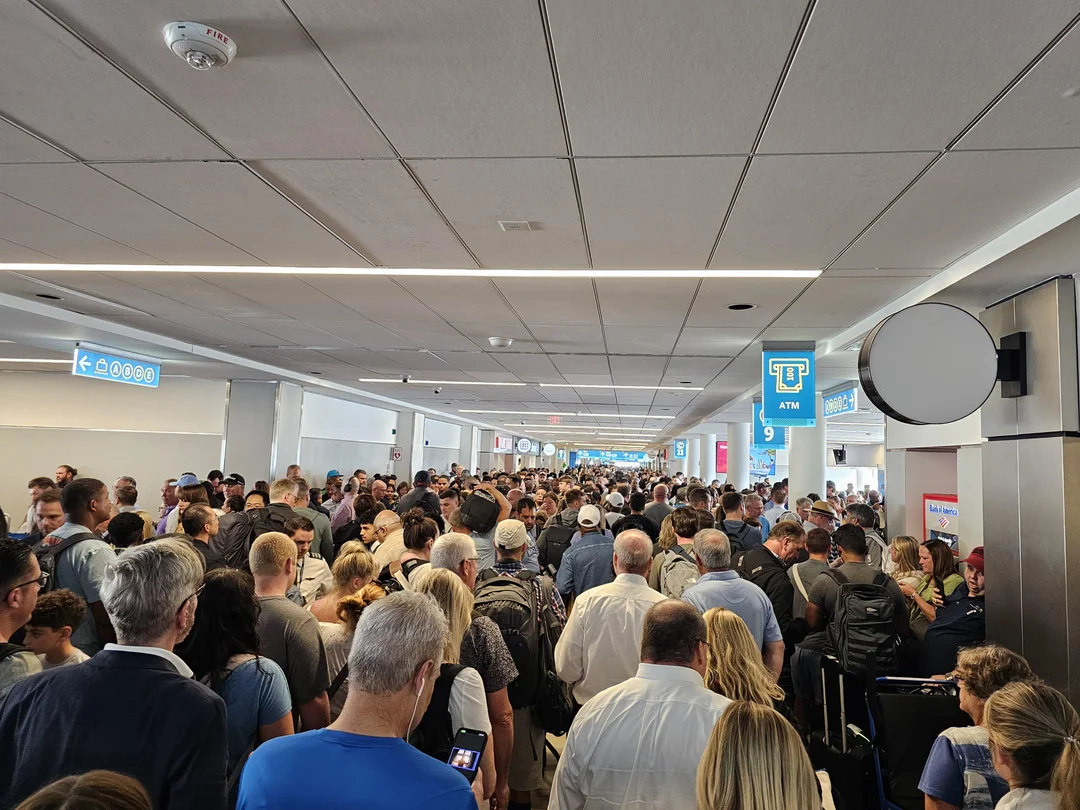
Charlotte’s airport is lining up more than $1 billion in new construction. It should fix one of the worst parts of the operation, the way that planes get trapped behind each other on the ramp, leaving passengers sitting after an early landing while their connections pull away. But it doesn’t come close to fixing everything wrong at that airport, though it will give American Airlines up to 16 more mainline gates – while leaving passengers to walk even farther through an airport that already sells 35-minute connections across crowded spokes. And despite some early descriptions of this as an expansion of both Concourses B and C, that hasn’t all been placed on a schedule yet. What Charlotte’s Building The airport has two connected projects. Charlotte will first spend $396 million expanding the aircraft ramp south of Concourses B and C. Then it will spend $700 million on a 380,000 square foot Concourse C extension with 12 to 16 gates. That’s about $1.1 billion on top of the $4 billion Destination CLT program that has been underway for the past decade. The airport expects the first South Ramp construction package to go out for bid this month, with construction beginning in March 2027 and taking about four years. The airport has converted former crosswind Runway 5/23 into Taxiway J and will reconstruct a broad swath of apron and taxilane pavement around it. The finished ramp is supposed to provide two-way aircraft circulation south of B and C rather than forcing planes through constrained alleys. Planes at Charlotte land early but arrive late because another plane is blocking the alley. Charlotte Is Not Giving Up A Particularly Useful Runway Runway 5/23 crossed one of Charlotte’s north-south runways. Air traffic controllers could not use the two independently, so the crosswind runway provided relatively little additional capacity. Ramp congestion already caused it to be used frequently as a taxiway. The airport’s new 10,000-foot fourth parallel runway is scheduled to open in fall 2027. Charlotte can operate parallel runways far more efficiently than intersecting ones, and the new runway makes it possible to dedicate the former 5/23 area to moving aircraft around the terminal. Then Charlotte Adds Gates The new Concourse C extension is expected to begin construction in 2029 or 2030 and take three years. The airport believes it needs more gates in 2032 (it probably needs them today). The final number will be 12 – 16 because the aircraft mix hasn’t been finalized, and larger planes require more space between gates. Charlotte plans to use modular construction for the first time. Large pieces of the building will be assembled away from the airport and brought to the site for installation while ramp construction continues. Dallas and Atlanta have used this approach to reduce the amount of time spent building beside an operating concourse. Charlotte’s environmental approvals and conceptual diagrams include extensions of both B and C. The airport also maintains an a project listing for eight to ten additional B gates at an estimated $463 million. However, Concourse B is not part on the construction schedule. This Helps Airplanes More Than Existing Concourses The project should deliver operational improvement, and gives American room to add flights and reduce the need to stretch gate utilization beyond what the airport can really handle. But that doesn’t touch the original 1982 concourse. There’s no widening of the B and C corridors. In fact, more gates will feed more people through the same central terminal choke points. At peak times passengers are packed body to body in low-ceiling spaces and it can become difficult to move through the terminal. Some Connections Could Exceed A Mile Charlotte already has some of the longest and most unpleasant walks among major American airports. Arrive on a regional jet at the far end of E and it can easily take 15 minutes or longer to reach a mainline connection, especially when the moving walkways are broken. American sells 35-minute connections for these itineraries. Regional passengers may first have to wait planeside for a carry-on bag, while the connecting flight’s door closes before scheduled departure. I’ve reached the terminal with less than 14 minutes to connect and had to run from one end of the airport to the other as the gate agent was closing the door. A connection between the far ends of fully extended B and C appears to cover approximately 5,000 to 6,000 feet or roughly one to 1.15 miles. A mile takes 20 minutes for many passengers (3mph) in an empty hallway. Weaving around boarding queues, wheelchairs, strollers and passengers standing in the middle of the corridor, there will be passengers who take 25 to 35 minutes to traverse it. Solo business travelers in proper shape but not running shoes should plan on 10-15. A connection from the far end of E to a future outer-B gate could approach 1.2 to 1.3 miles. The airport has discussed eventually building a tunnel from outer C back toward the Atrium. That could shorten some walks and keep passengers out of portions of the existing corridor. But that’s not in scope for current construction. We Also Have New American Airlines Lounges To Look Forward To American has announced a Flagship Lounge and a larger Admirals Club footprint. I reported in 2023 that the airport and American had explored a roughly 40,000-square-foot club on the upper level of the D/E connector, with the current main club converted to higher-revenue retail. The design firm working on that connector now describes a 95,000-square-foot expansion and renovation that includes additional concessions and “a larger airline club.” Charlotte still desperately needs at least a grab-and-go facility on E itself. (HT: Enilria) Topics on this page
Mile-Long Walks Coming To Charlotte Airport With 16 New American Airlines Gates
Full Article
Original Source
Read the full article at Viewfromthewing →KhanList aggregates and links to publicly available news content. We do not host full articles from third-party sources. Always verify important information with original sources.