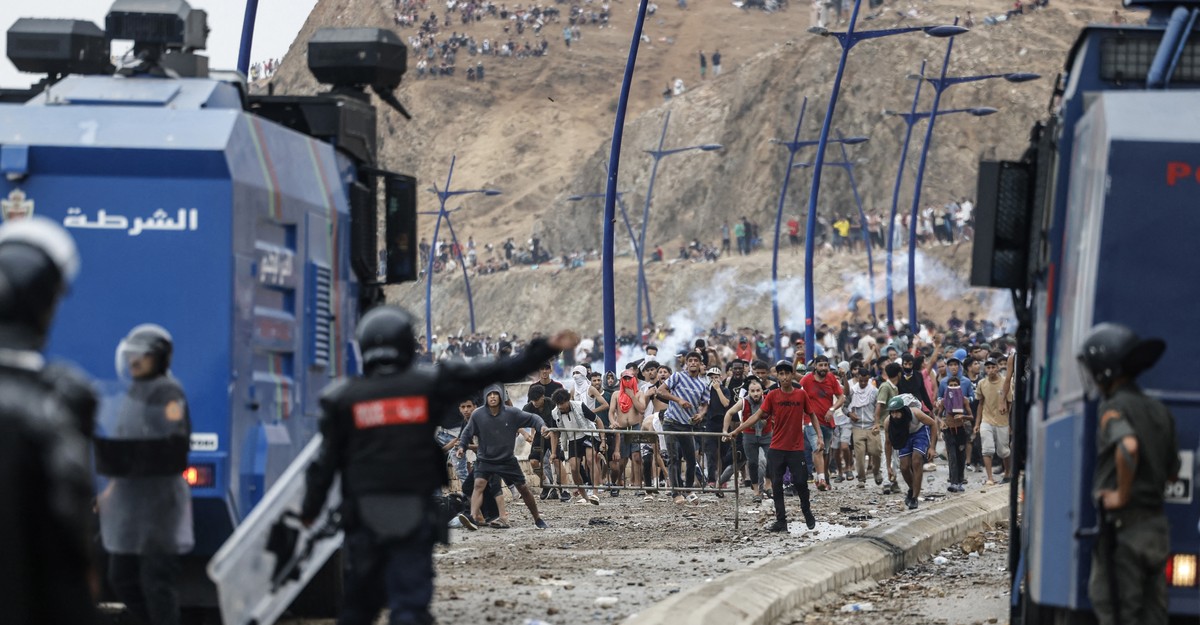
In the summer of 1985, representatives from five Western European countries met aboard a riverboat in Schengen, a wine-making village in Luxembourg, to celebrate the removal of checkpoints at their borders. According to the document they approved, which became known as the Schengen Agreement, the signatory countries sought “solidarity between their peoples by removing obstacles to free movement,” forming a borderless zone that gave tangible expression to principles of liberal internationalism that were ascendant as the West glimpsed victory in the Cold War.Schengen has succeeded spectacularly, at least by certain metrics. It has grown to include 29 countries, from Portugal to Poland, and more than 450 million people. Four decades on, it remains one of Europe’s most popular policies among people who benefit from it—those who work, study, shop, date, and live across borders, able to cross multiple European states in a matter of hours, without ever stopping their car. But as a mechanism to build European solidarity, Schengen has been a failure.The latest evidence of that came this week, when as many as 60,000 migrants from Morocco rushed into the Spanish exclave of Ceuta, which sits on the North African coast of the Mediterranean. Ceuta has a population of only 83,000 and isn’t even on the European continent. But because it is part of Spain, entering Ceuta, in theory, affords access to 29 countries. The migrants swam or climbed over fences to reach the tiny territory. Several dozen have died.Spain’s prime minister, Pedro Sánchez, decried the situation as an “attack” and a violation of his country’s territorial integrity, vowing that the migrants would be turned back; according to Spain’s interior ministry, more than half of them already have been. Sánchez blamed trafficking gangs, and others pointed a finger at Moroccan authorities for possibly instigating or enabling the huge number of crossings into the Schengen Area, dwarfing equivalent single-day figures from the European migration crisis in 2015. Morocco’s ambassador to Spain disputed such allegations.Rogé Karma: The Spanish exceptionThe political blowback for Sánchez, a leftist whose pro-immigrant position has differentiated him in an era of resurgent nationalism, was predictable. Criticism came from his domestic opposition in Madrid, as well as from the White House, where President Trump saw an opportunity to paint Europe as lax on immigration and identify an edge for his party as the midterms approach. “That’s going to be us in three years if the wrong side gets in,” Trump told Fox News.The most notable reactions, however, came from other European capitals, which once committed themselves to freedom of movement as a basis for cross-border solidarity, an integral part of shared European Union membership that also includes a common trade policy and, in most cases, a shared currency. Giorgia Meloni, the right-wing prime minister of Italy, called for the suspension of Spain’s Schengen membership (for which there is no formal process), and her foreign minister blamed the Spanish government for the chaos, labeling its plans to grant legal status to more than half a million migrants “profoundly wrong.” In response, Madrid summoned the Italian ambassador, accusing foreign leaders of “partisan demagoguery.”Other countries backed Meloni. Finland’s interior minister argued that Spain had “completely failed to protect the Schengen Area’s external border from infiltration,” adding in a post on social media, “This cannot continue.” France increased checks at its border with Spain, and the chancellor of Austria, which is about 1,000 miles from the Iberian Peninsula, said his country was weighing whether to close its borders.There is no evidence that any of the new arrivals in Ceuta have crossed the Strait of Gibraltar to the Spanish mainland. Transiting the strait typically requires a ferry or plane, and involves border and identity checks that validate whether passengers have the relevant visas. Meanwhile, there aren’t legal mechanisms to suspend a country’s Schengen membership, especially unilaterally. What other countries can do is reintroduce controls at their borders. The authority to do so was written into an implementing convention approved by the signatory states in 1990, and they’ve made liberal use of it. Italy had already reimposed checks at its land border with France because of the anticipated presence of “radical activists” at a festival in Piedmont, in northwestern Italy, and earlier today, Meloni’s government halted passport-free travel at air and sea borders with Spain. Austria had already reintroduced controls at borders with four of its neighbors, citing irregular migration through the Balkans, the burden of migrants on its asylum system, and the wars in Ukraine and the Middle East.But these piecemeal steps to police borders aren’t grandiose enough when there’s political hay to be made of immigration. Meloni can’t be outdone by her deputy prime minister and coalition partner, Matteo Salvini, who has taken to social media in recent days to urge, vaguely yet repeatedly, “Suspend Schengen.” Marine Le Pen, the far-right firebrand in France and a candidate for president in next year’s elections, vowed today to restrict the agreement if she came to power. Le Pen’s party, now called National Rally, has expertly channeled anger about Schengen. Amid the 2015 refugee crisis, when more than 1 million people crossed into Europe, mostly in flight from the Syrian civil war, party representatives performed death rites on the riverbank near where the agreement was signed 30 years earlier. They laid a wreath on a star-etched monument to the system of free movement created there.Read: Europe’s far right is turning on Trump The corps of mid-level diplomats who created Schengen gave little consideration to its political consequences. “We did our job as junior ministers,” the French representative, Catherine Lalumière, told me as part of research for my book on the history of the agreement. They thought that borderless travel would fulfill promises made by the Treaty of Rome, the founding document of European integration, and advance both the development of a common market and the cultivation of solidarity among member states. Perhaps they couldn’t have foreseen today’s incendiary debates over immigration.Except there were signs of a potent backlash already at that time. In 1983, the National Front, as Le Pen’s far-right party was then known, came to power for the first time in French municipal elections, in a small town called Dreux. A year after Schengen’s creation, the party entered the national Parliament for the first time, in elections held in 1986. As anti-immigrant populism gained influence in France, the government in Paris helped lead the drafting of Schengen’s implementing convention, trying to pair internal freedom of movement with security at Europe’s external borders. Language about “solidarity” present in the original agreement was nowhere to be found in the 1990 document. Instead, more than half of the convention’s 142 articles dealt with security and the exchange of data necessary to crack down on unwanted immigration of the kind now seen in Spain’s offshore exclave.The crisis in Ceuta is likely to be contained, and quickly. But if Europe’s reaction to a surge of immigration is to isolate individual states, rather than to use the tools it created to protect freedom and manage human displacement in a globalized world, Schengen really is at risk.
Migration Is Splitting Europe Apart
Full Article
Original Source
Read the full article at Theatlantic →KhanList aggregates and links to publicly available news content. We do not host full articles from third-party sources. Always verify important information with original sources.