
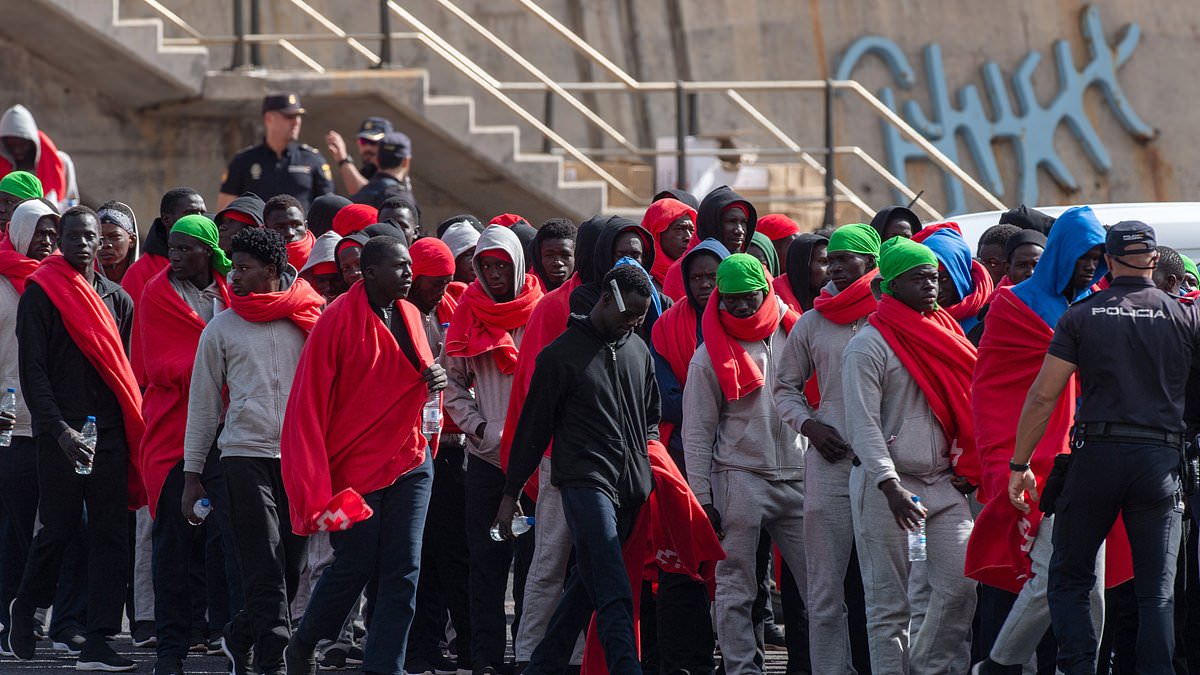
The leader of Spain's Canary Islands has pleaded for help to deal with an 'unprecedented' surge in migrant arrivals that has piled pressure on the archipelago's smallest island.Writing on X on Wednesday, regional leader Fernando Clavijo said: 'The Canary Islands cannot take it any longer. We are experiencing migration pressure that is unprecedented in 32 years of the Atlantic route.'Clavijo said he had requested an 'urgent meeting' with European Commission chief Ursula von der Leyen, demanding 'an immediate response' from the European Union.'It isn't fair that we are responding alone to a tragedy of this scale,' he said.Clavijo said in a subsequent post on X that he had requested Defence Minister Margarita Robles to 'mobilise the resources of the armed forces'. An exceptionally high figure of around 2,000 migrants reached the tiny island of El Hierro on Tuesday.Fourteen migrant boats, known locally as cayucos, were escorted into the port of La Restinga.The number of migrants reaching the tiny Spanish island – which measures just 20 miles by nine – has surpassed its local population of 12,000 in less than a month. Migrants prepare to board a ferry to be transferred to Tenerife island at La Estaca port The previous single-day high was recorded just ten days earlier, on November 14, when 1,580 men, women and children arrived in the Canary Islands in 24 hours. The arrivals on Tuesday included nearly 200 women and more than 100 children, including a 4-day-old baby who had been born during the journey.Youth Minister Sira Rego was due to visit El Hierro on Thursday to focus on the reception of children and teenagers, her office said. Clavijo, who has held several high-level meetings in Madrid with central government representatives to try to seek solutions, said on Tuesday: 'It has been a sadly historic day.'Never before have we seen arrivals of this kind with such intensity.'What we've been discussing with the interior ministry and foreign ministry is whether we're seeing co-operation from the source countries the migrants are coming from and in principle we're not getting answers.'The Canary Islands, a tourist hotspot for many Europeans drawn to year-round mild weather, have for years been a key entry point for migrants desperate to reach Europe. The route is also extremely dangerous, with thousands dying in the attempted crossing.Although the islands lie about 65 miles (105 kilometres) from the nearest African coast, many migrants take longer routes to evade security forces. The journeys can last days or weeks, with many boats missing their target and drifting into the open Atlantic.Speaking on BBC Radio, Magaly Gonzalez, the acting mayor of a municipality in El Hierro called El Pinar, revealed that the Canary Islands are running out of burial spots amid the surge in deaths from the treacherous Atlantic crossing. Migrants crowd a wooden boat as they sail to the port in La Restinga on the Canary island of El Hierro'Just two years ago we expanded the cemetery because we were running out of space for these burials,' she said. Most boats that arrived on Tuesday came from Senegal and Gambia.Despite the European Union's efforts in West Africa to reduce the number of migrants, many believe that leaving is their only option to find work and build a better life. The increase has put the Atlantic migration route from West Africa back in focus ahead of a snap general election in Spain on Sunday, where immigration is a major dividing line.Prime Minister Pedro Sanchez told public television on Wednesday that the government had been working for weeks on border controls with the Senegalese and Gambian authorities to reduce the number of boats leaving.An increase in patrols off Senegal, Mauritania and Morocco has pushed migrants to leave from further south, from Gambia, Guinea-Bissau and Guinea, making the hazardous crossings longer.Vox leader Santiago Abascal described what was happening in the Canary Islands as an 'invasion' during a fiery speech in Tenerife last week as he prepares for this Sunday's general election.Sanchez wants to stay in power after eight years at the helm despite polls predicting the Right-wing Popular Party will get most votes and try to form a coalition government with hard-Right Vox.Immigration is proving to be one of the key election issues along with others like corruption and access to affordable housing.The other immigration flashpoint has been Spain's North African enclave of Ceuta, where thousands of undocumented migrants swam or walked onto EU soil at the end of July.It recently emerged Spanish police had concluded between 100,000 and 125,000 undocumented migrants entered Ceuta at the end of July, far more than the original 72,500 estimate. A vessel from Spain's maritime rescue service (Salvamento Maritimo) went out to assist the boat as it entered the harbour for disembarkation Migrants stand near a Red Cross facility after disembarking from one of the six 'cayuco' boats rescued throughout the morning, at La Restinga harbor on the Canary island of El Hierro, early on November 24 Most returned in subsequent days but around 12,000 people are thought to have remained.On Monday police confirmed they had intercepted a group of migrants filmed running across a road in Ceuta under the cover of darkness with a rib to try to reach the Spanish mainland.Others were spotted carrying jerrycans filled with fuel in the 4am dash on Sunday in the coastal neighbourhood.Two people described as members of a criminal organisation dedicated to facilitating irregular immigration from Ceuta to the Spanish mainland were arrested.The 13 migrants intercepted were taken to a holding centre. Cops said they had paid €6,500 (£5,440) for the thwarted crossing. So far in November, there have been only five days when a migrant boat didn't reach the Canary Islands. In the year to November 15, 24,364 people reached the Canary Islands, reversing a downward trend that had seen 14,690 migrants arrive in the same period of 2025, according to interior ministry figures.But 11,037 of this year's arrivals happened between November 1 and 15, with El Hierro - the Atlantic archipelago's smallest island, home to around 12,000 inhabitants - declaring an emergency earlier this month.The new migrant crisis frontline: This tiny island in the Canaries was left living in fear when 11,000 African asylum seekers arrived on 100 boats. Now many are heading to Britain...
Migrant crisis brings Canary Islands to its knees as leader pleads for help, saying 'we cannot take it any longer' and calls in the military after record 2,000 arrive in one day
Full Article
Original Source
Read the full article at Dailymail →KhanList aggregates and links to publicly available news content. We do not host full articles from third-party sources. Always verify important information with original sources.