
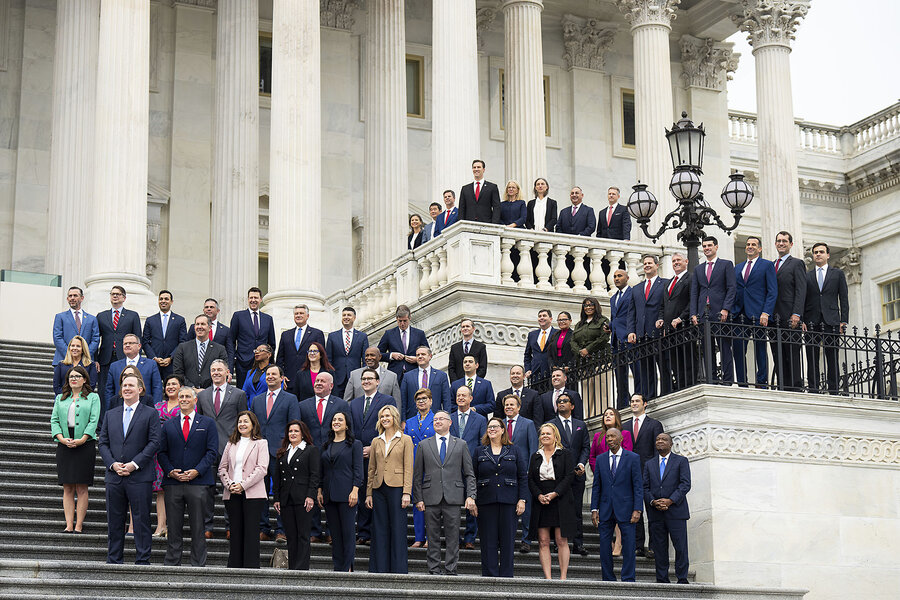
Washington | Oct. 08, 2026, 1:30 p.m. ET | 4 min read Americans say they’re looking for generational change in Congress.Members are, on average, two decades older than the American public. At a time when 3 out of 4 senators are baby boomers or Silent Generation, public polling shows most Americans favor age and term limits. And recently, the public has criticized members for being out of touch with issues like artificial intelligence that may be more easily understood by digital natives.It appears some change is coming. In 27 House races in which an incumbent is leaving or lost a primary, the seat will get younger, according to a Monitor analysis. In 21 of those, the new representative will be at least a decade younger. And in four, like the one for retiring Texas Democratic Rep. Lloyd Doggett’s seat, a departing baby boomer will be replaced by a millennial – someone almost two generations younger. It’s a similar story in the Senate, where in 11 of 14 open races, both candidates are younger than the departing incumbent (including the race for former GOP Sen. Lindsey Graham’s seat, where his replacement Darline Graham was appointed, not elected).“We seem to be reaching an inflection point,” says Jim Curry, a political science professor at the University of Notre Dame who co-authored a study on lawmaker age and representation in Congress. “After 10, 15 or so years of Congress and its leaders continuing to age ... we’re starting to suddenly see that shift.” Rod Lamkey, Jr./AP/FileRep. Lloyd Doggett, a Democrat in Texas, speaks alongside Massachusetts Democratic Rep. Richard Neal during a press conference on Elon Musk and Treasury data, on Capitol Hill, in Washington, Feb. 6, 2025. The shift won’t be dramatic. Despite voters who are dissatisfied with older generations dominating Congress, many incumbents beat out younger challengers to win their primaries over the summer. But the institution is seeing near-historic rates of members retiring or running for other offices, opening the door for a new generation of lawmakers.That matters, says Dr. Curry, because those new lawmakers will share lived experience with a wider range of Americans and could prioritize different things than legislators who have been in office for decades. Experts point to 1974, when voters elected the “Watergate babies,” a new class of younger, reform-minded Democrats after President Richard Nixon’s resignation. “The types of issues that lawmakers may be attracted to, or drawn to, or focus their time on, is related to their age,” says Dr. Curry. “Younger lawmakers are going to bring more energy, attention, effort towards issues ... that are more important to younger Americans.”Representing younger AmericansExperts point out that younger generations of lawmakers tend to be closer to issues that particularly affect Americans of their age bracket. Layla Zaidane, president of the Future Caucus, a group that supports millennial and Generation Z lawmakers of any party, says younger members elected in recent years were central in making student debt a national issue. The average amount of student debt owed by households increased more than threefold between 1992 and 2022, even after adjusting for inflation, making it a particularly salient issue for these generations.There are plenty of other issues that resonate with a new generation. Julia Demaree Nikhinson/APDemocratic congressional candidate Melat Kiros (at center) and Pennsylvania state Rep. Chris Rabb (at right) film a video during the election night party for Abdul El-Sayed, a progressive candidate in the Democratic primary for U.S. Senate in Michigan, at The Majestic Theatre in Detroit, Aug. 5, 2026. “You look at the challenges facing younger voters,” says Timothy Nokken, an associate professor of political science at Texas Tech University. “Things like health insurance, careers, buying a home. ... Those older folks [in Congress] I don’t think quite have a grasp of how challenging the landscape is in economics.”Events and trends can also linger in a generation’s collective memory, defining their approach to politics. Dr. Curry calls events like the Sept. 11 attacks “generational moments” that shape what people of a certain age bracket consider important or how they might react to news events. Older generations like baby boomers tend to be more critical of socialism, which many experts attribute to the fact that they lived through the Cold War.“You certainly have generational splits within the Democratic Party over issues like Israel-Palestine,” says Eric Schickler, a professor of political science at the University of California, Berkeley. “Younger members came of age in a different period with respect to what was going on in the Middle East, and so might have different assumptions than older members about that.”Republicans, meanwhile, have seen generational divides emerge in recent years on issues like America’s openness to newcomers, the necessity of business regulation, and attitudes toward President Donald Trump, according to a Brookings Institution study.Approach to lawmakingMembers from younger generations might also have different approaches to the lawmaking and governing process. New members tend to be more likely to challenge party leadership, experts say, although it can be difficult to know with certainty whether that’s due to generational attitudes or simply to freshman members being impatient to have their voices heard. Eric Gay/APFormer Texas Rangers All-Star baseball player Mark Teixeira, who is running for Congress, makes a campaign stop in San Antonio, Friday, Feb. 13, 2026. Dr. Schickler speculates younger Democrats might be less willing to take party leadership’s cues or to “understand that [they] probably can’t have every fight that [they] want to have against President Trump.” Democrats, for example, could present House Minority Leader Hakeem Jeffries with “some pretty hard competing demands,” he says. Deepen your worldviewwith Monitor Highlights.Politics with respectGet political stories with respectful analysis.There‘s a world of new ideas in everyBooks newsletter.There‘s more to life, enrich yours withCulture & Learning weekly.Follow humanity‘s discoveries withScience & Nature stories in your inbox.Gain a spiritual perspectivefrom the stories in your inbox.Want to understand the deeper impact of critical events? Learn the Monitor‘s insight.Already a subscriber? Log in to hide ads. Ms. Zaidane cautions against making assumptions about how a generation will approach leadership. Her organization found that among 2024 general election candidates, those from Gen Z – born between 1997 and 2012 – were more likely to run as third-party or unaffiliated candidates than any other age bracket. She says this challenges narratives that younger generations tend to take more extreme positions or be more ideologically partisan.“There’s a lot more nuance to their set of issues and their views that can’t really be summed up by a stereotype,” she says. ALREADY A SUBSCRIBER? LoginReal news can be honest, hopeful, credible, constructive.The Christian Science Monitor was founded in 1908 to lift the standard of journalism and uplift humanity. We aim to “speak the truth in love.” Our goal is not to tell you what to think, but to give you the essential knowledge and understanding to come to your own intelligent conclusions. Join us in this mission by subscribing.
Midterms could mark start of a generational shift in Congress
Full Article
Original Source
Read the full article at Csmonitor →KhanList aggregates and links to publicly available news content. We do not host full articles from third-party sources. Always verify important information with original sources.