
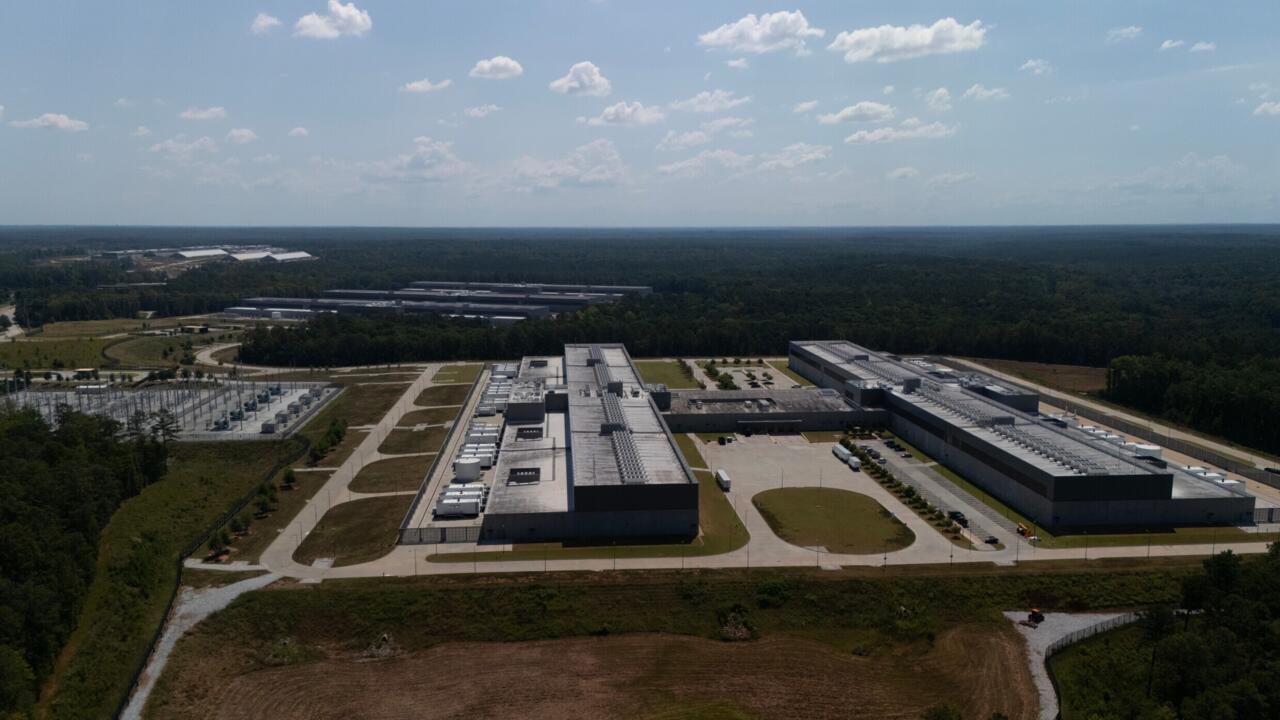
Quilliam Barber surveyed his backyard on a beautiful fall morning – the towering trees shading the southern sun, early autumn leaves dotting the green lawn, a tuneful bird working the quiet of this rural Georgia district to its advantage – and let out a heavy, forlorn sigh. “I feel terrible. It's right there,” said the 67-year-old retired truck driver, gesturing towards the sprawling open land behind his backyard. “It’s right up under my arm, you know. And I can do nothing about it.” Quilliam Barber and his wife, Wilhemina Barber, take a break in their backyard in Coweta County in the southern US state of Georgia. © Leela Jacinto, FRANCE 24 The Barbers’ property abuts a massive, 800-acre tract earmarked for a hyperscale data centre in Georgia’s Coweta County in the Middle Chattahoochee River Basin, part of the wider Apalachicola Basin in southeastern USA. His new neighbour, the Project Sail data centre, made headlines in early 2025, when the eye-popping scale of the plan came to light. The $17 billion venture, estimated to require roughly 900 megawatts of electricity and 9 million gallons of water, includes 13 buildings, each covering 378,000 square feet, taking the total land area to more than 4.9 million square feet, according to county filings. Standing next to her husband, Wilhemina Barber knows that with such a mega project coming up next door, things are about to change – dramatically. “It’s very quiet and peaceful out here. We love it, I love it, he loves it. We’ve got a pretty clear feeling it's going to play an important role if they do put it right in our back door," she said. Around two miles down the road, Ron Bockrath, picked up a poster from a pile on his kitchen buffet table. “Protect Coweta: No Data Center Here” read the yard sign in bold red. Ron Bockrath puts up a resistance at home in Newnan, Coweta County, Georgia. © Leela Jacinto, FRANCE 24 Bockrath’s opposition to the data centre has kept him busy over the past few months. From organising collectives and filing lawsuits, to collecting petition signatures, his efforts are part of a multi-pronged community campaign to stop the Sail project. Across the US, in cities and counties rich or poor, rural, urban or semi-urban, citizens are raging against the machine. Artificial Intelligence (AI), and the mega centres required to power it, emerged as one of the major campaign issues ahead of the November 3 midterm elections, popping up in debates and town hall gatherings, leaving many candidates scrambling to articulate a cogent position and their constituents dissatisfied. The public sentiment has been at odds with US President Donald Trump’s promotion of AI as “Superior Intelligence” (SI). Community-led initiatives have targeted AI-driven surveillance systems, including cameras misused by law enforcement officials. Read more'Get the Flock out': Americans respond to AI-driven surveillance cameras The backlash has at times been spearheaded by software engineers and geeks capable of hacking systems to identify guardrail weaknesses, and the gap between spin and reality. But with data centres, the mega infrastructure required to power AI, the pushback has been sweeping, drawing together Democrat and Republican supporters in a rare display of bipartisanship in a bitterly divided country. That’s because they represent a confluence of concerns: from rising electricity bills, to environmental hazards affecting local communities and impacting global warming, to a public dissatisfaction over millionaires, billionaires, tech mandarins and financiers profiting from the new technology amid a cost-of-living crisis. Georgia, a state that defined itself as a symbol of the “New South” after the American civil war, has kept up with the times. A technological boom, centred around Atlanta – “The capital of the New South” – has seen the area overtake Northern Virginia as the country’s top market for data centre construction. It has left Georgians on the front lines of pitched, local battles in the people’s war against data centres. A revamp from ‘rural conservation' to industrial district At the entrance to the Bockrath property in Newnan, Western Coweta County, another yard sign proclaims the mission that has occupied the 83-year-old retired research scientist for months. “NO Industrial Zoning. NO Data Center,” reads the sign, referring to a rezoning of this rural area into an industrial zone. A yard sign outside the Bockrath residence in Newnan protests the rezoning of Coweta County from a rural to industrial area. © Leela Jacinto, FRANCE 24 In April, county commissioners in this traditionally Republican stronghold approved a zone code revamp from “rural conservation district” to industrial area by a narrow 3-2 vote. Bockrath attended the meeting in a room packed with county residents, activists and journalists – and was dismayed by the proceedings. “People were supposed to be allowed to speak – for or against. That's good if you've got a population that's somewhat equally divided, then it makes sense to give equal time to both sides. However, in this case, the local population, not just the Western Coweta County, but the entire county, wanted nothing to do with these data centers and the way they were being forced upon us. But they gave equal time to each side to speak,” he explained. Project Sail is just one of at least five planned data centres in the county. Residents and collectives opposed to the various projects come together for countywide decision meetings. They also keep an eye on community initiatives across Coweta County, located around 50 miles southeast of Atlanta and home to around 146,158 people. “Twenty minutes was allowed for opposition, which isn't really very long, considering the magnitude of this project. That may be legally okay, but morally, it’s not okay. I got there almost two hours before the meeting. The 20 minutes were up before I was allowed to speak. They’re supposed to give great credence to people living in the area, but they were not allowed to express their opinion,” he said. The 2-3 vote was hailed by the commissioners who approved the rezoning. “This is a no-brainer for the county,” Commissioner Alphonso Smith told the Atlanta Journal-Constitution. “I will stake my political career on it.” A representative of the project’s developer, Prologis, a Fortune 500 company, said the rezoning would be transformative for the area and would generate tax revenues, the local newspaper reported. “The question isn’t if this site will be developed. It’s just how,” JC Witt, Prologis senior vice president of data centre investments told the commission meeting. ‘Miles of backup traffic’ for a signature drive The rezoning vote sparked multiple initiatives aimed at reversing the decision. Bockrath, along with some of his neighbours, including the Barbers, promptly filed two lawsuits in a Coweta County court, challenging the rezoning. The cases, filed in May, are currently making their way through the legal system. Meanwhile a grassroots collective, Citizens for Rural Coweta, launched a campaign for a “home rule petition”, which under Georgia's Constitution allows residents to petition the county's court to amend or repeal resolutions. In counties with more than 50,000 residents, signatures from at least 10% of registered voters are required. The signature drive saw Bockrath hit the road, knocking on doors to inform neighbours about the initiative. Local businesses across the county opened their doors for petition signings. Every week, venues and schedules were posted on the group’s social media accounts, followed by weekly updates. The response was overwhelming, said Bockrath. “There were miles, literally miles of backup traffic to come in and sign these things,” he recounted with a smile. To display this content from Instagram, you must enable advertisement tracking and audience measurement. Finally, on Friday, October 16, Citizens for Rural Coweta volunteers submitted boxes with more than 14,800 signatures to a county court. The 10% mark had been reached. Under Georgia's Constitution, the probate judge has 60 days after a petition is filed to determine whether it’s valid. If it is, the judge must call an election to be held between 60 and 90 days after the filing. ‘We need to speak the truth’ Community-led campaigns against data centres are taking up time and considerable mobilisation effort from citizens across the US. Bockrath admits it can be discouraging at times but he believes he has no choice. “Somebody has to do it,” he maintained. “We can't just give up. I don't think we want to see our country, or the world for that matter, get that messed up.” Volunteers have been drawn to the movement for a variety of reasons and causes, from the hyperlocal to global. For Bockrath, the motivation is primarily scientific. The retired researcher is concerned about the massive amounts of water required to cool systems in mega data centres. In Georgia’s Fayette County, for instance, many households face low water pressure complications, while some Newton County residents have been unable to drink the murky, brown water trickling out of their taps. Energy consumption and the impact on global warming is an issue that particularly worries Bockrath. “If you keep using more of our electricity, generating more heat, climate change is going to accelerate,” he said urgently before launching into a mini-lecture on global temperature percentages and melting polar ice caps. Underlying all these issues, Bockrath notes, is the spinning of truth. “In studying science, one of the things you learn is that you don't need to necessarily agree with your advisor, or chairman. What you're trying to do is find the truth,” he explained. “I'm not sure if that's the case always in things like marketing, in sales. There, I think, the idea is to sell your product or your idea, truth may not be as important. But I think it is. And I think we need to speak the truth.” Finding ‘another place to go’ Georgia’s data centre boom has been driven in large part by tax breaks and low electricity rates granted to many projects under outgoing Republican Governor Brian Kemp, who has held the state’s top post since 2019. But while companies get cheap rates, the cost of electricity for households has been rising exponentially. New data centres are driving up utility bills in at least 13 states, according to the Institute for Energy Economics and Financial Analysis. A Bloomberg analysis last year found residents living near data centres were paying as much as 267% more a month for energy than five years ago. The increase in utility bills is also adding to the cost-of-living crisis fueled by rising gas prices due to the Iran war. Coweta residents such as Bockrath are not persuaded by the arguments made by developers, and accepted by some commissioners, that data centres bring in tax revenues. “At the state level, we've got Governor Kemp, who's been very, very pro-business. I think he's been so pro-business that he's forgetting about the citizens,” he said. “You can bring in tax revenue from a data center, but if the citizens are being made to bear that cost in terms of their electrical bills, how is that helping them? It's not. It's hurting them.” It’s also hurting across ideological lines, making the resistance to AI, and data centres in particular, a rare bipartisan issue as the US prepares to vote in the midterms. While Coweta County, like most rural areas outside Atlanta, has long been a Republican stronghold, Bockrath notes that volunteers never discuss their partisan inclinations. The octogenarian grandfather describes himself as an independent, voting "both ways" in the past, depending on candidate platforms and performance. Although he declines to divulge how he plans to vote on November 3, Bockrath expresses disappointment with Republicans who have failed to challenge some of Trump's policies. "The Republicans didn't say, hey, that's not right, which they should have," is all he's willing to say. The anti-data centre movement, he explains, straddles partisan divides. Taking the example of the recent signature drive, Bockrath guesses that there had to be a mix of supporters of both parties. “To pick up almost 15,000 registered voters to sign a petition here, many of them had to have been Republican. Also, a number of them, I'm sure, are Democrat. It's not that much of a political issue. It shouldn't be. This is a humanity issue,” he said. For Barber, it’s also a matter of being forced to lose his past and links to the land. “I might have to relocate if I can. I feel terrible. I love this area. I grew up in this area. I raised my family here. I had kids, my grandkids, they all played, we played, in the woods out there,” he said. “But if they made me an offer, then yes, I would relocate.” His wife listens silently, her eyes fixed on the grass. “I'd be sad. I'd be very sad because it's just like starting all over again,” she revealed. “But if push comes to shove, we've discussed it, if they offer us a price and if it's something that we can live with, we'll take it and we'll find another place to go.”
Midterms 2026: Georgians on the front lines of the people’s war against data centres
Full Article
Original Source
Read the full article at France24 →KhanList aggregates and links to publicly available news content. We do not host full articles from third-party sources. Always verify important information with original sources.