
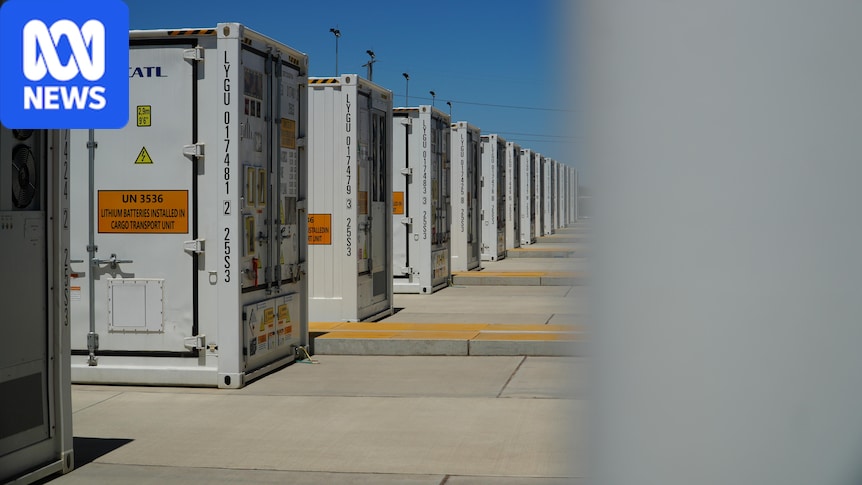
Western Australia's economic watchdog has put the owners of the state's big batteries on notice amid "unusual" behaviour that appears to have been driving up prices in the market.Economic Regulation Authority (ERA) chair Steve Edwell confirmed the agency had been investigating the pricing activities of batteries in the WA market, known as the wholesale electricity market, or WEM.The inquiries come as scrutiny mounts over the role of WA's fleet of large-scale batteries, owned by state-controlled utility Synergy and French firm Neoen.It is believed the issue has also caught the eye of the Australian Energy Market Operator.Power and responsibilityFrom practically nothing a few years ago, large-scale battery capacity in WA's main grid has risen to about 1400MW.Those batteries regularly meet more than 20 per cent of demand for power at peak times and can sometimes provide more than a third.More pointedly, they are now setting the prices in WA's main grid more than 90 per cent of the time.Mr Edwell said batteries had rapidly become an instrumental part of the state's power system.He said the technology had the capacity to deliver significant benefits to consumers by allowing renewable energy to be stored at times of surplus and supplied at times when it was scarce.But Mr Edwell signalled that those benefits were not guaranteed.Steve Edwell is the chairman of the Economic Regulation Authority Western Australia. (ABC News: Cason Ho)"We have been actively undertaking enquiries on these matters, as we always do when we see unusual behaviours or unexpected outcomes in the wholesale electricity market," he said."Where we suspect non-compliance with the Electricity System and Market Rules, we will investigate and take compliance action."Large-scale batteries are the newest technology in the wholesale market."These batteries are an important part of the energy transition, but only if we maintain a well-functioning market."The comments from Mr Edwell follow revelations, as reported by the ABC, that batteries had seemingly been driving up prices in the WA market in recent months.In one episode, coordinated charging by all of Synergy's batteries shortly after midnight propelled spot prices from $120 to more than $350 per megawatt hour.One market player, not authorised to speak publicly, said the incident was one of many in which Synergy's batteries in particular seemed to be driving prices materially higher.While prices in WA's short-term market account for only about 10 per cent of the electricity that is bought and sold — most is traded via direct contracts — experts say they are a vital indicator.High prices in the short-term market reflect an underlying tightness in supply and demand.Observers also note that prices are highest in winter, when supply and demand tightest because wind and solar output are at seasonal lows.Prices flatter, not always lowerRalph Sarich, a senior vice-president of global energy consultancy Rystad, previously explained that batteries were helping to flatten prices across the day.But he also noted that they would not necessarily drive down prices if there was insufficient energy being generated in the first place."The role the batteries have done really well is meet that evening demand, which is why you're seeing the price curve is a lot flatter across the day," Mr Sarich said."But the other thing you need to remember is batteries are not really generators. They're really just moving demand around throughout the day."Regulators such as the ERA have been trying to come to grips with batteries and their effects on the wholesale market.The authority has set out some of its concerns in a white paper on the topic.In that paper the ERA noted batteries were increasingly dominating the market, but behaved differently to conventional generators such as coal and gas plants and wind farms.Traditional generators offered — or "bid" — their output into the market based on fuel and maintenance costs, but batteries behaved differently, the paper said.For batteries, the regulator noted, the biggest cost was not necessarily physical — it was the so-called missed opportunity cost of not making more money later.In practical terms, this means that a battery could discharge at 4pm for $100/MWh, but at 6pm the price may have risen to $350/MWh.Few 'good' explanationsThe ERA said it would look at how much lead-time batteries should be allowed in setting their prices, how they should account for the costs of charging as well as discharging, and how — and how often — they should be allowed to change their bids, known as rebidding.Also in the ERA's sights was the question of "portfolio" bidding, or the use of batteries to push up wholesale prices to benefit a company's other generating assets."As with rebidding, portfolio-based behaviour may also raise concerns under the [market rules]," the ERA said in the white paper.The concerns of authorities have been echoed by market experts and observers who say Synergy in particular has been managing its battery fleet in questionable ways.Peter Tickler, co-founder of energy analysis and modelling firm Gridcog, said the topic had set tongues wagging in Australia's rapidly growing battery industry.Gridcog co-founder Pete Tickler says Australia has an overabundance of green energy at times. (ABC News: Aran Hart)Mr Tickler said there appeared to be only two options to explain the way Synergy had been managing its batteries."They're very ordinary at optimising their assets," Mr Tickler wrote on social media."[Or] they're deliberately exerting market power to drive up prices for their other assets to sell into."Choose your poison."Synergy has been contacted for comment.
Midnight power raid by big batteries in regulator’s crosshairs
Full Article
Original Source
Read the full article at Abc →KhanList aggregates and links to publicly available news content. We do not host full articles from third-party sources. Always verify important information with original sources.