
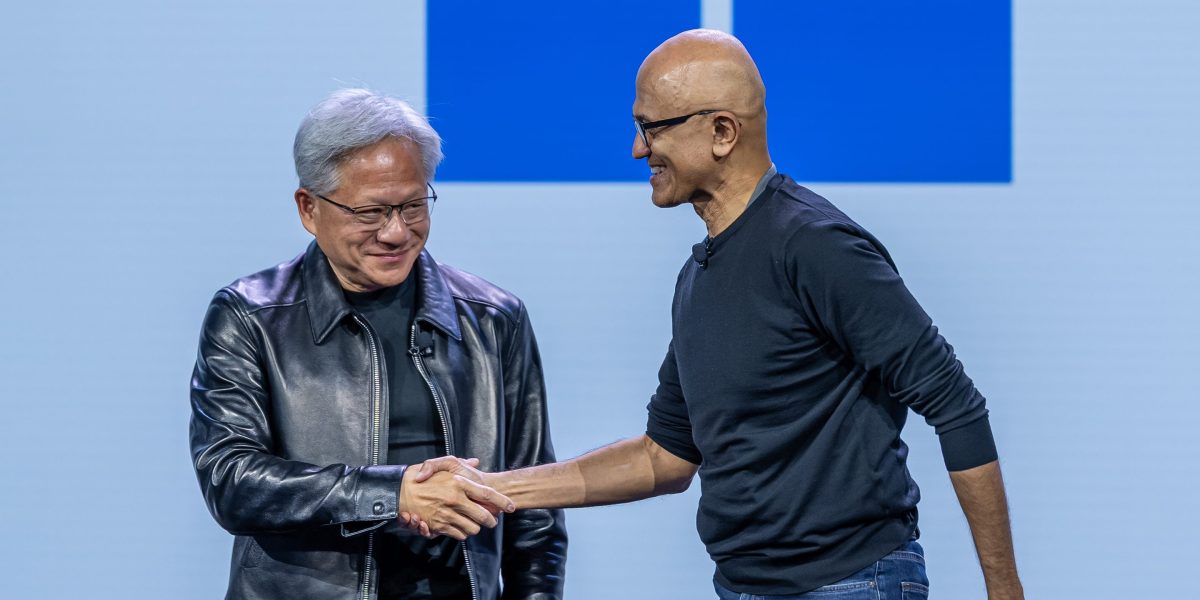
Microsoft Chief Executive Satya Nadella praised ousted Nvidia founder Jensen Huang as “a singular person” who has contributed immensely to the tech industry, but he stopped short of calling for Huang’s reinstatement to the chipmaker’s top job. “I just want to give him space for what he needs to do there, and it’s not up to me. It’s up to the Nvidia board to decide what happens next,” Nadella said Tuesday at a media roundtable in San Francisco during Microsoft’s Ignite conference. He added that he had “all the admiration, respect for what Jensen has done for this industry, and what he’s done for Nvidia,” noting that he has known and worked with Huang for a long time. Huang, who turned Nvidia into the dominant maker of AI chips and owns about a 3.56% stake, on Thursday stepped down as CEO of the company he co-founded 33 years ago, amid revelations of multiple affairs, including one with an executive whom U.S. intelligence officials suspect of being a Chinese spy. On Tuesday, Huang broke his silence and said he would be open to returning as CEO. Nadella, who said he texted Huang over the weekend to say he was thinking of him, said that Nvidia has a deep bench of talent. “I think Nvidia does have a lot of human capital and very capable leadership,” Nadella said, noting that interim CEO and Chief Financial Officer Colette Kress once worked at Microsoft. “I’m making sure that we have the same type of partnership, and we’re scaling Rubins as we speak,” Nadella said, referring to Nvidia’s next-generation Vera Rubin line of processors. “It’s a pretty critical project for us.” As one of the world’s largest cloud computing providers, Microsoft is a major purchaser of Nvidia chips, and the two companies have a longstanding relationship. Nadella appeared with Huang last month at a Microsoft Windows event. Nvidia is navigating its most tumultuous period in company history, as Huang’s ouster has raised numerous questions about how one of the world’s most valuable companies can continue to operate without the all-powerful executive who was critical to its decision-making and deals, including agreements with Microsoft and other major tech companies. Speaking about the recent midterm elections and the overwhelming rejection of AI data centers by communities throughout the U.S. that voted to restrict data center development, Nadella said that building data centers requires earning support “one community at a time” by delivering long-term local value, rather than attempting to lobby in Washington. He acknowledged community skepticism, such as concerns that data centers create local nuisances or drive up electricity bills, and emphasized that companies cannot resolve this through public relations alone, but must physically prove the benefits. “I don’t think the public is getting it wrong,” he said. Nadella also stated that election results have not altered Microsoft’s plans for building data centers, and he noted that the constraints on data center growth are more about the availability of power, chip wafers, and memory, rather than election cycles. Nadella also addressed a massive outage of Microsoft’s systems last week that disrupted Outlook, Teams, Copilot, SharePoint, and other Microsoft 365 services worldwide. And he spoke about the company’s recent buyout offer to 60,000 employees, which is nearly 30% of its workforce. Nadella said that the outage was not caused by AI code or AI deployments, and that the incident was a “perfect storm” in which a bug surfaced under specific web traffic conditions during routine testing. In fact, internal AI tools helped engineers solve the problem more quickly, he said. Nadella said that the voluntary buyout offers were designed for employees to “have some agency on how they decide what to do with their careers,” and that rather than leaving employees with the anxiety of something happening to their jobs, the offers gave people a clear option. He did not say whether the offers were a prelude to layoffs. “There are some teams that are changing faster, some teams that are in a different place,” he said, speaking about the different speeds of teams that are part of the company’s workplace transformation.
Microsoft’s Satya Nadella praises Jensen Huang, says return as CEO is ‘up to the Nvidia board’
Full Article
Original Source
Read the full article at Fortune →KhanList aggregates and links to publicly available news content. We do not host full articles from third-party sources. Always verify important information with original sources.