
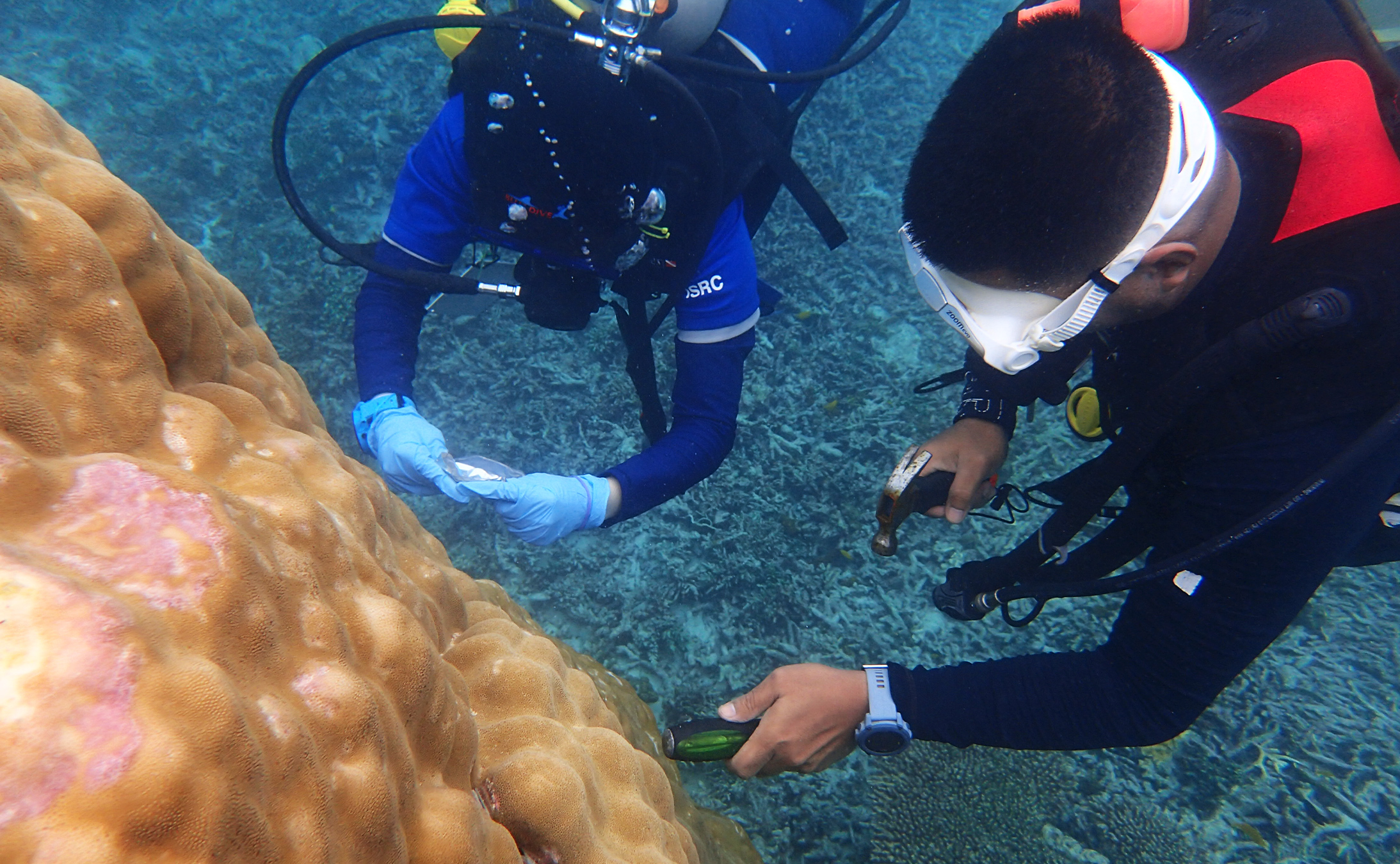
A study by Universiti Malaysia Terengganu (UMT) found microplastics in 64% of coral fragment samples taken from sites at Pulau Redang Marine Park.The primary plastic identified was polyethylene terephthalate (PET), a polymer commonly used in single-use drinking bottles.Corals tangled in plastic debris or fibers had nearly three times as many microplastics in their skeletons as those that were not.Sites closer to tourist hotspots recorded the highest levels of contaminants, while quieter sites reserved for turtle nesting had lower levels. KUALA LUMPUR — Microplastics, tiny plastic particles about 5 millimeters (0.2 inches) or smaller, have settled into the skeletons of corals in a marine protected area in Malaysia, according to a recent study. The study, published in the journal Regional Studies in Marine Science, focused on Pulau Redang Marine Park, in the southern South China Sea. Known for its turquoise blue waters and rich coral reefs, Pulau Redang has been designated as a marine protected area since 1985. Researchers from Universiti Malaysia Terengganu (UMT) collected 200 coral fragments from five reef sites around the marine park, off the eastern coast of Peninsular Malaysia, and found that 64% of the fragments contained microplastics. Microplastics come from intentionally manufactured particles like industrial pellets and microbeads in personal care products, as well as the breakdown of larger plastic items such as plastic bottles and fishing gear. These tiny particles can be found everywhere, from mountaintops to seabeds. Once they enter the ocean, they can travel far and wide. “I was a bit surprised that I could find microplastics in the corals so easily,” lead author Ong Chai Kee told Mongabay in a video call. “The ocean is so big, and I was thinking, ‘What are the chances that these little plastics could enter so many corals?’” Malaysian marine biologist Ong Chai Kee wraps the sample containers in foil to prevent airborne contamination and prepare them for analysis. Image courtesy of Ong Chai Kee. The team sampled from two dominant hard corals: the branching Acropora and boulder-like Porites. To isolate the microplastics, they dissolved the corals’ calcium carbonate in 5% hydrochloric acid, strong enough to dissolve the coral but not the plastic. The primary plastic identified was polyethylene terephthalate (PET), a polymer commonly used in single-use drinking bottles. Ong said black microplastics were also common, which may be linked to black water sports gear. “The color of the microplastic can help indicate the source of the plastic,” said Ong, a marine biologist at UMT. “One of the colors we found in a lot of the microplastics was black, which could be from water activities like snorkeling or diving where black is commonly worn,” she added. “But we can’t definitively say that the microplastics came from this tourism area because the marine environment is so open.” Lee Jen Nie, the study’s corresponding author and associate professor of marine sciences at UMT, said the team chose to study microplastics in corals because of the open ocean environment and the fact that corals are immobile animals living on the seafloor. “They are at the bottom of the seafloor and don’t move, so they rely on what the water column brings to them,” she told Mongabay in a video call. The amount of microplastics did not differ much between Acropora and Porites. However, the study noted that Acropora’s jagged, branching structure was more prone to having plastic tangled with its surface. Meanwhile, corals tangled in plastic debris or fibers had nearly three times as many microplastics in their skeletons as those that were not. “Once the plastic gets entangled on the corals, they can’t run away,” Lee said. “So they would have a direct source of plastic.” A close-up view showing plastic threads protruding from a coral polyp, left picture, and fine plastic filaments trapped within red turf algae on a coral fragment. Image courtesy of Ong Chai Kee. Microscopic images of microplastics recovered during the study, including a synthetic fiber, left; a clear plastic fragment, center; and a green plastic fragment, right. Image courtesy of Ong Chai Kee. Sites closer to tourist hotspots recorded the highest levels of contaminants, while quieter sites reserved for turtle nesting had lower levels. Long Beach, the busiest tourist site, recorded 1.31 microplastic particles per gram of coral — more than double the 0.54 recorded at Chagar Hutang, a turtle nesting site. According to a previous study by researchers in Taiwan and the U.S., exposure to microplastics can cause coral structures to degrade more quickly. However, the UMT scientists noted that they are unsure about the larger ecological impacts microplastics have on coral health and that long-term consequences could be a key area for further studies. Muhammad Reza Cordova, a marine scientist at Indonesia’s National Research and Innovation Agency (BRIN), who was not part of the study, said the research showed an important lesson. “Protecting coral reefs should not only focus on fishing restrictions or tourism management,” he told Mongabay in an email. “We also need to prevent plastic waste from entering the marine environment in the first place,” he added. “Marine protected areas are important but their boundaries cannot stop microplastics carried by ocean currents or generated by nearby human activities.” Banner image: Divers collect coral samples at Pulau Redang Marine Park, Malaysia. Image courtesy of Ong Chai Kee. Plastic ‘Frankenrocks’ pose new pollution threat to coastal environment Citations: Lin, P. Y., Hsieh, S. L., Ding, D. S., Chen, C. T. A., Beck, D. E., & Hsieh, S. (2025). Microplastics alter crystal growth in coral skeleton structures. Environmental Chemistry Letters, 23(1), 7-11. doi:10.1007/s10311-024-01790-8 Ong, C. K., Anuar, S. T., Khalik, W. M. A. W. M., Ibrahim, Y. S., & Lee, J. N. (2026). Effective acid treatment and investigation of microplastics in two common hard corals from Pulau Redang Marine Park, Malaysia. Regional Studies in Marine Science, 104916. doi: 10.1016/j.rsma.2026.104916 Cite this articleAshley Yeong (2026). Microplastics pollute nearly two-thirds of corals in Malaysia’s marine protected area, study finds. Mongabay Conservation news. DOI: https://doi.org/10.66709/news-334938 Credits Topics
Microplastics pollute nearly two-thirds of corals in Malaysia’s marine protected area, study finds
Full Article
Original Source
Read the full article at News →KhanList aggregates and links to publicly available news content. We do not host full articles from third-party sources. Always verify important information with original sources.