
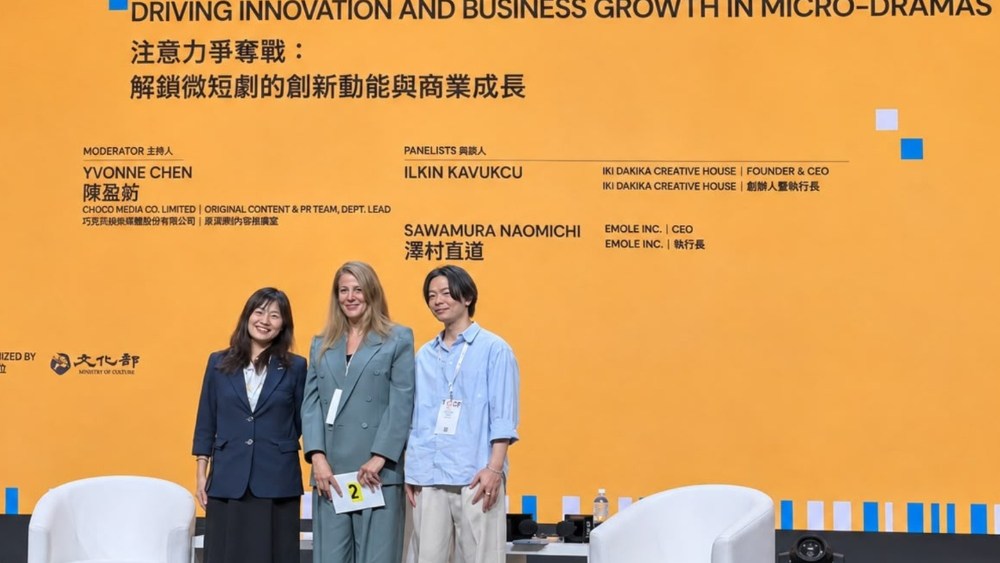
Microdramas compete for attention in crowded mobile feeds, but a strong opening hook does not always need a dramatic twist, İlkin Kavukcu, founder and CEO of Turkish studio İki Dakika Creative House, said at a Taiwan Creative Content Fest (TCCF) session on microdramas in Taipei. Kavukcu said her studio looks for moments of emotional recognition that might prompt viewers to stop scrolling and see something of their own lives in a story. Audience sharing, she said, is one sign that a series has connected. İki Dakika distributes its work on TikTok, Instagram and YouTube, aiming to build longer-running stories around characters rather than relying on a succession of one-off plot twists. Kavukcu also described a business model that brings brands into the creation of a story world, giving them a role in shaping the fictional world and its economic model rather than simply placing a product in an episode. İki Dakika has worked with around 30 local and global brands, she said, and is developing co-productions with Italy, a choice she linked to shared cultural themes such as family and tradition. Sawamura Naomichi, CEO of emole Inc. and founder of Japanese short-form drama platform Bump, outlined four popular genres in Japan: female rivalries, hidden identities, infidelity and revenge, and lightly suggestive dramas aimed at men. Female rivalry stories, he said, depend on sharp dialogue and characters who may be easy to mock but remain endearing enough to win viewers’ support. Sawamura said the genre also resonates in Taiwan and South Korea, while hidden-identity stories have wider international appeal. He said the hidden-identity format keeps viewers watching by delaying a protagonist’s reveal and the moment they confront their antagonists. Infidelity and revenge, meanwhile, can establish a relationship and its central betrayal quickly, giving viewers an immediate reason to hope the protagonist will retaliate. That speed suits a format with little time for extended setup, Sawamura said. For Bump, the first episode is critical, Sawamura said. The company tracks audience drop-off in the first 30 seconds and whether viewers move on to Episode 2. A strong opening should establish the protagonist’s emotional stakes, the central conflict and the payoff viewers can anticipate. Making the villain’s behavior sufficiently infuriating can build the audience’s desire to see them punished, he said. Bump typically spends about two months developing a project before script approval, followed by roughly 30 days for filming and post-production, Sawamura said. A 25-episode series with about 45 minutes of total runtime can be filmed in four days, and the company currently has 20 to 30 projects in production at once. Asked whether microdrama IP can extend into other formats, Kavukcu said, “We are already doing this. We can shoot in both vertical and horizontal formats, as long as we have a long enough production schedule. In Turkey, companies including Disney are also interested in trying this.” Sawamura said Bump already has examples of IP being developed further, with manga and animation particularly well suited. “Gundam represents a market worth JPY500 billion to JPY600 billion [$3.2 billion to $3.8 billion],” he said, referring to Bandai Namco’s giant-robot franchise. “Since an app like ours is similar to a manga app, we can consider adapting microdramas into manga or animation.” Bump has also tested co-productions in the U.S. and South Korea. Sawamura said local partners helped shape scripts around cultural context, relatable relationships and social media trends. Company information provided for the session says Bump has surpassed 4 million downloads, with more than 7 billion social media views.
Microdrama Makers From Turkey and Japan Bet on Emotional Hooks and Infuriating Villains at Taiwan Creative Content Fest
Full Article
Original Source
Read the full article at Variety →KhanList aggregates and links to publicly available news content. We do not host full articles from third-party sources. Always verify important information with original sources.