
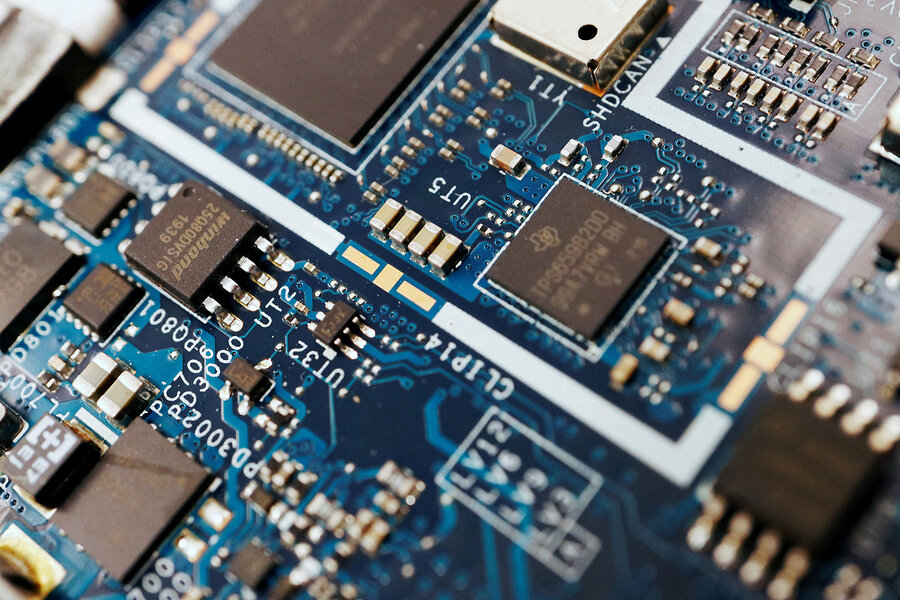
London | Nov. 25, 2026, 12:11 p.m. ET | 4 min read Think of it as the Strait of Hormuz, Version 2.0.For all the worldwide disruption caused by the Iran war’s throttling of oil and gas exports from the Middle East, an even greater economic dependency, with far more damaging implications, has been shaping up thousands of miles to the east.It’s in Asia: the destination of U.S. President Donald Trump’s first foreign trip since the midterm elections. Beyond the handshakes and photo ops at his summit talks with Chinese leader Xi Jinping, this new potential choke point is proving a major obstacle to the “stable” relationship that both leaders say they’re seeking.At issue isn’t hulking barrels of oil, but tiny products that are a fraction of the width of a human hair: the microchips essential to everything from consumer gadgets to cars, from modern infrastructure to military hardware.And essential, above all, to the world’s newest economic frontier – what Mr. Trump has termed the main theater of U.S. competition with China: artificial intelligence. About 90% of the most advanced semiconductor chips are produced in a single place. It’s the island democracy of Taiwan, which Mr. Xi has said he’s determined to “reunite” with mainland China, by force if necessary.Some 70% of the high-end memory chips in demand from the data centers that power AI come from South Korea. The country sits across the Demilitarized Zone from North Korea, whose dictatorial leader, Kim Jong Un, has been emboldened by his expanding nuclear weapons arsenal, and his new military partnership with Russia. Ahn Young-joon/AP/FileA man passes by the Samsung Gangnam store in Seoul, South Korea, Oct. 31, 2023. Samsung Electronics reported its highest quarterly profit for the year and saw narrowed losses from its computer chip business amid a slow recovery in global demand. Both the United States and China want unfettered access to the latest chips. At a bare minimum, they want to insulate themselves against any supply disruption. They’re especially intent on trying to prevent their AI rival from gaining exclusive control.The reality is that the economic effect of losing access to either of these two sources of microchips, let alone both, would eclipse the repercussions from the closure of the Strait of Hormuz during the Iran war.Hormuz Version 1.0 has indeed caused serious economic pain. The leap in oil and gas prices, and the spike in inflation, have been felt worldwide, including in America. There, they were a major factor in the drubbing that voters gave Mr. Trump’s Republican Party in November’s elections.But the Hormuz shutdown was a very 20th-century crisis. It had echoes of the world’s first great oil-supply shock, triggered by the embargo by Arab producers in response to U.S. support for Israel during the October 1973 Middle East war. Twenty-first-century economic realities have since cushioned countries against the scale of the energy shock in the 1970s: large stockpiles, particularly in China; alternative energy sources; and, in the case of the U.S., a hugely reduced reliance on Mideast oil.Yet the supply of microchips affects pretty much everyone, everywhere, in today’s world.And the combination of chipmaking expertise and experience in Taiwan and South Korea, as well as the specialist facilities needed to produce the most sought-after chips, can’t be easily or quickly replicated elsewhere.With the headlong expansion of AI, these chips are already rapidly growing in demand. The main reason iPhones got more expensive this year is because the enormous appetite of AI data centers has been driving up the price of top-end memory chips from South Korea.Frontier AI companies such as Anthropic and OpenAI also need the latest dedicated microchips, of the sort developed by California-based Nvidia. Yet while Nvidia designs them, it doesn’t make them. Chiang Ying-ying/APVisitors review MSI's handheld Claw 8 EX AI+ with the new Intel Arc G3 Extreme chip at the Computex Taipei exhibition, one of the world's largest computer and technology expos, in Taipei, Taiwan, June 2, 2026. By far, most come from Taiwan. Against that background, even the encouraging atmospherics between the U.S. and Chinese leaders at November’s summit couldn’t mask the difficulty of securing a stabler relationship while competing for a dominant role in advanced technology and AI.In the two years since Mr. Trump’s return to the White House, his personal relationship with Nvidia CEO Jensen Huang prompted him to slightly loosen constraints on some of its chip sales to Beijing. But just days before the summit, Mr. Huang admitted to having an affair with a woman suspected by U.S. intelligence of being a Chinese spy.In a move denounced by Beijing, the administration promptly announced plans for a new curb on Southeast Asian companies’ transshipment of the latest-generation Nvidia chips to China.For his part, Mr. Xi has long made clear his readiness to exert counterpressures against U.S. steps to limit China’s access to high-end microchips.His main leverage has been another key component in nearly all areas, civilian and military, of technologically advanced manufacturing: rare earth elements, and especially lightweight rare earth magnets, on which China has a near monopoly worldwide.But he’s also left little doubt in his meetings with Mr. Trump about the priority he attaches to “reintegrating” Taiwan. The major impulse is political: It’s part of Mr. Xi’s broader, nationalistic narrative of China’s rise to preeminence on the world stage, amid what he views as America’s decline. Deepen your worldviewwith Monitor Highlights.Politics with respectGet political stories with respectful analysis.There‘s a world of new ideas in everyBooks newsletter.There‘s more to life, enrich yours withCulture & Learning weekly.Follow humanity‘s discoveries withScience & Nature stories in your inbox.Gain a spiritual perspectivefrom the stories in your inbox.Want to understand the deeper impact of critical events? Learn the Monitor‘s insight.Already a subscriber? Log in to hide ads. Still, the practical implication of a Chinese-ruled Taiwan goes to the very core of the U.S.-China competition for economic and technological preeminence.Beijing would control an island that has become the manufacturing epicenter of the world’s thinnest, most powerful, most coveted microchips. Bring news welcomed in any home into your home45% off$110/year → $60/yearJournalism that gets above the fray and brings perspectives you won't get anywhere else.Already a subscriber? Sign in
Microchips hold key to US-China ties ... and world affairs
Full Article
Original Source
Read the full article at Csmonitor →KhanList aggregates and links to publicly available news content. We do not host full articles from third-party sources. Always verify important information with original sources.