
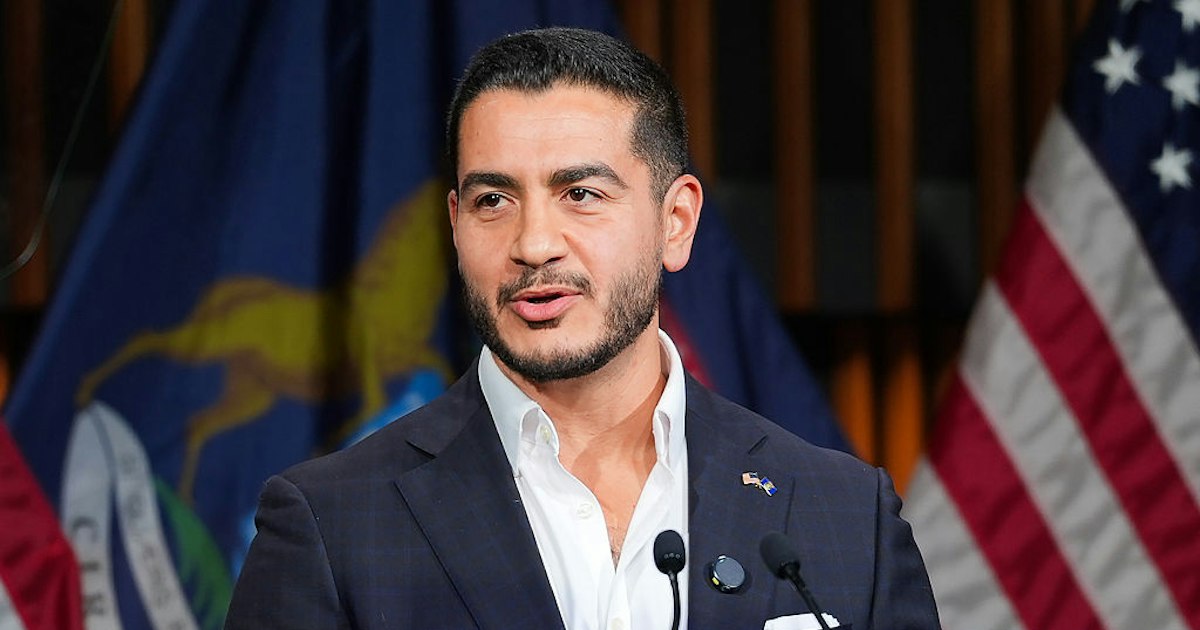
Politics Abdul El-Sayed is now poised to greatly erode the taboo around Israel in Washington. Photo by Salwan Georges/Getty Images I’m glad the Democrats won big. Since February 28th, I’ve hoped Trump would receive a humiliating rebuke; his launch of a needless war far outweighs his other failings and accomplishments. I am especially pleased Abdul El-Sayed won by a convincing margin in Michigan. Not that I harbor any hope that he will become, by my lights, an appealing senator; he espouses leftist views on issues, from transing kids to socialized medicine, that I find wrongheaded or repellant. (I also believe mass Muslim immigration has been an unmitigated disaster for Western Europe, and would support a dramatic curtailment of Muslim immigration here—positions I’m sure El Sayed doesn’t share.) But the newly elected senator has the right enemies on even more important issues, and prevailed against them against heavy odds. I spent the morning of election day immersed in the discourse of Jewish lamentation. It began with the veteran journalist Joe Klein arguing that El Sayed doesn’t belong inside the Democratic tent, and led (because Klein opens with it) to historian Simon Schama’s long and eloquent essay about antisemitism in the West, which he paints as a more or less unbroken thread running from John Chrysostom to the anti-Israel protestors on American campuses. Schama believes that antisemitism is absolutely central to the West, a functionally constitutive element in the development of Christianity, the Enlightenment, and modern nationalism. That is quite a claim, and probably at odds with an argument now increasingly floated by Israel’s ardent backers—that ours is a Judeo-Christian civilization whose destiny and duty it is to fight Islam, implicitly under Israel’s leadership. These civilizational questions won’t be settled here; I note them because Klein made them the backdrop to his argument that El-Sayed must be rejected because he is “a free range anti-Israel bigot.” I don’t know Klein now, but remember pleasant conversations with him a generation or more ago, from a time when I and my colleagues at the New York Post editorial page used to read his New York Magazine column religiously—it seemed a rare glimmer of sanity from the Manhattan liberal media establishment. Were I to see him again, I would want to somehow reassure him about the extent of antisemitic bigotry he and Schama purport to find so pervasive and menacing. On the right, Schama dwells on Candace Owens and Nick Fuentes. I would agree they are despicable, and add that you will never find them taken seriously or respected by consequential people. On the left, around 60 percent of Michigan’s Jews made their own judgement about Klein’s charge of bigotry by voting for El-Sayed, despite being drenched in a massive media campaign to depict the Democratic candidate as a Muslim Brotherhood acolyte and violent jihad-sympathizer. The reason to celebrate El-Sayed’s victory is that, far more so than other Democrats, he put opposition to the Iran war front and center. He didn’t merely complain about affordability under Trump; he made central to his campaign the costs of choosing to drop bombs on other people’s children instead of spending our tax dollars here on Americans. AIPAC was against El-Sayed from the beginning, because of his opposition to Israel’s war on Gaza, and spent an astonishing $31 million to defeat him in the primary. Then it doubled down in the general election, pouring in millions more. Like many, El Sayed calls the Israeli assault on Gaza a genocide. I demur, and believe the term should be reserved for the systematic and purposeful killing of civilians, as in the Holocaust; I spent a good part of the last three years arguing, often with family members, that what Israel did is probably no different from the United States would do in response to a similarly barbaric attack. My post–October 7 reactions on social media prompted one very pro-Israel editor to ask me to write, which I did. But Israel did not, as I expected, confine its response to the military destruction of Hamas. It sought to render Gaza uninhabitable. And not just Gaza. Any aerial view of southern Lebanon shows a similar landscape of utter devastation. Tens of thousands of buildings reduced to rubble. Lebanon presumably deserved it because a few rockets were fired at Israel after Israel murdered Iran’s leader, a spiritual leader of Shi’ite Muslims, in a sneak attack. Subscribe Today Get daily emails in your inbox As Benjamin Netanyahu boasts, Israel has been trying to get America into a war with Iran for twenty years. He has had regular access to the halls of American power, receives (or used to) thunderous standing ovations by both parties when invited to address Congress. The donors allied with him have near constant access to the White House. An observer from a culturally distant land might regard the relationship between Trump and Netanyahu, Speaker Mike Johnson and Netanyahu, the former Speaker John Boehner and Netanyahu, indeed Israel’s leader and almost any Republican politician, and conclude that Jerusalem is plainly the metropole and the United States a colony expected to supply money and military resources. As Trump State Department spokeswoman (and former Fox News contributor) Tammy Bruce put it, “the United States is the greatest country on earth… next to Israel.” The consequence of this attitude is not only the present use of American tax dollars to render the countries surrounding Israel uninhabitable. It is America fighting wars of indefinite duration for the foreseeable future. The top Republican donor Miriam Adelson’s Israeli newspaper is already talking about a new Israeli war against Turkey. “Finish the job,” say the Iran hawks, not specifying whether they want Washington to send troops or commit massive war crimes with nuclear weapons. Until this political moment, the idea that the United States should fight wars in perpetuity to ensure Israel’s nuclear monopoly in the Mideast was hardly considered a fit subject of debate in Washington. One can’t be certain of much about the new Senate, but one can be sure that these issues will be on the mind of Sen. Abdul El-Sayed. That is not a victory for bigotry, but for common sense.
Michigan’s Common-Sense Rebuke of Middle East Warmongers
Full Article
Original Source
Read the full article at Theamericanconservative →KhanList aggregates and links to publicly available news content. We do not host full articles from third-party sources. Always verify important information with original sources.