
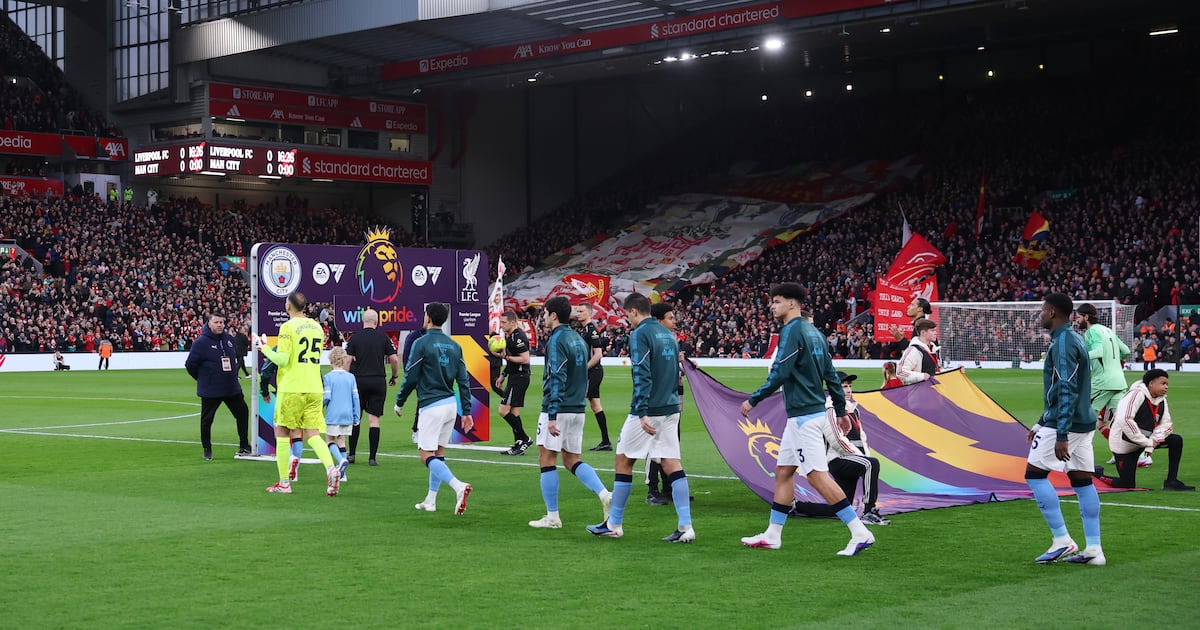
This means more.Or it will do. Judging by the amount of red preparations mentioned in Liverpool over the past 48 hours, Manchester City will, well before arriving at Anfield on Sunday, encounter irrefutable evidence of what all of the past days, seasons and years have accumulated. And it isn’t just trophies.Along their silver way, City have also gathered scepticism, anger and hostility, a lot of it. This club with two league titles – 1937 and 1968 – in their 104 years before being acquired by Abu Dhabi, won eight more between 2012 and 2024. Eight league titles in 13 seasons – the statistic alone provokes disbelief.Today that sentiment stands shoulder to shoulder with belief in City’s guilt. It is the size of England. It will be heard loud and shrill at Anfield.READ MORESunday is no longer simply a football match. The decision announced during this extra-long international break that City had used “sham payments” to artificially enhance their income by £900 million (about €1 billion) between 2009 and 2018 has been met with a mix of fury and frustration. Outside the City fan base, there has been no understanding of context, or a desire to unearth any. The drawn-out nature of the Premier League’s investigation has led to a great impatience.In the court of public opinion, City’s case has been lost. While it is no court of law, opinion matters. Sunday’s kick-off has been transformed into an event and Anfield will be seething. That is no guarantee Liverpool will perform efficiently; it is the reaction within City’s starting XI that will be instructive. Pep Guardiola once said Anfield’s reputation is “not marketing”, that when Liverpool score, suddenly it seems they have “players everywhere” and visitors “look small”.That was before the City judgment.[ Malachy Clerkin: Pep Guardiola said Manchester City destroyed football – he didn’t know how right he wasOpens in new window ]Now that sham has entered the Premier League lexicon, City as a collective and as a series of individuals will feel the full force of criticism. The physical dimensions of Anfield, internally and externally, leave little room for escape. The only way City can neutralise the atmosphere is to put on a masterclass of clinical football, and that won’t be easy in a whirlwind.How City’s players cope with the noise and Liverpool players’ energy will shape not just Sunday, but City’s season – on the pitch – and potentially the future make-up of the squad. There is a notion Erling Haaland or Rayan Cherki could deal with anything insouciantly – “stick together, enjoy the ride and smile” was Haaland’s message on Thursday. Within money-defined professional football plenty think the millions continuing to wash into City players’ bank accounts will determine their attitude more than riled opposition supporters. But we will not know for certain until kick-off.Iliman Ndiaye, not appearing to be as irked as some people about his move to Manchester City. Photograph: Michael Regan/Getty Images Plus, individuals differ. How will, for example, Iliman Ndiaye respond on his first return to Merseyside?Ndiaye left Everton on September 1st as the transfer window closed. Terms had been agreed with Tottenham on a move south, with Everton gaining Richarlison as well as cash. But then City walked in and dropped a reported £65 million on the table. Tottenham no more, off popped Ndiaye to City. So easy.Something niggled about the deal, the manner of it. Maybe it’s because Ndiaye was Everton’s best player. From a perspective of sporting democracy, it would be healthy to see him thrive there. Maybe it is because Everton were being denuded, just as Bournemouth were in January when Antoine Semenyo was snipped away by City, just as Crystal Palace were when Marc Guéhi was extracted the same month. Or maybe it was the reported fee. Because one of the consequences of City’s inflated wealth and inflated spending is they have made £60-£65 million seem routine. It’s not. Everton, Bournemouth and Palace - the previous clubs of Ndiaye, Semenyo and Gueéhi - have never spent that amount on a player.On accepted figures in the public domain, nor have Brentford, Brighton, Coventry, Fulham, Hull, Ipswich, Leeds, Nottingham Forest or Sunderland. Aston Villa may do, should Nicolas Jackson reach certain targets.Those are 12 or 13 of Man City’s Premier League contemporaries who have not reached the £60 million figure. Some are nowhere near it.Yet City – again on accepted figures – have spent £60 million or more 11 times in the past eight years. Three times they have spent more than £100 million.It could be argued this is football’s food chain and always has been, but it is the inflation of City’s income that enabled it to make such signings – repeatedly. There was also an acceleration in wages.Sometimes the brutal power City’s finances gave them in squad-building appeared almost casual. It began with Robinho joining for £32.5 million in September 2008 as a show of what Abu Dhabi could do. It was day one of the takeover. People now smirk about Robinho and City, but it was a British record transfer fee.Money can buy you John Stones, and trophies. Photograph: Martin Rickett/PA Wire Only Manchester United and Chelsea had ever spent more than £20 million on a player – Juan Veron and Rio Ferdinand for United and Andriy Shevchenko for Chelsea. By the end of summer 2009 City had done it four times – Robinho, Carlos Tevez, Emmanuel Adebayor and Joleon Lescott. Forward to 2015, Chelsea tried three times to peel John Stones away from Everton. Everton were able to resist a £30 million top offer. Their fans raided The Beatles and sang “money can’t buy you Stones”.[ Liverpool’s Cody Gakpo reflects on ‘tough summer’ after collapse of Manchester City moveOpens in new window ]One year on, when City turned up at Goodison Park with £50 million, money did buy Stones. When the music stopped Stones had helped City to six league titles, a Champions League and much else. Everton have not been champions since 1987.Stones had a sustained impact. Semenyo has started well, scoring the winner in the FA Cup final – you may have forgotten. Ndiaye is impressing.Other transfers have been less successful. But City’s stockpiling of talent – and Chelsea have done the same – has meant ill-judged recruitment can be absorbed. At other clubs it leads to exposure. There is no airline sponsorship bailout.Arsène Wenger, in his pre-Fifa period, called it out. In the Lance Armstrong era he named it “financial doping”. Kolo Touré, Adebayor, Bacary Sagna, Gaël Clichy and, most painfully of all, Samir Nasri, all left frugal Arsenal for lavish City. Half a team.It was not just about City strengthening, it was about opposition weakening. From there lies dominance.[ Kylian Mbappé reveals he was ‘close’ to Liverpool move after Jürgen Klopp talksOpens in new window ]For neutrals there were some sublime moments from Guardiola’s teams, but their trophies brought shrugs. It felt hollow, the culmination of economic supremacy, an entitled attitude and questionable paperwork.“Sportsmanship” sounds like a weak word, but in sport it is the bottom line. Sunderland were the most recent team to play City and on Thursday their manager Régis Le Bris said “we want fair competition”. What a good idea.
Michael Walker: Liverpool v Manchester City is no longer simply a football match
Full Article
Original Source
Read the full article at Irishtimes →KhanList aggregates and links to publicly available news content. We do not host full articles from third-party sources. Always verify important information with original sources.