
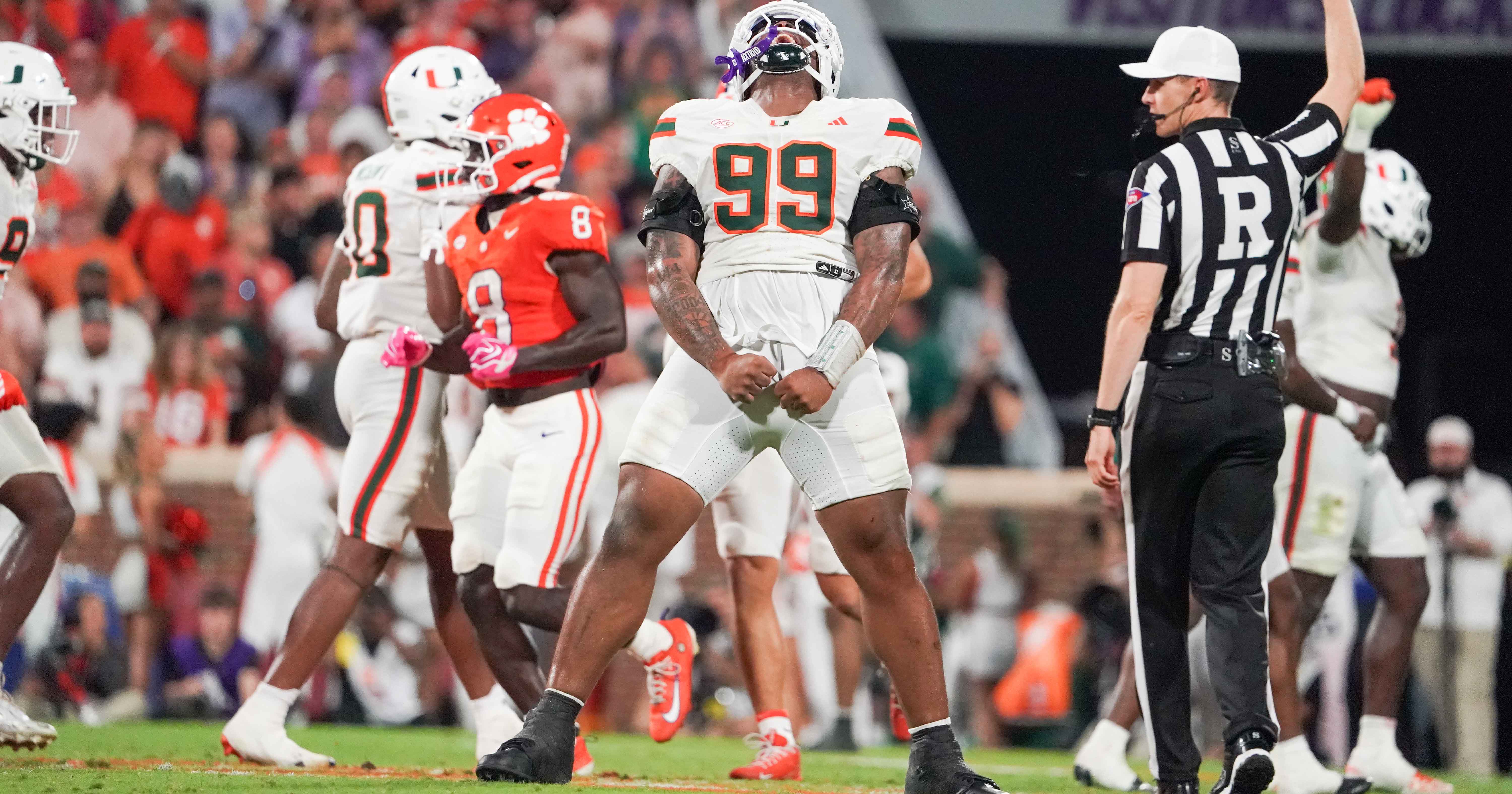
CLEMSON, S.C. — Clemson wanted to run the football. Miami wouldn’t let them. That may ultimately be the biggest takeaway from No. 4 Miami’s 41-13 dismantling of the Tigers on Saturday night. The Hurricanes didn’t simply beat the Tigers. They took away what Clemson does best, forced a freshman quarterback into an increasingly difficult situation and then allowed Miami’s athletic defensive front to take over. Clemson entered the night having rushed for 186 yards against North Carolina and 257 yards against Cal last week. Against Miami? Just 55 yards. And much of that production came after the game was already decided. That was the difference. Clemson wanted to establish balance and take some of the pressure off freshman quarterback Tait Reynolds. Instead, Miami’s defense made Clemson one-dimensional almost immediately. And once the Tigers had to throw, the Hurricanes’ pass rush became a nightmare. Miami finished with six sacks, 20 quarterback pressures through three quarters, a forced fumble and an interception. Reynolds spent much of the night under siege, taking hit after hit as Miami’s defensive front repeatedly won its individual matchups. The Hurricanes didn’t always need elaborate blitzes to get there, either. At times, Miami rushed just four defenders and still reached Reynolds. The result was a Clemson offense that couldn’t stay on schedule and a freshman quarterback who was asked to do far too much. Reynolds attempted 31 passes in the first half alone. That’s not necessarily the game plan Clemson wanted entering the night. But Miami’s ability to eliminate the running game left the Tigers with few alternatives. The Hurricanes’ defense essentially squeezed Clemson until there was nowhere else for the Tigers to go. The Miami defense wore Reynolds like a tight pair of skinny jeans – absolutely zero room to breathe. Miami’s offense kept Clemson guessing While Miami’s defense was controlling the game, the offense was doing something equally important — making Clemson hesitate. The Hurricanes opened the game with motion and counter action designed to manipulate Clemson’s second and third levels. On Miami’s first play from scrimmage, that approach produced an immediate result. Darian Mensah found Cooper Barkate on what appeared to be a short completion. Barkate did the rest, turning the play into a 61-yard touchdown. It was an early indication of what Miami’s offense could do when it forced Clemson’s defense to think instead of simply react. The Hurricanes continued to use variations of the counter throughout the first half, changing which players were involved and creating different looks off the same basic concepts. That constant movement helped Miami create openings while keeping Clemson’s defense from settling into a rhythm. Barkate ultimately finished with five receptions for 98 yards and the touchdown. Malachi Toney was another example of Miami’s philosophy: get the football into the hands of your playmakers. Toney finished with five catches for 40 yards, but Miami also found ways to get him the ball creatively, including a 19 yard reverse. It doesn’t always have to be complicated. Sometimes the objective is simply to get the ball to your most dangerous players and let them create. The offensive line was tested Miami’s offensive success became even more impressive considering what happened along the offensive line. Matthew McCoy and Max Buchanan both suffered injuries during the game, forcing Miami to use more than nine offensive linemen. The injuries also appeared to affect the Hurricanes’ ability to continue using some of the counter-action concepts that had been so effective early. But Miami adjusted. The Hurricanes continued to move the football and eventually put together a 14-play, 83-yard scoring drive in the third quarter that consumed nearly eight minutes. Mark Fletcher Jr. capped that drive with a two-yard touchdown run. Fletcher finished with 16 carries for 77 yards and two touchdowns, while Miami totaled 192 yards on the ground. Mensah added another dimension to the offense. The transfer quarterback completed 18 of 27 passes for 227 yards and a touchdown while adding 27 rushing yards and a rushing touchdown. Perhaps more importantly, Mensah once again demonstrated the decision-making that has been one of the defining characteristics of Miami’s offense this season. He didn’t have to carry the Hurricanes. He simply had to consistently make the right decision. And with Barkate, Toney and the rest of Miami’s playmakers around him, that was enough. Miami’s defense delivered the knockout punch By the time Miami had extended its lead to 24-6, Clemson’s options were becoming increasingly limited. The Tigers had to throw. Miami knew they had to throw. And that’s exactly the situation the Hurricanes’ defense wanted. Late in the third quarter, Ahmad Moten forced a fumble on Reynolds, giving Miami another opportunity to capitalize on the pressure it had created all night. Miami eventually turned the takeaway into a field goal to make it 27-6. At that point, the outcome was essentially decided. Everything that followed was largely cosmetic. But Miami wasn’t finished. In the fourth quarter, Safety JJ Dunigan intercepted Reynolds and returned it for a touchdown, putting an exclamation point on a defensive performance that had controlled the game from the beginning. This was more than another win Miami improves to 5- 0 overall and 3-0 in ACC play. Clemson falls to 3-2 and 2-1 in the conference. But the significance of this win for Miami goes beyond the record. The Hurricanes showed they can win a game by controlling the line of scrimmage on defense, taking away an opponent’s identity and forcing that opponent to play a style it doesn’t necessarily want to play. Clemson came into the game wanting to run. Miami took that away. Clemson needed Reynolds to make enough plays to keep the offense moving. Miami made him uncomfortable from the opening quarter until the game was out of reach. And offensively, Miami demonstrated that it doesn’t need one specific player or one specific concept to win. The Hurricanes can create explosive plays through their passing game. They can run the football. They can use motion and counter action to manipulate a defense. And they have a quarterback who continues to make sound decisions. That’s what made Saturday night different from simply looking at the final score. Miami didn’t just beat Clemson. The Hurricanes dictated the terms of the game. At 5-0, that’s perhaps the most encouraging development of all.
Miami in 60: Breaking down the intricasies of the Hurricane victory at Clemson that moved Miami to 5-0
Full Article
Original Source
Read the full article at On3 →KhanList aggregates and links to publicly available news content. We do not host full articles from third-party sources. Always verify important information with original sources.