
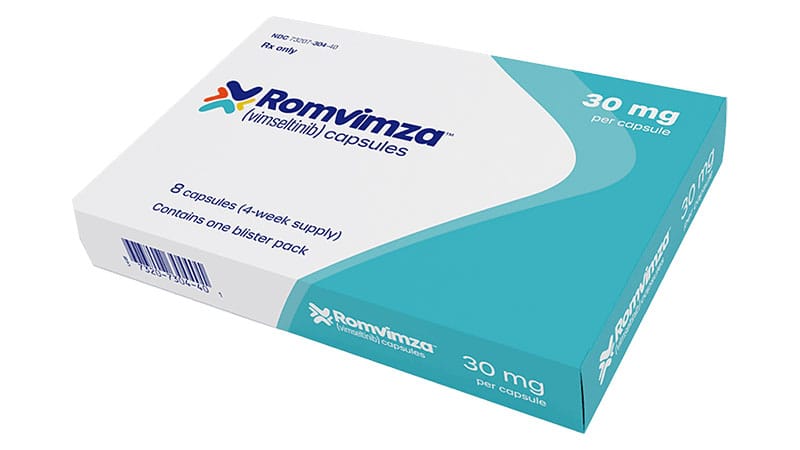
The Medicines and Healthcare products Regulatory Agency (MHRA) has approved vimseltinib (Romvimza, Deciphera Pharmaceuticals) to treat tenosynovial giant cell tumours (TGCT) in adults. The agency said vimseltinib could be used when TGCT impacts movement, or where surgery is not an option.TGCT is a rare benign mesenchymal tumour that forms around joints, bursae, and tendon sheaths. It is due to recurrent genomic aberrations often involving the colony-stimulating factor 1 (CSF1) gene, and usually affects a single joint, most often a knee or ankle. There are two forms: the nodular type has a mostly indolent course, whereas the diffuse type is locally aggressive. Nodular TGCT usually affects smaller joints and presents as a single lesion in soft tissue, near tendons or interphalangeal joints. It tends to evolve over a period of years and may occasionally erode bone or involve the overlying skin. Diffuse TGCT typically involves extensive and infiltrative involvement of the joint synovium and/or tendon sheath, and extends into extra-articular structures. It may lead to haemarthrosis, destruction of bone and cartilage, and severe disability with substantial morbidity. It frequently relapses despite treatment including surgical resection. Disease Severely Impacts Quality of Life TGCT tumours may affect any joint, though nodular TGCT usually involves the hand and wrist, followed by the knee, while most diffuse TGCT arise from the knee, followed by the ankle and hip. Typical symptoms of chronic pain, swelling, stiffness, limited range of motion, and joint instability may severely impact function and quality of life. Most patients with TGCT are young and middle-aged adults. Current treatment modes with active surveillance or surgical resection - marginal excision in nodular or extensive synovectomy for diffuse TGCT - are acknowledged to be eclectic and frequently suboptimal. Joint replacement may be effective for pain but carries a high local recurrence rate.Globally the 5-year recurrence-free survival for nodular TGCT is 70%-90% and 30%-80 % for diffuse TGCT. Very rarely, TGCT may undergo sarcomatous transformation with metastatic spread.Drug Blocks Growth-Promoting Proteins Vimseltinib is an oral, selective switch-control kinase CSF1R inhibitor that slows the growth of TGCTs by blocking the tumour growth-promoting proteins.Julian Beach, MHRA executive director, healthcare quality and access, said in a press release that the approval “provides a new treatment option for patients with TGCT who have symptoms but are unsuitable for surgery”.Vimseltinib was designated an orphan medicine during development, and MHRA approval was via the International Recognition Procedure (IRP) Route B. In the phase III MOTION study published in The Lancet in 2024, 40% of the 83 patients who received vimseltinib had an objective response, with tumour shrinkage of 30% or more, compared with none of the 40 patients who received placebo.Twice-Weekly Oral Dosing The drug is available as hard capsules in doses of 14 mg, 20 mg, and 30 mg. They should be swallowed whole with water, with or without food, twice weekly. The recommended starting dose is 30 mg, taken twice weekly at least 72 hours apart, for as long as benefit is observed or until unacceptable toxicity occurs. If so, dose interruptions or reductions may be required. Dose reductions may also be considered based on clinical improvement.Patients are advised to take vimseltinib exactly as prescribed. It should not be used in pregnancy. The most common adverse effects, which may affect more than 20% of users, include tiredness, peri-orbital swelling, ankle and foot oedema, itching, rashes, and high blood pressure; laboratory changes include increased liver enzymes, cholesterol, and creatinine, and decreased neutrophils. Long-term safety has not been established.The drug is subject to additional monitoring and any suspected adverse reactions to vimseltinib should be reported via the Yellow Card scheme.Dr Sheena Meredith is an established medical writer, editor, and consultant in healthcare communications, with extensive experience writing for medical professionals and the general public. She is qualified in medicine and in law and medical ethics.
MHRA Approves New Drug for Rare, Disabling Joint Tumour
Full Article
Original Source
Read the full article at Medscape →KhanList aggregates and links to publicly available news content. We do not host full articles from third-party sources. Always verify important information with original sources.