
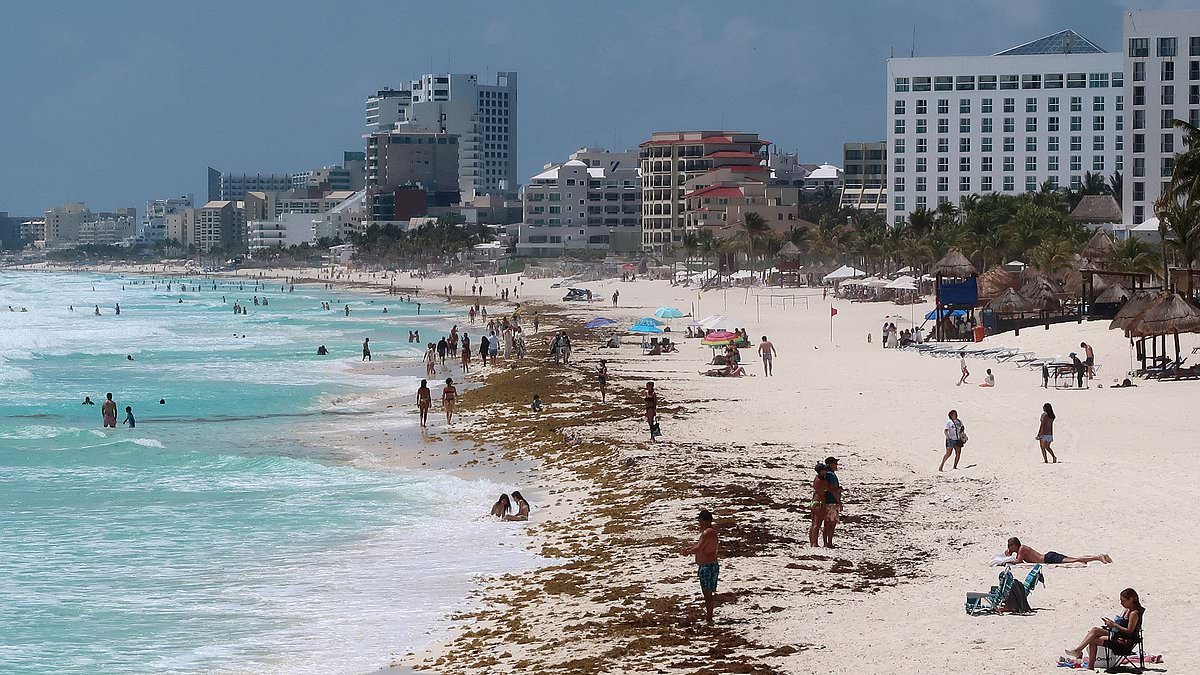
READ MORE: Think twice before packing that bathrobe! The hotel room items you can take home – and what could cost youWant to holiday like a travel expert? Get free access to this subscriber article about the best Greek islands to visit (and the worst ones to avoid) when you sign up HERE to the Escape newsletter See more Daily Mail on Google - save us as a Preferred Source Published: 05:28 EDT, 7 August 2026 | Updated: 05:28 EDT, 7 August 2026 Brown, foul-smelling seaweed is forcing beaches to close across parts of Mexico’s Caribbean coast, dealing a blow to holidaymakers in one of the country’s most popular destinations.The spread of sargassum has prompted Mexico’s health ministry to test food and water at more than a dozen hotels in the resort region of Quintana Roo after British health authorities reported cases of cyclosporiasis in travellers who had stayed there.The ministry said laboratory results would be released once testing is complete.Mexico has recorded 33 cases of cyclosporiasis, a parasitic illness that causes stomach problems, across several states.Meanwhile, environmental officials estimate that around 119,000 tonnes of sargassum will wash up along Mexico’s Caribbean coastline by the end of 2026. Beaches in Mexico have been affected by sargassum seaweed, for instance in the resort city of Cancun At least 67 people in the UK are known to have fallen ill with cyclosporiasis since May, with more than half of these having returned from MexicoBrian Barnes, a research assistant professor at the College of Marine Science at the University of South Florida, said warmer sea temperatures were helping fuel the growth of sargassum.He explained that once it is stranded, sargassum decomposes quickly, emitting a stench often compared to rotten eggs, The Independent reported. Tulum Councilman Eugenio Barbachano said the resulting decline in tourism is 'extremely serious'.Workers have been deployed to shovel the seaweed from beaches, including across Quintana Roo’s Riviera Maya.The state's governor Mara Lezama said managing the seaweed costs roughly 11 per cent of the state GDP.Beaches in the area are on red alert for the algae. By late June, it was reported that 92.5 per cent of beaches registered an 'excessive' level of sargassum. And health chiefs have warned of a huge spike in cases of a parasitic infection that causes 'explosive' diarrhoea in the UK – with travellers returning from Mexico partly to blame.At least 67 people have fallen ill with cyclosporiasis – which spreads through contaminated water or food – since May, with more than half of these having come back from the North American country. Cyclosporiasis doesn't naturally occur in the UK - but 48 cases reported have been linked to MexicoThe parasite is rampaging through the US, with nearly 7,000 cases now confirmed, according to the Centers for Disease Control and Prevention.While cyclosporiasis doesn't naturally occur in the UK, health officials are now advising all travellers to take precautions following a sharp rise in infections in the UK.Latest figures, published by the UK Health Security Agency (UKHSA), show 67 cases have now been reported in England, Wales and Scotland between April 30 and July 15.On average, just 93 cases are reported per year, indicating a sharp rise in infections.Of the 67 cases that have been reported in returning travellers, 48 were linked to travel to Mexico.One case was linked to travel to the US alone and another to Kenya. What is cyclospora? How is it transmitted? Everything you need to know Cyclosporiasis is an intestinal illness that is best treated by an antibiotic.It's caused by a microscopic parasite, called Cyclospora cayetanensis.When this parasite contaminates food or water and is then ingested, it can cause the intestinal illness.Symptoms of the stomach illness include diarrhoea, with frequent, sometimes explosive, bowel movements, loss of appetite, weight loss and stomach cramps and pain.Other common signs reported include bloating, increased gas, nausea, fatigue, vomiting, body aches, headache, fever, and other flu-like symptoms.If left untreated, cyclosporiasis may last anywhere from a few days to a month, or longer.The stomach infection is diagnosed by testing of stool samples, and although most cases resolve on their own, antibiotics can be given to treat severe or prolonged infections.
Mexico's nightmare summer: Beaches close as foul-smelling algae engulfs Caribbean coast resorts - and tourists warned over stomach bug
Full Article
Original Source
Read the full article at Dailymail →KhanList aggregates and links to publicly available news content. We do not host full articles from third-party sources. Always verify important information with original sources.