
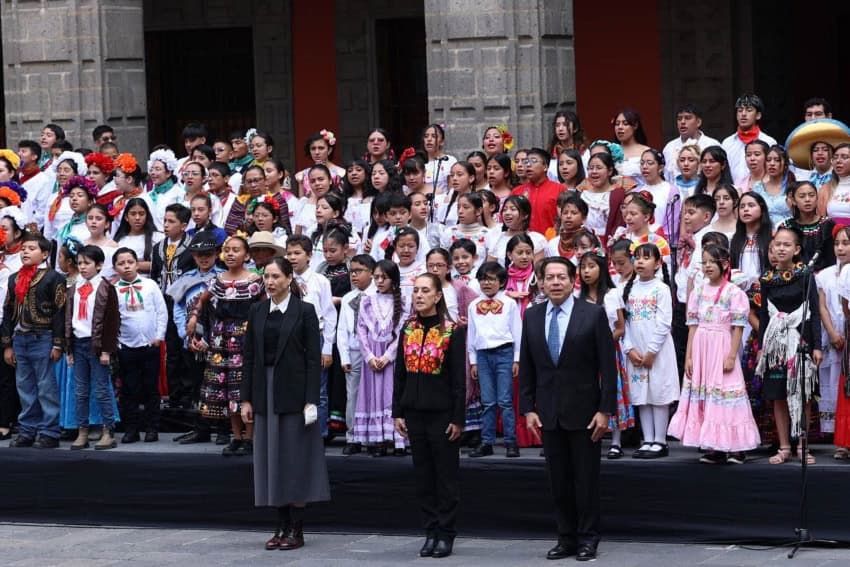
Mexico’s latest international test results are more than a school report card. They are a warning about whether young Mexicans are equipped to understand, question and decide for themselves in an age of artificial intelligence. And because the U.S. and Mexico trade close to US $1 trillion a year, the answer matters on both sides of the border. This is the first article in a series on education in Mexico and the choices that will shape the country’s future. We hope this series informs and inspires readers to get involved in their local communities, to help address what could be one of Mexico’s greatest liabilities moving forward. Picture a classroom of 25 Mexican 15-year-olds. According to the latest international assessment, about 10 of them fall below the basic level in reading, math and science alike. Across the Organization for Economic Cooperation and Development (OECD), it would be about five. Those 10 students are the reason for this series. Their scores describe where they stand today, not what they are capable of becoming. Latest PISA survey reveals 4 in 10 Mexican students do not meet basic level in science, math and reading The figures come from the Program for International Student Assessment, known as PISA, which the OECD released on Sept. 8. In Mexico, 41.8% of 15-year-olds fell below the basic level in all three subjects, more than double the OECD average of 19.7%. Seven in 10 did not reach it in math. The problem is not new, but the stakes are. Artificial intelligence is changing how people work, learn and find information globally, and school systems everywhere are still adapting. That levels the playing field in a way few moments do: A country that gets this right can come out ahead. Mexico has that window, perhaps a narrow one, even as the U.S.-Mexico-Canada Agreement is under review. Mexico is the top U.S. trading partner, and about 39 million U.S. residents are of Mexican origin. What happens in those classrooms will inevitably reach factories in Guadalajara, boardrooms in Houston and family kitchens in Chicago. In that world, the skills PISA measures are not academic extras. They are the basis of agency — the ability to understand what is in front of you, question it and decide what to do next. Our argument in this series is simple. Mexico’s ability to shape its own future depends on building those skills now, starting with its youngest children. A decade of decline in math and reading Mexico’s 15-year-olds scored 388 points in math, 408 in reading and 414 in science, against OECD averages of 463, 461 and 482. That places Mexico 64th of 90 in math, 52nd of 90 in reading and 63rd of 91 in science. Figure 1. Source: OECD (2026), PISA 2025 results; scores as reported by Ostos (2026). Has Mexico improved? No, and the direction is as worrying as the level. Since 2022, math has fallen 7 points, a decline the OECD counts as real. Since 2015, math is down 20 points and reading 15. Averages hide how many students fall short of PISA’s basic level, known as Level 2. Only 30% of Mexican 15-year-olds reach it in math, compared with 65% across the OECD. About half reach it in reading and in science, compared with 69% and 74%. At the top, just 0.5%, about 1 in 200, perform at the highest levels in at least one subject, against 11.9% across the OECD. For a country seeking a place in a technology-driven economy, that is a thin pipeline of top talent. Figure 2. Source: OECD (2026), PISA 2025, as reported by Ostos (2026). Counts are rounded. Why this is not yesterday’s problem Weak foundational skills raise companies’ training costs and slow productivity, as Mexico News Daily CEO Travis Bembenek noted the day the results came out. The human cost is sharper still, and AI makes it visible. Picture a teenager asking a chatbot to explain a loan offer, a health warning or a news story. The answer arrives in seconds, fluent and confident. Whether she can tell if it is accurate, incomplete or invented depends on exactly the skills PISA measures. Reading comprehension lets her weigh the answer. Mathematical reasoning lets her see when the numbers do not add up. Scientific thinking, the habit of asking how we know what we think we know, is her first defense against scams and false information. With strong foundations, AI can work like a patient tutor. Without them, it makes it easy to stop thinking. When 4 in 10 teenagers fall below the basic level in all three subjects, the issue goes far beyond test scores. It becomes a question of who will have a voice in how Mexico changes, and who will simply have change happen to them. Is education the biggest challenge facing Mexico? A perspective from our CEO None of this says Mexican students are less capable. PISA measures what students can do under the conditions they have had, not what they could achieve under better ones. That distinction is the source of our optimism. Conditions can change. Consumer or shaper? Nvidia co-founder Jensen Huang has described artificial intelligence as a “five-layer cake” of energy, chips, infrastructure, models and applications, essential infrastructure “like electricity and the internet.” Mexico is already part of the infrastructure layer. In Querétaro, Amazon Web Services announced plans to invest more than US $5 billion, and CloudHQ plans to build six data centers, a US $4.8 billion investment. Economy Minister Marcelo Ebrard called such projects “one of the main drivers” of the economy ahead. This investment is welcome. Our extension of Huang’s model, not his, is that every layer depends on people. Someone has to build the applications that serve Mexican farmers, clinics and small businesses, and judge whether an AI tool works in Spanish and Indigenous languages, protects children’s data and helps students think, rather than thinking for them. Hosting servers is not the same as shaping what runs on them, or who benefits. One top performer for every 200 students is a warning on exactly this point. Three clocks Figure 3. Sources: MND Staff (2024, 2025, 2026); INEGI (2026). 2015 scores are calculated from the 2025 scores and the reported 10-year changes. Three clocks are ticking at once, and none will wait for the others. The first is technology. AI is changing quickly, and decisions about investment, partnerships and skills are being made now. The second is population. According to INEGI’s 2025 population survey, the median age rose from 29 to 32 between 2020 and 2025, and the average number of children born alive per woman aged 12 and older fell from 2.1 to 1.9. An aging country needs every young person able to contribute fully. The workforce of the 2040s is in primary school and preschool today. The third is learning. Foundational skills take years to build, starting in early childhood, and there is no shortcut. Yet AI tools will not wait for schools to be ready. Geopolitics adds pressure to all three. On July 1, U.S. Trade Representative Jamieson Greer said the United States “did not agree to renew the USMCA in its current form.” The most durable advantage a country can have is a population able to learn, adapt and decide. That isn’t only Mexico’s concern. Companies that build, buy and invest across North America need partners who can manage complex technology. Trade rules can change, but a skilled workforce is the part that lasts. Mexico’s students are more than capable, as these students, holding their certificates during the 2026 National Meeting of Science Students at the Secretariat of Public Education, can attest. (Graciela López/Cuartoscuro) The challenges extend into adulthood. Forty percent of Mexicans ages 25 to 34 lack a high school qualification, against 12% across the OECD, and 29% of young women ages 18 to 24 are neither in education nor employed. Opportunity and preparation are moving in opposite directions. The question is not whether Mexico can afford to act. It is whether it can afford another generation without these foundations. Start now, build deep: A two-track response Mexico cannot wait for perfect schools before putting AI to work, and AI cannot let it skip the foundations. The answer is to move on two tracks at once: practical steps that start now, with adolescents, adults, workplaces and programs already running, and the patient work of building strong foundations from early childhood on. Both must be built with the people closest to the problem: students, families and teachers, who know what works in their own communities. What comes next Our next article maps Mexico’s starting line. Later articles will lay out both tracks and what government, business, philanthropy and readers can do together. Whether you live in Mexico, the United States, Canada or beyond, you have a role to play. Tell us what you are seeing and what we have missed. Remember the 10 students in that classroom of 25. Mexico’s future will be shaped either way. What the country builds now will decide whether they are among the people who shape it. Sharon Ravitch is an internationally recognized research methodologist and professor of practice at the University of Pennsylvania Graduate School of Education, where she is chief methodologist for the AI Pedagogy Initiative. The author of nine books on leadership, systems and methodology, she has advised education ministries and organizations across Latin America, the Caribbean and South Asia, and has been involved in school improvement in Nicaragua since 2009. Geoffrey Drayton has spent more than two decades at the intersection of education, technology and public policy across Latin America. He builds partnerships and programs that bring literacy resources, English language learning tools and teacher professional development to classrooms throughout the region. Drayton is a graduate of the University of North Carolina at Chapel Hill, where he played varsity soccer for four years.
Mexico’s Educational Crossroads: Who shapes Mexico’s future? Why we can’t wait
Full Article
Original Source
Read the full article at Mexiconewsdaily →KhanList aggregates and links to publicly available news content. We do not host full articles from third-party sources. Always verify important information with original sources.