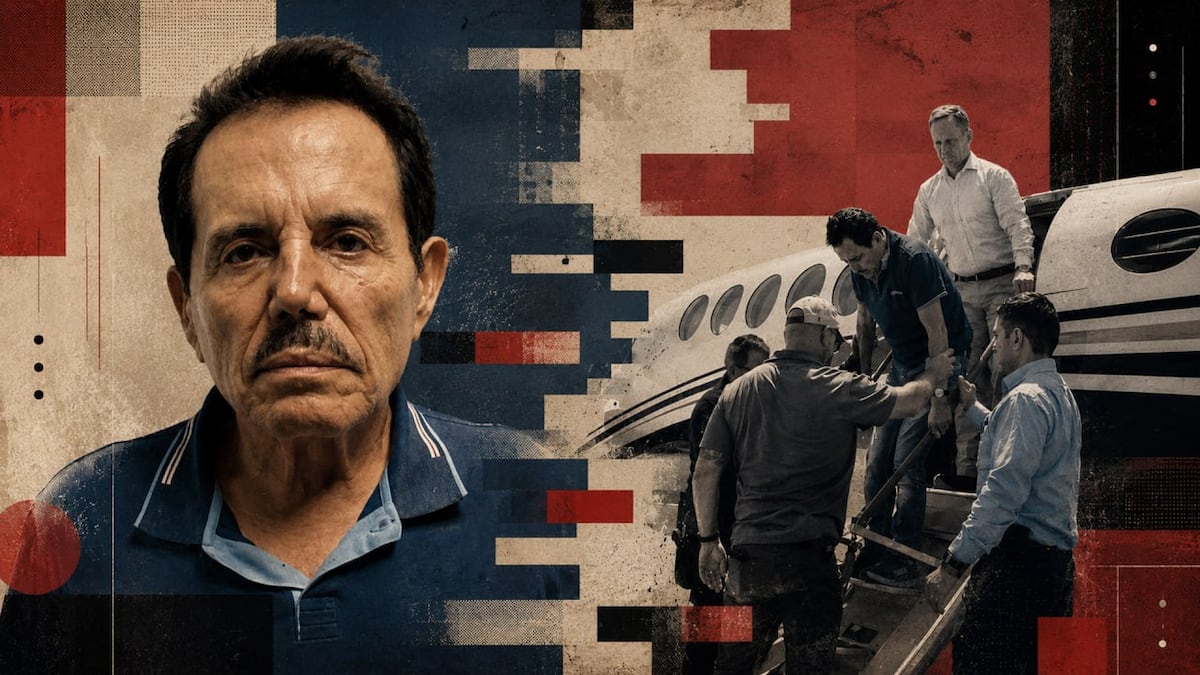
A 76-year-old man, gray-haired and unwell, is the focus of the latest slanging match between Mexico and the United States. He is Ismael “El Mayo” Zambada, the once-powerful Sinaloa Cartel leader and a representative of the drug trafficking old school, who arrived in the U.S. under very strange circumstances two years ago and has been held in custody ever since, with no hope of release. His image currently dominates the binational conversation: the memory of his delivery and the circumstances surrounding his small-plane trip from Culiacán to New Mexico — effectively a kidnapping. South of the border, the episode is an open, festering wound, an attack, the government argues, on national sovereignty; north of the border, it is the origin of Washington’s latest major trophy and the emblem of the narrative of corruption cast onto its neighbor.Everything has changed a great deal since July 25, 2024, when El Mayo was forcibly taken to a border airstrip. Mexico and the United States had different presidents then and diplomacy prevailed. Sinaloa stood as an important criminal logistics hub, relatively peaceful, thanks to the famed “pax narca.” El Mayo lived quietly between the mountains and southern Culiacán and Governor Rubén Rocha ruled without the burden of U.S. justice — one that would later manifest itself in the form of drug-trafficking charges. El Mencho and his Jalisco New Generation Cartel (CJNG) ruled the roost in the central Pacific and the Bajío, oblivious to their impending downfall. And in between, from Tijuana to Cancún, there was violence. Mexico recorded over 30,000 murders every year for several years running. That was the state of affairs. And then came the kidnapping.At first they blamed Joaquín Guzmán López, one of El Chapo’s four sons. A longtime partner of El Mayo in the drug trade, a master of tunnels and escapes, El Chapo was finally arrested in 2016 and later extradited north. He was sentenced to life (plus another 30 years, just in case), and has lived in an Arizona prison ever since, complaining several times about its conditions. Behind him, in the business, he left his four sons, two of whom would follow him into prison. First it was Ovidio, arrested in January 2023 in Sinaloa and later extradited. Then Joaquín surrendered. So far their motives are uncertain, but two things are clear. One: the latter traveled with El Mayo on the light aircraft, as captor. Two: Joaquín agreed to plead guilty, as his brother Ovidio had done before him, a gateway to cooperating with the authorities.El Mayo has also agreed to plead guilty, though he has insisted he will not cooperate. The capo has embraced the life sentence looming over him and asks only — as he stated in a letter sent to the judge last week — that his age and fragile health be taken into account. He does not want a confinement like El Chapo’s, where, the latter protests, he cannot even breathe clean air. In Sinaloa, meanwhile, the war over the vacuum Zambada left behind continues, pitting his followers, led by one of his 16 children, Ismael Zambada Sicarios, “Mayito Flaco,” against Joaquín Jr.’s remaining brothers, Iván Archivaldo and Jesús Alfredo — the aces of the criminal deck that Washington watches closely, whose arrests are rumored periodically but have not yet materialized.That is the present landscape in Sinaloa. The government is on the offensive in the narrative sphere, a tactic it has extended to the country at large, pointing to a clear drop in homicidal violence after a year and a half of war. Sinaloa recorded 44% fewer killings between June 2025 and July of this year — fewer than four a day, according to its own figures, updated last week. A year earlier the rate had been almost seven. However, the statistic is misleading at times, because the local prosecutor’s office in charge of the data sometimes miscounts or fails to include all victims. It is also the case that the arrest or killing of a key lieutenant in the fighting can cause violence to spike again.The web of relationships — alliances, but lately, above all, betrayals — between the Guzmán and Zambada families shares space with statistics in the government’s narrative strategy. The fire has flared up in the most unpredictable way in the forest of bilateral relations, which has been battered by the heatwaves of recent months and the squabbles between Washington and Mexico City — some of which are truly unnecessary. The spark this time was the FBI’s announcement that it would donate the light aircraft in which El Mayo was flown, under guard, to New Mexico to the same museum at the airfield, a matter it aired at a farcical press conference and detailed to two Mexican media outlets. One of the outlets in question, Pie de Nota, added that it had information proving that the FBI had orchestrated Zambada’s abduction and his transfer to the United States.Mexico’s president, Claudia Sheinbaum, has seized on that information and devoted several hours to the issue last week. She demanded clarification on whether the FBI participated in the kidnapping, because if true it would have violated national laws and international treaties. This comes after Sheinbaum and her cabinet in April discovered (and criticized) CIA participation in local anti-drug operations in Chihuahua. That criticism was soon followed by the U.S. Department of Justice’s surprise charges against Governor Rocha and nine other politicians from Sinaloa, linked to Sheinbaum’s party, which were apparently made public without anyone in Mexico being able to do anything to prevent it.Sheinbaum’s anger set Mexico’s bureaucratic machinery in motion, though the consequences are unlikely to be what the president wanted. On July 8, the Attorney General’s Office (FGR) held a press conference to reinforce the argument suggested from the National Palace: that the Guzmán brothers’ cooperation agreements with U.S. justice are part of a larger pact that included Zambada’s kidnapping. The FGR claimed that the FBI had provided incomplete and biased information in response to its requests since 2024 regarding the case, and dismissed as false U.S. assertions that it had remained neutral in the Zambada case. So far, so predictable. The problem arose later.The FGR’s complaints about a lack of information on Zambada’s kidnapping have collided with its own data, which in fact corroborate a Los Angeles Times report from a few months ago. It turns out that in July 2024, when the plane transporting Zambada and Guzmán landed in New Mexico, the FBI also detained the pilot. According to the FGR, U.S. immigration authorities deported him. The pilot, who apparently worked for the Guzmán brothers, continued to offend. Mexican authorities detained him and eventually expelled him to the U.S., as part of the batches of criminals Mexico has sent north to satisfy Donald Trump’s constant criticisms of its lack of action against crime. The question is obvious: why is the FGR protesting so much about the lack of information on the flight and the kidnapping if they had one of the protagonists in their hands and let him go?The answer to that question is the loose thread in the tapestry being woven by both countries, which find in the Sinaloa drug-trafficking families reasons to turn on one another. El Mayo, meanwhile, awaits sentencing. His current confinement mirrors, with due differences, that of Rubén Rocha. The governor, a veteran of local politics, has temporarily stepped down from office while the allegations against him are being investigated and is living under house arrest at his home in Culiacán. It is unlikely that he will turn himself in, as at least one other defendant has done — his former police chief, a retired army general. Last week, the Mexican Security Cabinet denied the latest of a thousand rumors: that Rocha had been urgently moved from Culiacán after a U.S. attempt to arrest him was detected. It was a lie, they stated. Sign up for our weekly newsletter to get more English-language news coverage from EL PAÍS USA Edition
Mexico without El Mayo Zambada: Year two
Full Article
📰 Original Source
Read full article at English →KhanList aggregates and links to publicly available news content. We do not host full articles from third-party sources. Always verify important information with original sources.