
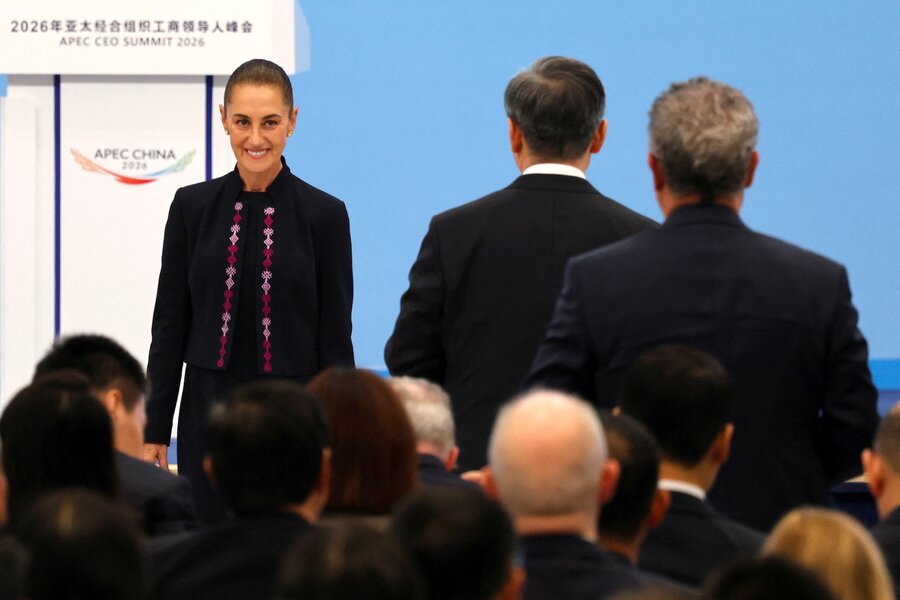
Mexico’s president became a social media star this week – for flying economy class on a 21-hour journey to the Asia-Pacific Economic Cooperation summit in China. But that was just a footnote to Claudia Sheinbaum Pardo’s core mission in Shenzhen: to attract global interest and investment to boost her country’s economic growth and business productivity.In fact, for much of this year, her government has worked to garner similar interest and investment from Mexico’s global diaspora, too – particularly from the thousands of expatriates engaged in advanced scientific research, innovation, and enterprise-building in other countries. In May, Mexico announced a targeted initiative, the Mexican Diaspora Chairs program, to forge links between Mexicans working on cutting-edge scientific research abroad and academics, practitioners, and budding entrepreneurs in Mexico. This month, officials announced that 668 researchers living in 44 countries would participate in the first round (out of more than 950 applications received). They are working on projects ranging from artificial intelligence and biotechnology to microelectronics and advanced mathematics education. “What we have found in many of you is the desire to continue to be linked with Mexico and [to] ... contribute to the country,” a government representative told more than 130 of the Europe-based researchers at a gathering in Germany earlier this month.This sentiment reflects the enduring attachment and desire to give back to their homelands that is a common feature among emigrant communities around the world.“If you were abroad and learned something about leadership, some technical aspect of your career, how to scale a project, it’s our responsibility to return to Mexico and implement it,” U.S.-based medical scientist Javier Coindreau told CNN recently. For him, that “return” to Mexico is less about physical relocation and more about sharing knowledge, investing, and helping develop new opportunities there. However, it’s more than nostalgia or obligation that is driving such willingness to participate in Mexico’s progress. Successful Mexican expatriates, CNN reported over the weekend, appear to be encouraged by governmental efforts to improve efficiency, transparency, and trust in the country’s political and economic systems – and to encourage freer scientific inquiry and business innovation.Mexico ranks 14th in the world when it comes to the share of high-technology exports as part of total trade. But, according to the 2026 Global Innovation Index, it ranks 65th on innovation. That’s a function of focusing on manufacturing components and products designed elsewhere, as well as of limited R&D investment in the country. Dr. Sheinbaum’s populist predecessor, Andrés Manuel López Obrador, had often targeted academics and researchers as an elite group that needed to better align with government viewpoints, using funding as a means to exert control. Deepen your worldviewwith Monitor Highlights.Politics with respectGet political stories with respectful analysis.There‘s a world of new ideas in everyBooks newsletter.There‘s more to life, enrich yours withCulture & Learning weekly.Follow humanity‘s discoveries withScience & Nature stories in your inbox.Gain a spiritual perspectivefrom the stories in your inbox.Want to understand the deeper impact of critical events? Learn the Monitor‘s insight.Already a subscriber? Log in to hide ads. “The virtuous cycle of innovation – transforming ... knowledge into products and economic well-being – has yet to be completed,” according to Enrique Galindo Fentanes, a nationally renowned researcher at the country’s leading public university. “Scientific entrepreneurship is not a luxury; it is an imperative to build the knowledge economy in the Mexico we want,” he wrote in the outlet La Crónica de Hoy this year, adding, “Every year, Mexico graduates 16,000 PhDs. ... If only 1% became entrepreneurs ... there would be 160 new science-based companies a year.”With the help of its skilled diaspora, and by continuing to make improvements in governance and anti-corruption efforts, Mexico seems to be heading in the right direction. ALREADY A SUBSCRIBER? LoginReal news can be honest, hopeful, credible, constructive.The Christian Science Monitor was founded in 1908 to lift the standard of journalism and uplift humanity. We aim to “speak the truth in love.” Our goal is not to tell you what to think, but to give you the essential knowledge and understanding to come to your own intelligent conclusions. Join us in this mission by subscribing.
Mexico taps its diaspora’s skills – and affections
Full Article
Original Source
Read the full article at Csmonitor →KhanList aggregates and links to publicly available news content. We do not host full articles from third-party sources. Always verify important information with original sources.