
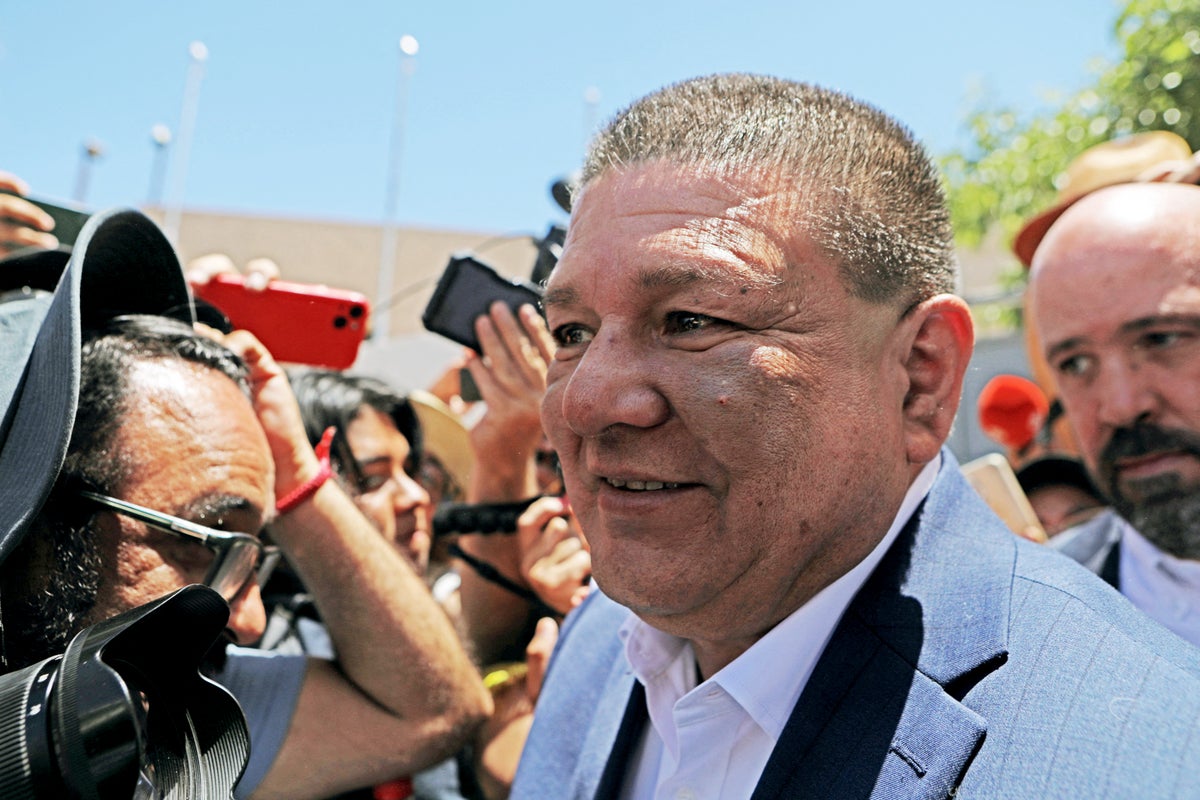
A federal judge in Mexico has ruled that a former state attorney general will stand trial on treason charges following his alleged involvement in an unauthorized joint operation with the CIA in northern Mexico.César Jáuregui, who previously served as the Chihuahua prosecutor, stands accused of illegally launching a field operation alongside U.S. intelligence operatives to dismantle a clandestine drug laboratory without informing or gaining authorization from the federal government. The secret effort unraveled after a deadly car crash in April killed two state officials and two CIA agents as their convoy returned from the site.Mexican President Claudia Sheinbaum arrives at the National Palace to give her daily morning press conference in Mexico City (AP)Defense attorney Luis Villegas confirmed that Jáuregui was ordered to stand trial. The former prosecutor was arrested on Oct. 17 and initially charged with illegal exercise of public office, which a judge ruled could proceed to trial. Federal officials subsequently added the treason charge.The prosecution represents an extraordinary move in Mexico, where charges of treason have not been successfully brought to trial in decades despite a recent attempt. The offense carries a sentence of 5 to 40 years in prison, though legal experts stress that the charge is exceptionally difficult to prove.The presence of CIA agents on Mexican soil sparked outrage from President Claudia Sheinbaum, who has made a strong defense of national sovereignty a core pillar of her administration. The incident has also raised fresh questions concerning the Trump administration’s conduct on Mexican territory.The operation to dismantle the drug lab in the municipality of Morelos, located in the mountains of Chihuahua, took place on April 19. As the return convoy traveled back, a vehicle veered off the mountain road and plunged into a ravine. Former Chihuahua Prosecutor Cesar Jauregui is pictured during a rally in support of the Governor of Chihuahua, Maru Campos, outside the Attorney General's Office (FGR) in Ciudad Juarez (AFP/Getty)Two Mexican state agents—including Chihuahua's chief of investigations—and two Americans died in the accident.While the Federal Security Cabinet noted that laboratories were dismantled during a joint effort involving state prosecutors and the army, it provided no further details. The operation resulted in no arrests as suspects fled the scene.President Sheinbaum said none of the foreign operatives had permission to act in Mexico and that the military was unaware of their presence. The day after the crash, she reiterated that she had not known about the mission, while Jáuregui claimed the Americans joined the group after the action. Two additional U.S. agents traveling in another vehicle in the convoy were later expelled from the country. Jáuregui resigned as state district attorney after the crash, saying he wanted to clear the way for an inquiry. He is currently being held in pretrial detention at a maximum-security prison.During a closed-door hearing this week, federal prosecutors said they were seeking an exemplary sentence. Defense attorney Héctor Villasana stated that prosecutors told the court they wanted to prevent a scenario akin to the United States’ removal of Venezuelan President Nicolás Maduro.President Sheinbaum said none of the foreign operatives had permission to act in Mexico and that the military was unaware of their presence (Getty)When contacted, the U.S. State Department informed The Associated Press that it is aware of and monitoring Jáuregui’s case, though it did not connect the prosecution directly to the deaths of the CIA agents.Conflicting official statements remain regarding the status of the Americans involved. Defense coordinator Villegas said the two deceased Americans were officials providing training in intelligence and drones. U.S. Ambassador Ronald Johnson previously identified them as "embassy personnel," though the AP later confirmed they were CIA agents. According to Jáuregui's legal team, federal prosecutors claimed the agents maintained close ties to Chihuahua's chief of investigations, who died in the crash.Legal experts have cast doubt on the legal foundation of the treason charge, noting its heavy political overtones ahead of Mexico’s 2027 midterm elections. Samuel González, an analyst and former chief prosecutor for organized crime, explained that while Jáuregui may have breached his duties by failing to notify the federal government or by permitting foreign agents to carry weapons illegally, "even if that were the case, it would not constitute treason," which is fundamentally a wartime crime.Officials in Mexico's government are eager to avoid a situation akin to the U.S. abduction of former Venezuelan President Nicolas Maduro earlier this year (Reuters)Villegas similarly criticized the prosecution's strategy, stating it was unacceptable for federal prosecutors to compare the presence of U.S. agents to a foreign "invasion."The controversy unfolds against a backdrop of heightened political tension. Trump has repeatedly asserted that Mexico is not doing enough to combat drug cartels, while Sheinbaum's political opponents, including Chihuahua’s governing National Action Party, have alleged that she is leading a "narco-government."Carlos Pérez Ricart, a professor at CIDE and author of "A Hundred Years of Spies and Drugs," observed that regardless of whether the legal case is ultimately dismissed, its public fallout will be substantial. He warned that the prosecution "sends a very bad signal to Washington" and risks undermining bilateral security efforts when discussions should instead focus on "more or better" collaboration.Ricart pointed out that U.S. agency activity in Mexico has been a constant feature for decades. Although former President Andrés Manuel López Obrador (2018–2024) placed limits on foreign agents, and Sheinbaum subsequently amended the Constitution to prohibit field operations without explicit federal consent and forbid foreign operatives from carrying weapons, informal local arrangements have persisted.Unsanctioned anti-narcotics cooperation often occurs without federal awareness because it relies on direct trust between U.S. agencies and state or local authorities, Ricart noted. "These actions happen, have happened, and will continue to happen," he said. "However, since there are no clear rules, they can lead to abuses."
Mexican official to face treason trial over secret CIA raid that left two US agents dead
Full Article
Original Source
Read the full article at Independent →KhanList aggregates and links to publicly available news content. We do not host full articles from third-party sources. Always verify important information with original sources.