
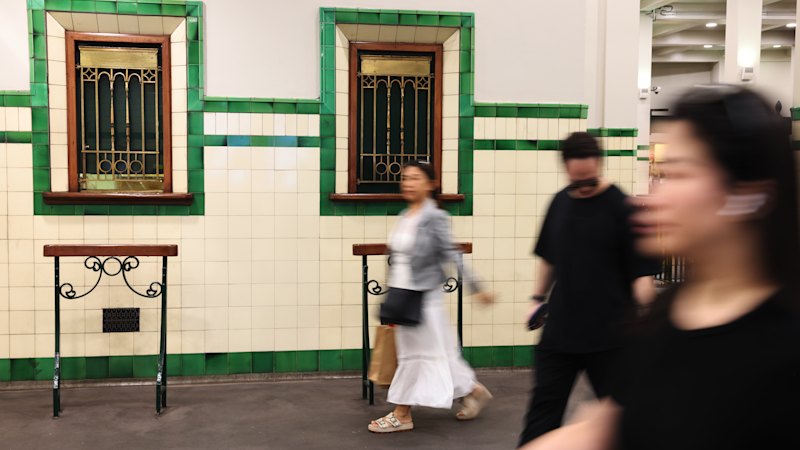
November 24, 2026 — 5:00amLike Sydney’s modern metro train system, the first underground railway in Australia was a feat of its time. Now, the first stage of the City Circle rail line is on the cusp of its centenary, having reshaped Sydney while continuing to serve as a critical transport artery today.Nearly 100 years after the first train passed through, Museum and St James stations are in good nick despite their age, the latter undergoing a spit and polish over the past few months in readiness for major celebrations over the December 19-20 weekend.Commuters file through St James station ahead of its centenary next month.Louise Kennerley“It’s basically functioning exactly as it was 100 years ago,” Transport’s community heritage manager Andrew Killingsworth said. “It paved the way for future rail development both in the city and the suburbs. It proved the concept, and it proved it in a very successful way.”When it opened on December 20, 1926, the first stage of the City Circle connecting Central to Museum and St James stations was one of only 12 underground railways in the world.Unlike the metro train tunnels carved out over the last decade by highly complex boring machines, open-cut excavation was used to construct the City Circle.Australian Railway Historical Society archives manager Craig Mackey with an old map of Sydney’s rail network.Louise KennerleySt James has undergone restoration work over the past six months ahead of its centenary.Louise Kennerley“That meant they had to cut open Hyde Park – it was like open-heart surgery,” Killingsworth said.“[They built] the tunnels using like what today would be primitive methods – shovels, horse and cart, steam diggers – and then built the tunnel arches, and then covered it back up again. The Hyde Park we see today is a legacy of 1926.”Whereas the rail line previously terminated at Central, the extension to Museum and St James spurred both CBD and suburban development by allowing people to move freely between them.Transport heritage experts Andrew Killingsworth, left, Craig Mackey and Steven Barry on a disused platform at St James station.Louise KennerleyOne of famed Sydney engineer John Bradfield’s reports on proposed electric railways. Louise KennerleyMark Foy’s department store became intertwined with Museum station, while St James station spurred the purchase of a site across the road for David Jones.Transport’s community heritage specialist Steven Barry said St James station and the rest of the underground railway opened the way for an increase in the central city’s height limit.“There was this huge congestion issue in Sydney. By unlocking the transport problem, Sydney could reach its full potential,” he said.The well-known entrance to St James station, which is on the edge of Hyde Park and across the road from David Jones department store.Louise KennerleyA 1914 map of plans for Sydney’s rail network.Louise KennerleyPlans for the City Circle railway were conceived by famed Sydney engineer John Bradfield who brought ideas back from visits to New York and other American and Canadian cities.“He goes to the Brooklyn Bridge train station and measures the subways and footfall – how quickly people can move through in the peak – and brings back those dimensions. That informs the sizing of the subways that you see throughout the City Circle,” Barry said.“It really did put Sydney and Australia on the world stage in terms of having an underground railway.”In a 1915 report, Bradfield surmised that lifts were outdated and that the escalators – or “moving stairs” – he had seen in the US were the future for shifting large numbers of commuters here, too. Years later, escalators were installed at Wynyard.A view south from Macquarie Street of the open-cut excavation of Hyde Park for the underground railway.An official party on the first train on December 9, 1926, 11 days before the line to St James was opened to the public.Killingsworth said Bradfield’s vision and ingenuity fuelled the rail network’s expansion in Sydney, citing a flyover junction at the southern end of Central Station and overhead electrification.“Suburban development in Sydney was spurred by rail development. And the electric trains facilitated that. They were quicker, cleaner, more convenient ... and so people could move further out. The quarter-acre block is probably a legacy of that,” he said.Built in stages, the City Circle was completed in 1956 when the line was extended between Circular Quay and Wynyard, closing the loop.Ahead of the centenary next month, work has been under way at St James station ranging from light improvements and painting to brass cleaning and sandstone work. On Wednesday, six 1920s art deco pendant lights will be fitted to the station concourse roof.A celebration called Underground 100 will be held over the December 19-20 weekend to mark the centenary, comprising multimedia experiences at St James station, tours of its hidden tunnels, and heritage electric train and vintage bus rides.It will also feature a children’s discovery trail, 1920s-inspired performers, commemorative merchandise, as well as food and refreshments inspired by the railway’s early years.Entry to Underground 100 will be free, while tunnel taster tours and heritage train rides are ticketed due to limited capacity. The latter can be booked from Wednesday.Transport Minister John Graham said the 100-year commemoration was a reminder of the enormous impact infrastructure investments had on the city.“In the same way Bradfield’s underground railway shaped Sydney, the metro tunnels are reshaping the next century of life in Sydney,” he said.From our partners
Metro of their day: Grand dames of Sydney’s underground railway that shaped the city
Full Article
Original Source
Read the full article at Smh →KhanList aggregates and links to publicly available news content. We do not host full articles from third-party sources. Always verify important information with original sources.