
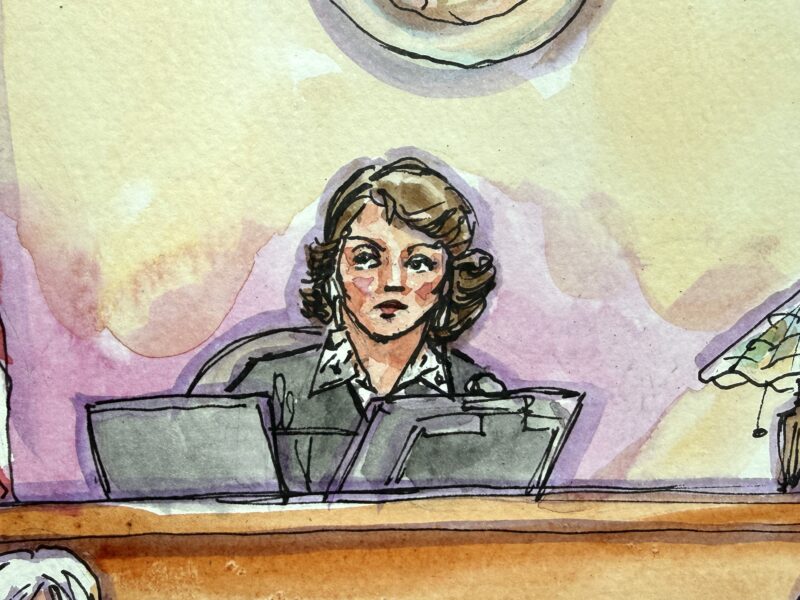
During the third day of testimony at a trial between four states and Meta, a social psychologist testified of increased depression and other issues likely caused by social media.OAKLAND, Calif. (CN) — A social psychologist testified Monday at the high-profile trial between four state attorneys general and tech giant Meta that daily social media use has likely caused low psychological well-being in adolescents.Jean Twenge — a San Diego State University professor, psychology researcher and book author on topics such as gender, personality and narcissism in young people — testified for almost four hours on the third day of trial.She explained how her reviews of scientific studies measuring adolescents’ time spent on social media showed increases in depression, self-harm and suicide, sometimes by upward of 5% in a 100,000-person study, between 2010 and 2023. She noted that girls in particular, ranging in age from 10 to 17, had the largest spike in mental health effects and were more likely to inflict self-harm, including cutting or taking medication, due to increased use of technology, including social media use.Furthermore, before the rise of social media, boys were more likely to die by suicide than girls, but rates increased more during the 2010s, she noted on graphs shown to the jury.J. Christian Lewis, chief of the Division of Consumer & Senior Protection under the Kentucky Attorney General’s Office, asked Twenge, one of the state’s expert witnesses, what happens when teens spend a lot of time, more than two hours a day, on social media.Twenge said the time “had to come from somewhere,” and many teens lose sleep because they are on smartphones at night. Additionally, she said the time online displaces time teens spend seeing friends in person or doing activities like going to parties.“That is a terrible formula for mental health,” she testified.During cross-examination, Meta attorney Paul Schmidt repeatedly asked Twenge about how the studies, based on the Bradford Hill criteria, a principle used to evaluate the associations of cause, showed specific causation of social media and declining mental health in teens.Schmidt noted Twenge’s research didn’t break down social media by specific apps and sometimes didn’t distinguish between social media use and the harms of other tech use, like gaming.He also flipped statistics on many of the graphs — telling Twenge if 20% of teens were surveyed as unhappy after two hours of social media use, then 80% would have to be happy with social media use, or it had no impact on happiness.“You understand there is a difference in something that may be cause and something that is the cause?” Schmidt asked Twenge.She answered yes, but for many of Schmidt’s questions, she said the data needed to be viewed in a broader context.The third day of the blockbuster trial in Chief U.S. District Judge Yvonne Gonzalez Rogers’ courtroom — the first in the multidistrict litigation of more than 3,000 active cases — pitted the parent company of Facebook and Instagram against California, Colorado, Kentucky and New Jersey. Another 25 states that sued Meta in 2023 will head to trial later.The states claim Meta violated the Children’s Online Privacy Protection Act, a federal law requiring online companies to obtain verifiable parental consent for users under 13. Additionally, the lead states claim Meta leadership made deceptive statements about its platforms that likely misled the public and violated consumer protection laws.An eight-person jury is hearing the case and will give an advisory verdict to Rogers. The Barack Obama appointee will decide the case and any possible penalties. If Meta is found liable, penalties could reach up to $200 billion and change how Meta manages teen accounts. The trial is expected to last six to eight weeks, with a few high-profile witnesses, including Meta CEO Mark Zuckerberg and head of Instagram Adam Mosseri, slated to testify.The second witness called by the states Monday was George Volichenko, a former Meta data scientist. Volichenko was on the well-being team at Instagram in 2022 that worked on features such as “take a break” and “quiet mode,” tools introduced on the app to “essentially curb really long sessions,” he said.California Deputy Attorney General Megan O’Neill questioned Volichenko. He quit after nine months, he testified, because he was “not happy with the limited freedom the team was given to devise, test and launch features that would make a difference."Meta attorney Brian Stekloff poked holes in Volichenko’s expertise in the field of teen mental health.“Teen mental health involves some complex issues, correct?” asked Stekloff.Volichenko said yes and subsequently answered another question about what Instagram called “problematic use,” or time spent on the app that interfered with other things in teens’ lives.Stekloff made a point that many employees at Meta were dedicated and well-qualified to work on teen mental health issues.Cross-examination of Volichenko continues Tuesday.If you are having thoughts of suicide, call or text 988, or call the National Suicide Prevention Lifeline at 1-800-273-8255 (TALK). Visit SpeakingOfSuicide.com/resources for a list of additional resources.Subscribe to our free newslettersOur weekly newsletter Closing Arguments offers the latest about ongoing trials, major litigation and rulings in courthouses around the U.S. and the world, while the monthly Under the Lights dishes the legal dirt from Hollywood, sports, Big Tech and the arts.Additional Reads
Meta questions psychologist’s testimony in teen mental health harms trial
Full Article
Original Source
Read the full article at Courthousenews →KhanList aggregates and links to publicly available news content. We do not host full articles from third-party sources. Always verify important information with original sources.