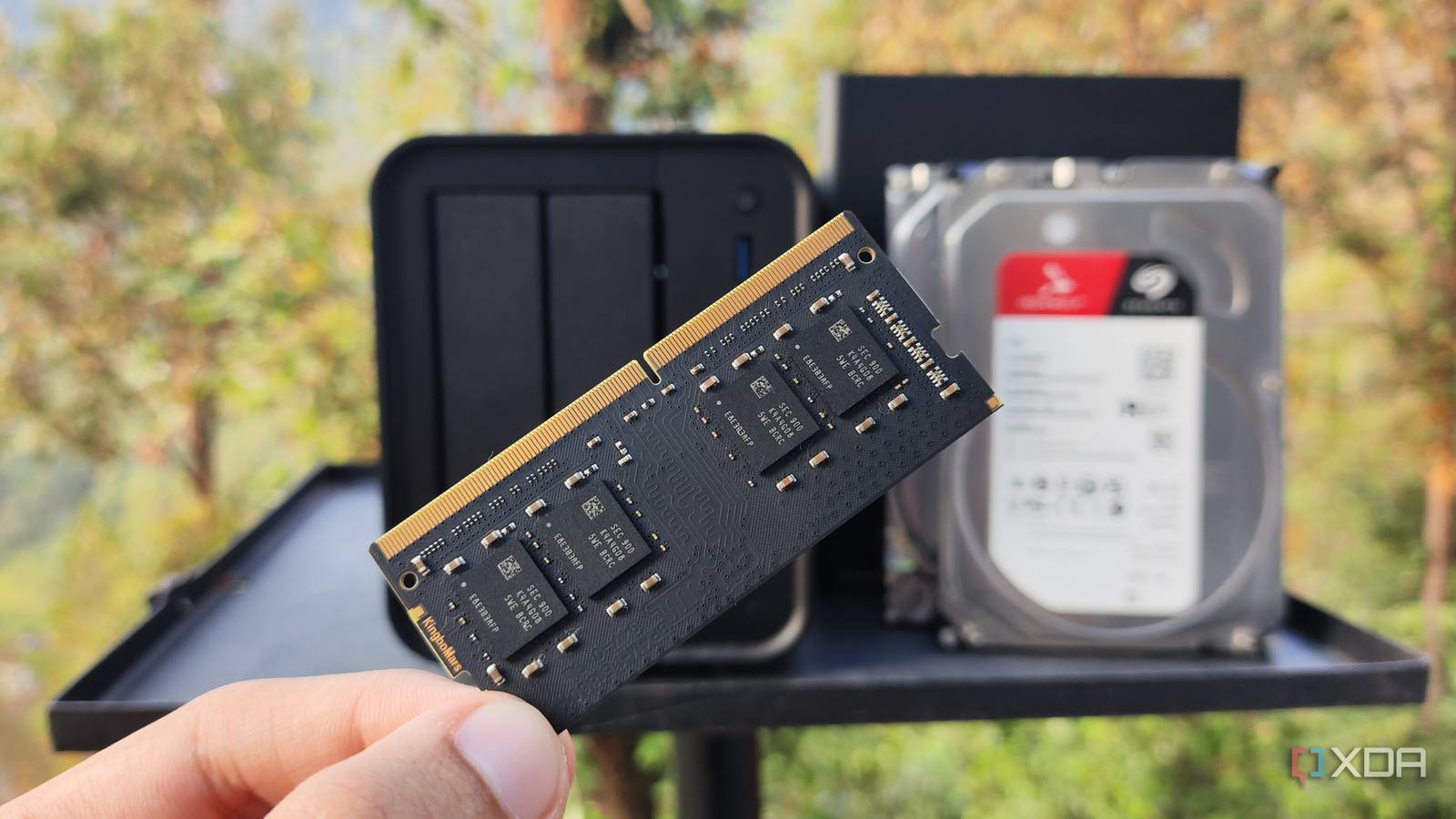
Published Jul 28, 2026, 7:00 PM EDT Abhinav pivoted from a career in banking to pursue his first love in writing. Even while working full-time, he continued contributing as an editor-at-large, a role he has held for more than 7 years. A lifelong tech enthusiast who has built three gaming and productivity powerhouse PCs since 2018, his passion for technology keeps him closely following the semiconductor industry, from NVIDIA and AMD to ARM. His MSc dissertation explored how artificial intelligence will reshape the future of work, reflecting his curiosity about the wider social impact of emerging technologies. When prices climb high enough, everyone starts looking at old technology rather differently. Most of my time this year has been spent watching that happen at the consumer level, and the signs have been persistent and pervasive. First, it was DDR4 production restarting, then a four-year-old CPU returning to retail, and then buyers finally deciding to stretch their platforms they had every intention of leaving behind. It appears, though, that some of the world's largest companies are doing the exact same thing. A recent research published by Meta engineers detailed how a new CXL memory expander called Vistara lets the company pull DDR4 memory out of decommissioned servers and install it into brand-new DDR5-only machines. It's already deployed in production across millions of servers, and it's one of the most impressive responses to the memory crisis. And gave retired DDR4 a second life One of the core problems Meta describes in the paper relates to mismatched lifespan of hardware. Servers get retired after five to seven years, but the DRAM inside them stays useful for ten to fourteen. At the same time, roughly 40% of Meta's servers are memory-capacity bound, which means they run out of RAM long before they get behind on raw CPU performance. The company, as a result, ends up retiring millions of perfectly functional DDR4 DIMMs while simultaneously needing memory elsewhere in the server fleet. The issue here is that you can't simply transition DIMMs into newer servers. Modern server-grade processors, such as AMD's Turin, only support DDR5 through their onboard memory controllers, which leaves perfectly functional DDR4 modules with nowhere to go. Meta's solution for this, then, is Vistara. Rather than replacing the CPU's memory controller, Meta built a custom Compute Express Link (CXL) 2.0 ASIC that sits on a PCIe Gen 5 connection and acts as a bridge between DDR4 and modern processors. Each chip provides two 72-bit DDR4 channels and three RISC-V management cores dedicated to running the hardware. On Meta's MemServer platform, two Vistara chips sit alongside a 158-core AMD Turin processor and 768GB of DDR5-6400, and adding another 256GB of reclaimed DDR4-2400 reclaimed a full terabyte of memory. The way it works is such that the recycled memory never pretends to be local DRAM. Instead, the OS is shown a separate memory node with no processor attached to it. Since the OS has understood memory sitting at different distances for decades, especially in multi-socket servers, Meta could build on something Linux already knew how to do rather than invent a new approach, and the applications needed almost no modification at all. Consumer CPUs simply don't speak the language The obvious question, one might wonder, is why this solution isn't applicable to consumer desktops. Now, physically, one could do it. CXL runs over the PCIe electrical layer and uses the same connector, so nothing would stop seating it. The issue then becomes the fact that CXL is a separate protocol layered on top which requires dedicated silicon at both ends, both in the device and in the host processor itself. Server and workstation-grade chips have it, while consumer processors don't. In other words, consumer processors have no idea how to treat a PCIe device as system memory, because the protocol support simply doesn't exist on consumer-grade chips. Their integrated memory controllers only know how to talk to the DDR5 DIMMs wired directly to the motherboard. That's why the few expansion cards that accept standard DDR5 DIMMs target only workstation platforms like TRX50 and Intel W790. Those processors implement the necessary CXL features, while mainstream Ryzen and Intel chips simply don't. AMD mentioned bringing CXL to consumer platforms back in 2022 with a 3–5 year roadmap, but so far, there has been no mention of development on that front, and it's safe to assume there won't be anytime soon. Nobody will build this for consumers And the reason for that is simple economics Even if consumer platforms supported CXL tomorrow, it's difficult to envision a manufacturer building a product like Vistara for the mass market. The economics of it have a major role to play in that. CXL controllers, retimers, and the extra board complexity all add to the cost, and that's all before you account for developing the memory expansion hardware itself. Consumers don't have the same problem that Meta does, either. In a hyperscale data center, adding memory through CXL can eliminate the need to deploy an entirely new server, saving thousands of dollars in hardware, power, and rack space. On a gaming PC, you're at best avoiding the purchase of another RAM kit through cost savings. As such, it's not hard to explain why CXL has remained almost exclusively a server technology. AMD's newly announced 6th Gen EPYC processors support CXL 3.1 memory expansion alongside 128 PCIe Gen 6 lanes per socket, while the CXL Consortium finalized the 4.0 specification last year. It's rather bittersweet to realize that the technology keeps moving forward, but nearly every major milestone has landed in enterprise hardware first, mostly because that's where the return on investment exists. Data centers continue to get the best of tech The barrier between consumers and great technology continues to be the economics of adoption and distribution, and that pretty much summarizes the technological paradigm since the DRAM crisis. Data centers continue to engineer their way out of inflation, and the cost savings multiply across millions of servers. Unfortunately, that's not how the math works for desktop computing, which the memory crisis seems to be squeezing just as hard, but impacting disproportionately more.
Meta is putting old DDR4 in DDR5 servers with a custom chip, and it's the RAM crisis workaround I wish I could buy
Full Article
Original Source
Read the full article at Xda-developers →KhanList aggregates and links to publicly available news content. We do not host full articles from third-party sources. Always verify important information with original sources.