
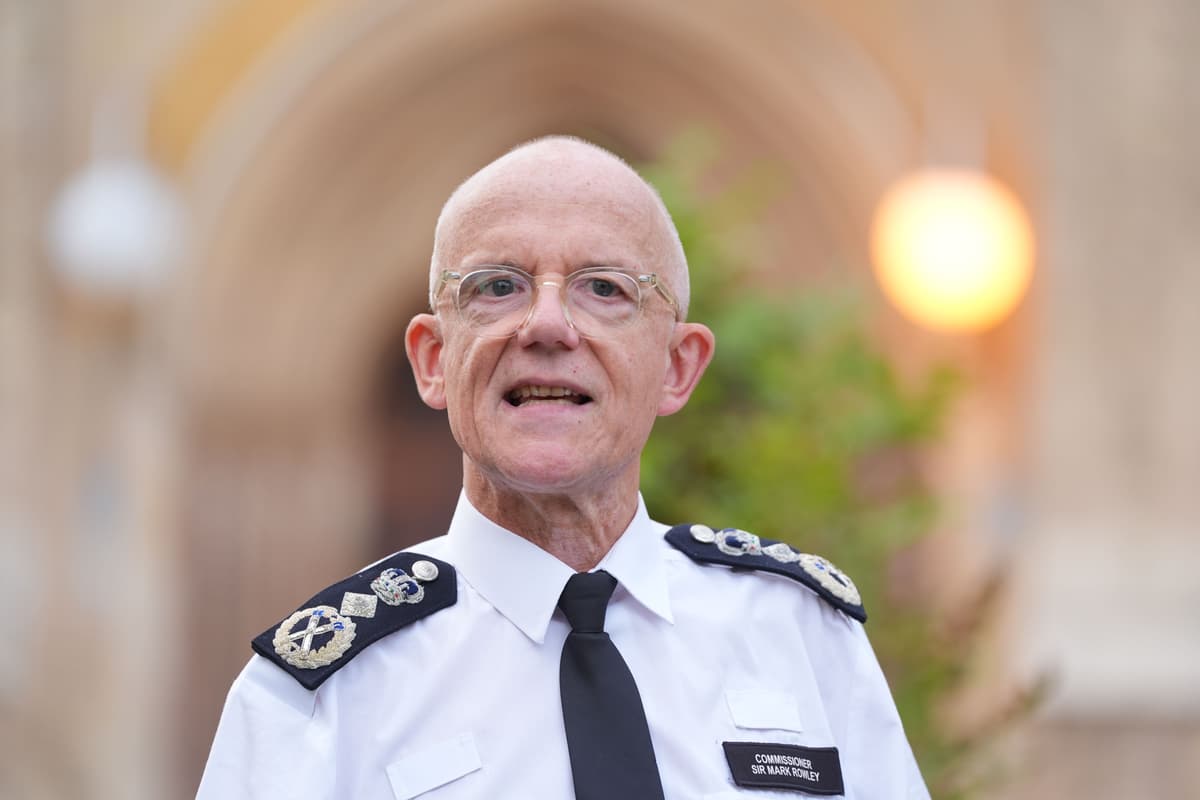
Metropolitan Police Commissioner Sir Mark Rowley has defended his call to cut the number of police forces in England and Wales through mergers.The Scotland Yard chief said his proposals, set out in a major speech were the “opposite of Beeching” – in reference to the “Beeching Axe” of local railway services in the 1960s.In his speech, the Met chief said resources are being wasted financing 43 separate police forces and argued for eight to 10 larger regional forces, more able to tackle criminal gangs.Speaking to the Press Association, Sir Mark said rather than cuts to local policing, the proposals would help bolster the number of officers on the beat.He said: “This is the opposite of Beeching. This is about, I don’t know, the equivalent would be more local railways, not fewer.“The building block for the work we want to do is bottom up. It’s about strong local policing. Everything stands behind that.“At the moment, it’s not as strong as it needs to be.“The reason is, crime gets more complicated, so you need more specialist skills to deal with it.”Maggie Blyth, temporary chief constable of Gloucestershire Police (PA Media)PA MediaSir Mark said rationalising the current structure would free up resources to go back into local policing and allow specialist units to tackle organised crime, which some, smaller forces, struggle to do adequately.He said the blunt truth is the police service needed to adapt or that “criminals will win”.At a roundtable discussion with other police chiefs, Sir Stephen Watson, Chief Constable of Greater Manchester Police (GMP), who has turned his force around to being a top performer after being in special measures, said the state of public finances means there is no way more funding would be coming for policing.He said: “We have got to use the money better than we do today.Chief Constable Victoria Fuller of Cleveland Police (Owen Humphreys/PA)PA Wire“And it must be an inconvertible fact, that we have tied up in 43 headquarters, 43 chiefs, 43 deputies, 43 IT directors, 43 HR directors, 43 procurement specialists, 43 different IT systems, it must be the case that there is money to be liberated through economies of scale and bringing some rational bringing together of those resources.“And the point of that exercise is to bolster that which happens at the local level.“All we are trying to set out is, there is a way, pragmatically we think, within what we’ve got to do much better and we are also making the case that the status quo, is simply not sustainable.Read More“If we don’t change, this is decline by design. I think the case for reform is unanswerable.”Victoria Fuller, Chief Constable of Cleveland Police, whose force area saw rioting this summer after the death of two police officers among seven killed in a road crash, said a single, “North East” police force “may make sense”.She said her relatively small force was only able to “surge” to fight organised crime in the aftermath of the deaths, by drawing on resources from other forces and specialist help from the National Crime Agency.She said: “The tragedy in August showed us what we can do with more. Firearms recovered, drugs recovered. We’ve been tackling this before, but our communities have seen in Cleveland, what enhanced resources and specialist capability can do for us.”Maggie Blyth, temporary chief constable of Gloucestershire Police, one of the smallest forces in the country, denied that her force would be “gobbled up” by a merged, larger force based in Birmingham or Bristol.She said: “We’ve looked at that, and I don’t think that is the case, because what we can confidently offer to our public in Gloucestershire is a focus on the local, maintaining the neighbourhood at very local level.“Making sure that there are officers in our neighbourhood team, that our calls are answered in a timely way, that there is somebody there to respond.“We can do that because we can be assured that some of those economies of scale around the back-office functions are undertaken by a large infrastructure.”Police chiefs also fielded questions challenging the “democratic deficit” in such a wholesale change, as such police reform was not mentioned in the Labour Government’s manifesto.And questions remain about how mergers would also affect how much voters pay for policing, the police precept part of council tax bills, with residents in some areas paying much more than in others.The proposals have faced resistance from police and crime commissioners and local leaders who fear a restructuring will cost money and weaken ties between senior officers and the communities they serve.The Government launched a review to consider dramatically reducing the number of forces in January this year.The review, led by former Scotland Yard chief Lord Bernard Hogan-Howe, will make recommendations on how to restructure policing.But Labour’s North East Mayor Kim McGuinness said: “If you move to a handful of very big forces you will risk losing the ability for local people to have their say.“Yes, some issues rightly need a national approach, but we have to protect the principle of local accountability – that means local targets, local control of budgets and a chief constable held to account by their residents.“What we definitely do not need is the head of London’s very troubled police force coming north and telling us how policing should work.“The Met is not in a position to preach to northern police forces.”Kent’s Conservative police and crime commissioner, Matthew Scott, claimed Sir Mark suggestions would lead to a “decade of disruption”.“Money – your money – will be diverted to pay for this folly, rather than fighting crime and supporting victims,” he said.“Every pound spent reorganising is a pound not spent catching criminals, and a pound that policing does not have, wasted.”
Met chief Mark Rowley defends proposal for police forces to be merged
Full Article
Original Source
Read the full article at Standard →KhanList aggregates and links to publicly available news content. We do not host full articles from third-party sources. Always verify important information with original sources.