
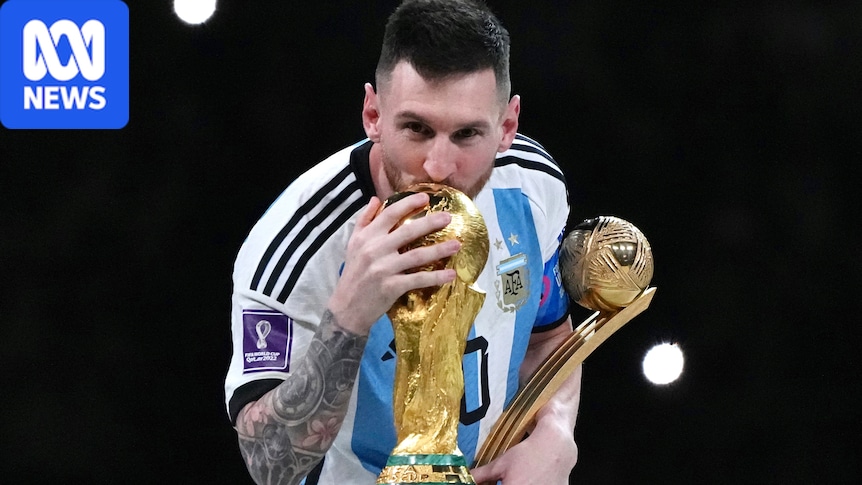
Lionel Messi's retirement from the Argentina national side brings down the curtain on one of world football's most storied international careers.The records and achievements of Messi are stuff of legend, and his status in international sport is reserved for only the very greatest of their craft.Messi was denied the perfect finish to his Argentina career in July, defeated in a thrilling FIFA World Cup final by Spain that went to extra time.But the loss in New Jersey only denied the fairytale finish, and did not diminish the legend that Messi created for himself, or the legacy that he has left among his people.But the love and admiration of his people, the two Copa America wins, and the 2022 FIFA World Cup triumph, which brought Argentina back to the pinnacle of world football and raised Messi to the legendary status of fellow countryman Diego Maradona, almost never happened.Legend at Barca, struggles with ArgentinaMessi has been on top of world football for two decades, winning the coveted Ballon d'Or as the world's best player a staggering eight times.From 2004 to 2021, he won 10 La Liga titles, seven Spanish Cups, seven Spanish Super Cups, four Champions Leagues, three UEFA Super Cups and three FIFA Club World Cups with Barcelona.In a legendary 2012, he scored 91 goals in all competitions, a record haul for a calendar year, and slotted 50 goals in the 2011-12 La Liga season.Trophies, accolades, love and admiration grew and grew for the Barcelona great, but success for Argentina was not forthcoming.Coming through the ranks, Messi led Argentina to a Youth World Championship in 2005 and the Olympic medal at the Beijing Games in 2008.But in the very big tournaments, trophies were harder to come by.When Messi made his senior debut for Argentina in 2005 against Hungary, the South American giants had not won a trophy since the 1993 Copa America.Messi's Argentina senior debut was nothing to write home about either, sent off after less than a minute on the pitch for elbowing an opponent.But Messi overcame that infamous beginning to establish himself as a star, and the hope of a nation that Argentina could return to the top of South America, and the world.What followed was a string of bitter disappointments.Argentina made the final of the Copa America in 2007, but was soundly beaten 3-0 by arch rival Brazil.At the 2010 FIFA World Cup in South Africa, Messi failed to score at the tournament as Argentina exited at the quarterfinal stage.Argentina was then knocked out again at the quarterfinal stage, this time at the 2011 Copa America, by eventual winner Uruguay.These were bitter disappointments for Argentina and Messi, but the pain was about to increase, and it led to the great man announcing he did not want to be part of it anymore.Three years, three finals, three painful defeatsHeading into the 2014 FIFA World Cup in Brazil, it had been 21 years since Argentina's last major trophy.But the blue and whites marched into enemy territory intending to claim international football's greatest prize, and doing it in the backyard of their greatest rival.Argentina won all three group games — over Bosnia and Herzegovina, Iran, and Nigeria — to top the group, beat Switzerland 1-0 in extra time, and finally won a quarterfinal by defeating Belgium 1-0.A scoreless semifinal against the Netherlands, finalists in 2010, went to penalties, where Argentina won 4-2, including a successful spot kick from Messi.But the joy ended there.In a major final for the first time in seven years, Argentina faced a German side that had just humiliated Brazil 7-1 in the semifinal.Like all of Argentina's games to that point, the game was tight and tense. It went to extra time, but the strike of German Mario Götze sealed Germany's triumph.A photograph of Messi looking at the World Cup trophy after the defeat, captured by Bao Tailiang for Chengdu Economic Daily in China, became the defining image of Messi for years.Lionel Messi walking past the FIFA World Cup trophy after defeat in the 2014 final. (Supplied: Bao Tailiang for Chengdu Economic Daily via X)The heartbreak only continued for Messi and Argentina.The Copa America was held in 2015 and 2016, with Argentina reaching the final both times and losing to Chile each time.Both finals ended scoreless and went to penalties. Messi converted his penalty, the only Argentinian player to do so, in the 2015 defeat, but the great man missed his spot kick in 2016.The pain of the 2016 final defeat was too much for Messi, who announced he was retiring from Argentina."For me, the national team is over," he said after the loss to Chile in 2016. "I've done all I can. It hurts not to be a champion.""It's been four finals, I tried."It was the thing I wanted the most, but I couldn't get it, so I think it's over."I think this is best for everyone. First of all for me, then for everyone."I think there's a lot of people who want this, who obviously are not satisfied, as we are not satisfied reaching a final and not winning it."World football was that close to never seeing Messi reach the heights he would achieve.Six-week retirement, 10 years of legacy buildingWhen Messi announced on Sunday, June 26, 2016, that he would no longer play for Argentina, he ended what was by any other measure a magnificent international career.He had made 113 appearances, scored 55 goals and led his country to four major finals.But the absence of a trophy was not good enough — not for someone as great as Messi.On July 10, the world watched Cristiano Ronaldo lift an international major trophy as Portugal won the 2016 Euros.On August 12, Messi announced that he was back.What followed after his six-week retirement is, on its own, one of the greatest international careers ever forged.Messi would add another 94 caps to his name, score another 70 goals, and more importantly, end Argentina's trophy drought.And Messi didn't just win one major trophy for Argentina; he won four.The 2018 FIFA World Cup in Russia was another familiar quarterfinal exit for Argentina, but it was the precursor to an era of success.Argentina finally broke through to win the Copa America in 2021, and they did it against Brazil, in Brazil.Lionel Messi was thrown into the air in celebatrion after Argentina ended a 28-year trophy drought. (Getty Images: MB Media)With the COVID-19 pandemic keeping many fans away from the famed Maracanã Stadium in Rio, Argentina ground out a 1-0 win to claim the nation's first major trophy in 28 years.Messi was hoisted in the air by teammates in images that went around the world.The drought was over, and the rain was here to stay. Argentina won a second trophy in 2022 when they defeated European champions Italy in the relaunched Finalissima, but greater prizes were to come.By this stage, Messi had surpassed everything achieved by Maradona, except one.Maradona almost single-handedly won the World Cup for Argentina in 1986, and gave him a legendary status that was near God-like.Now, it was Messi's time to do the same.He did it in Qatar at the 2022 World Cup, leading the blue and whites back to the top of world football.The final against France, the defending world champions, was anything but ordinary. Those who were accustomed to Argentina grinding out 1-0 wins got the shock of their lives when they traded blows with France in one of the greatest finals ever played.Messi scored two goals, including in extra time, while Ángel Di María also scored for Argentina. But the South Americans met their match in France, or more specifically, Kylian Mbappé, who scored a hat-trick, including a 118th-minute penalty to send the final to spot kicks.In the penalty shootout, Messi converted, Mbappé converted.Argentina was perfect. France was not.When Gonzalo Montiel's shot hit the back of the net, Argentina was world champion and Messi had reached the God-like status that had only been reserved for Maradona.The image of Messi kissing the World Cup became the defining image of his illustrious career.Lionel Messi finally got his hands on the FIFA World Cup trophy, which had eluded him for so long. (Getty Images: China News Service/VCG/Cui Nan)One more trophy would follow for Argentina, another Copa America in 2024 to make it three major trophies in four years.That trophy was icing on the cake for Messi's legacy, which by now was in uncharted territory.Messi's international career by numbers1Lionel Messi led Argentina to the FIFA World Cup title in 2022. He also led his country to two more finals, 2014 and 2026, which both resulted in 1-0 defeats in extra time.2Lionel Messi led Argentina to two Copa America titles in 2021 and 2024. Before then, the last time Argentina was champion in the Copa America was in 1993.6Lionel Messi has played in a record six FIFA World Cups — 2006, 2010, 2014, 2018, 2022 and 2026. Only Portugal's Cristiano Ronaldo has also managed that feat.21Lionel Messi scored 21 goals at the FIFA World Cup finals. He is second on the all-time list behind French star Kylian Mbappé, who has scored 22 from just three tournaments.34Lionel Messi holds the record for the most FIFA World Cup finals matches played. He was on the field 34 times for Argentina in a FIFA World Cup tournament. Ronaldo is second on the list with 27 appearances for Portugal.125Lionel Messi holds the Argentina goal-scoring record, netting 125 times for his country. That is more than double the previous record holder, Gabriel Batistuta, who scored 54 times for his country.207Lionel Messi made 207 appearances for Argentina, a national record. He made his debut in 2005 against Hungary, and played his final match against Spain in the 2026 FIFA World Cup final. Ronaldo holds the world record for international appearances, playing 233 times for Portugal.
Messi's legendary run for Argentina almost never happened after heartbreak
Full Article
Original Source
Read the full article at Abc →KhanList aggregates and links to publicly available news content. We do not host full articles from third-party sources. Always verify important information with original sources.