
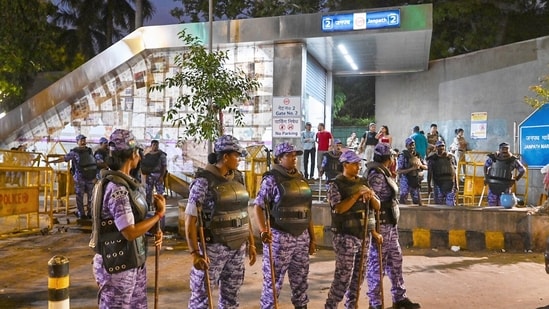
The Supreme Court on Monday said that mere agitation can't be grounds for police excesses. The observation came during a hearing of pleas alleging police brutality against students during the Jantar Mantar protest against the NEET-UG paper leak and other alleged exam irregularities.6: Security personnel stand guard at the entrance to Jantar Mantar on Janpath Road (HT)“Merely agitation cannot justify police excess,” Chief Justice of India Surya Kant observed during the hearing, according to Bar and Bench. “Just because there is agitation does not mean there is lathi charge. Self evolved discipline is needed which is essential to democratic process,” the CJI further said.He also called for a uniformed protocol on agitations, and not just restricted to Delhi. “There should be a protocol in place. There should be proper space and no restriction. But if there is some anti social elements etc that can be taken care of,” he reportedly said.‘Right to peaceful protest guaranteed’During the hearing, the Supreme Court also said that the right to peaceful protest is “absolutely guaranteed" as advocate Fauzia Shakil defended the plea alleging police brutality.“Right to peaceful, lawful protest absolutely guaranteed under Constitution. So long as it is peaceful agitation, merely because there is agitation, there can't be excess,” the CJI said.A counsel representing cops was also present during the hearing and alleged that the personnel were “kicked, lynched literally” during the protests.The hearing came in the backdrop of the July 20 CJP protest in Delhi when protesters clashed with cops, lathi-charge took place and tear gas was fired. This was one day after climate activist Sonam Wangchuk was moved to a hospital from the Jantar Mantar site where he had been on a hunger strike.
'Merely agitation can't justify lathi-charge': SC on July 20 student protest crackdown at Jantar Mantar
Full Article
Original Source
Read the full article at Hindustantimes →KhanList aggregates and links to publicly available news content. We do not host full articles from third-party sources. Always verify important information with original sources.