
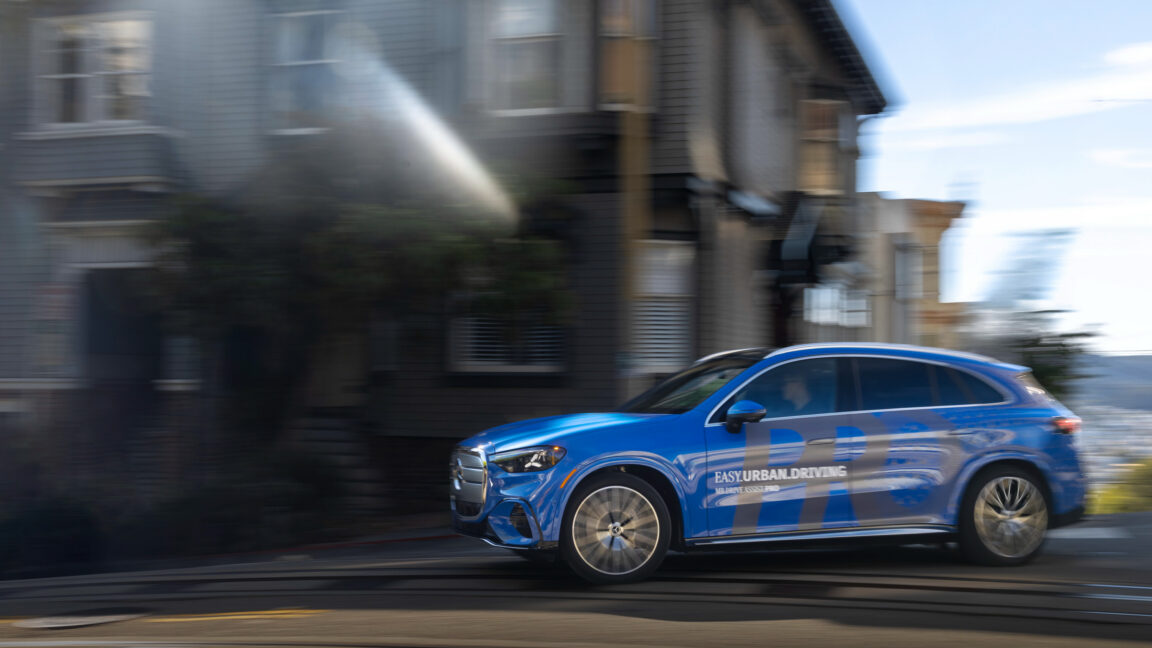
Skip to content Advanced driver assistance system: ADAS The point-to-point driver assist is coming to the US and Germany in 2027. Mercedes' new point-to-point driving assist was quite at home on the chaotic streets of San Francisco. Credit: Mercedes-Benz Mercedes' new point-to-point driving assist was quite at home on the chaotic streets of San Francisco. Credit: Mercedes-Benz SAN FRANCISCO—When Ars first drove the new Mercedes-Benz CLA last year, the automaker also gave us a sneak preview of its next driver assist. Called Drive Assist Pro, it’s for collaborative partially assisted driving, and from the passenger seat at the time, the demo was impressive. Now the automaker is getting ready to start rolling out Drive Assist Pro to customers with cars running the new MB.OS operating system here in the US and in Germany, and it let us have some time behind the wheel. While most automakers want a reputation associated with safety, Mercedes has long used passive and active technology to do so in its products. It was one of the first OEMs to introduce airbags, then a decade later started adding active safety systems like antilock brakes, electronic stability control, and adaptive cruise control. And so, by giving the car’s electronics the ability to control the brakes, and throttle, we arrive at the first level of assisted driving—called “level 1” in automotive engineerspeak. “Level 2” assisted driving, where the car also controls the steering as well as the acceleration and braking, got famous with Tesla Autopilot. But the first lane-keeping assists predate it by almost a decade in passenger cars, when Toyota introduced a system in 2004. The human driver behind the wheel is still in charge, responsible for situational awareness (and anything that arises from a lack thereof), with the idea that long drives become less tiring and a little more effortless when the car does the boring job of keeping a constant speed or a constant distance to the car ahead and between the white lines. 3? No, +, ++ The next step, numerically at least, should be level 3, where we move from assisted driving to partially automated driving; here the car takes over the task of driving fully under some circumstances, like heavy traffic. But that’s getting ahead of ourselves—the main developments over the past few years have been the inelegantly named “L2+” systems that combine more advanced driver monitoring with a higher degree of assistance, usually on geofenced highways. General Motors’ Super Cruise was the first of these, allowing hands-free operation as long as the car can tell the driver has their eyes on the road. Now many automakers offer something similar: Ford has Bluecruise, BMW has Highway Assistant, and Mercedes is about to add a hands-free highway assist next spring to its MB. Drive Assist system, which will be standard on the 2027 S-Class and AMG GT 4-Door Coupe and an option on the 2027 CLA, GLB, C-Class, GLC, and GLE. I tested that system while in San Francisco in a 2027 S-Class, and it’s competent within its operational design domain. The user interface is a little more subtle than Super Cruise’s big green LED in the steering wheel; instead, the icon on the dash changes, with the hands on the steering wheel going from green to grey when it’s safe to remove them. Like other systems, MB. Drive Assist has been programmed to make automatic lane changes if the car decides that’s going to be quicker—these can be canceled with the turn signal or simply by resisting the car steering into the next lane. The main instrument display gives you a good idea of what the car perceives around it. Note the green wheel icon in the top right—the As on either side mean hands-free mode. Credit: Jonathan Gitlin The main instrument display gives you a good idea of what the car perceives around it. Note the green wheel icon in the top right—the As on either side mean hands-free mode. Credit: Jonathan Gitlin MB. Drive Assist Pro takes that idea and brings it to lower speeds and much more complex traffic situations—“level 2++” (we really need to stop letting engineers name things). Instead of hands on the green steering wheel icon, there’s a large green arrowhead, showing you’re in point-to-point mode—compared to the various configurations of the highway assist, I found this much less likely to engender mode confusion. (Did the green hands mean I could take my hands on or off the wheel? On, but see what I mean?) The driving behavior was about exactly as cautious as I would want on surface streets. The electric GLC was as smooth accelerating and braking as the entirely autonomous Waymo robotaxi I rode in the day before, and the car’s electronic brain was able to safely pass double-parked cars—waiting patiently for an oncoming bus first—and stopped for stop signs, red lights, and pedestrians on crosswalks (while making a left turn at the time). The system is collaborative—steering or accelerating won’t end the automation, but unlike BMW’s new iX5, any use of the brake will turn it off. What makes it all work? Some customers in Germany and California will be part of an early access program for Drive Assist Pro from next month, with a wider rollout in the first half of 2027 for model year 2026 CLAs, as well as the model year 2027 CLA, GLC Electric, GLE, GLS, and S-Class, and more coming in model year 2028. (The system is already live in China.) The unifying factor is the MB.OS, the automaker’s latest operating system. Like other automakers, Mercedes has embraced the software-defined vehicle paradigm, replacing dozens or even hundreds of discrete ECUs with a handful of powerful domain controller computers that oversee vehicle dynamics, occupant comfort, infotainment, and automation. Drive Assist Pro combines a mix of 10 cameras, five radars, and 12 ultrasonic sensors, all stitched together by a domain controller that uses Nvidia’s Orin processors. I’m told that in China, cars are now advertised with processor and RAM specs rather than boring information like range or performance: In that spirit, Mercedes says it can deliver 254 tera operations per second, uses a 2.5 Gbit ethernet network, and has more than 70GB of RAM. The driving decisions are made by Nvidia’s Alpamayo end-to-end tokenized stack that picks your driving trajectory, with a rules-based system running alongside as a safety check. That’s reassuring, as is the knowledge that Nvidia’s stack has been certified by Germany’s TUV, which takes a less lackadaisical approach to safety than the current incarnation of the US Department of Transportation. Jonathan is the Automotive Editor at Ars Technica. He has a BSc and PhD in Pharmacology. In 2014 he decided to indulge his lifelong passion for the car by leaving the National Human Genome Research Institute and launching Ars Technica's automotive coverage. He lives in Washington, DC. 2 Comments
Mercedes' clever new driving assist handles complex traffic like a champ
Full Article
Original Source
Read the full article at Arstechnica →KhanList aggregates and links to publicly available news content. We do not host full articles from third-party sources. Always verify important information with original sources.