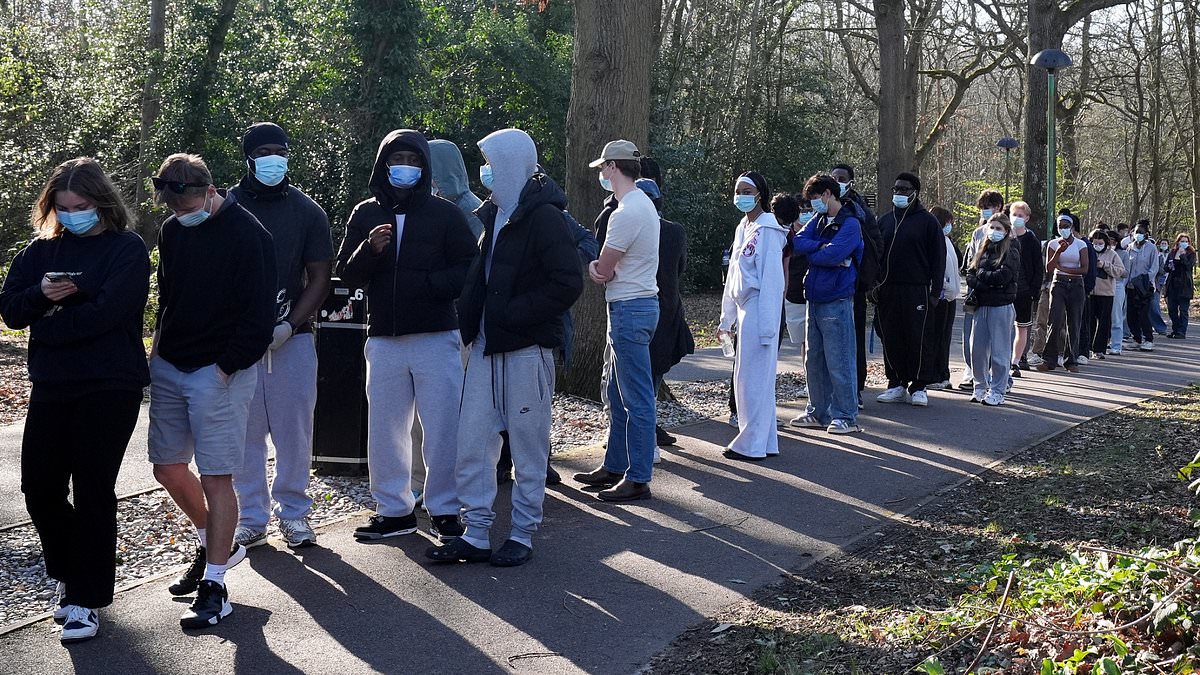
Pupils at two different schools are being treated for meningitis while a student at a third school has died, amid fears of a fresh outbreak of the life-threatening infection. The UK Health Security Agency (UKHSA) confirmed two young people in Reading, Berkshire, are undergoing treatment.One attends Reading Blue Coat School, while the other is a pupil at Highdown Secondary School and Sixth Form Centre, the UKHSA said.A third student from Reading, who attended Henley College in Oxfordshire, died earlier this week from the illness.Officials said all three young people were socially connected. In a statement, Henley College said its 'thoughts and sincere condolences are with the student's family and friends at this extremely difficult time'.'We are supporting those affected within our college community and are following the advice and guidance given by the UK Health Security Agency,' it added.'Out of respect for the family, we will not be providing further detail at this time.'The University of Reading said no cases had so far been reported among its students, but urged people to remain vigilant. Pupils at two different schools are being treated for meningitis while one has died, amid fears of a fresh outbreak of the life-threatening infection in Reading, Berkshire. Pictured: Students wait in line outside the sports hall at the University of Kent for vaccines Testing on one of the cases showed it is not the same strain of meningitis B previously seen in outbreaks this year in Kent and Dorset, but further test results are being awaited.Close contacts of the cases in Reading are being offered antibiotics as a precaution, the UKHSA said, before adding that the risk to the public was 'low'. Olivier Picard, chair of the National Pharmacy Association, said: 'This is a tragic case and our thoughts are with the friends and family of those affected.'Pharmacies in the area, including my own, have already seen a very significant increase in demand for vaccination against MenB from worried parents.'Although pharmacies are now carrying more stock than when we saw the outbreak in Kent, this is having to be managed carefully and demand could well exceed what pharmacies currently have in supply.'The JCVI should urgently publish its recommendations for MenB vaccinations and whether this should be extended to teenagers and young adults, in light of these recent outbreaks.''Concerned families should follow closely advice from the UK Health Security Agency who state the risk to the wider public remains low.'Pharmacies stand ready to support public health efforts locally.'Dr Shamez Ladhani, consultant epidemiologist at the UKHSA, told BBC News it was 'really unfortunate' to have three separate outbreaks within such a short period of time. He said: 'Just like Kent was, just like Dorset... it is difficult to know where it is going to go from here,' he said.'Hopefully it will settle down. At the moment, every indication is that there is no increased risk to any of the students in Reading, but the situation is evolving and if that changes we will take action if needed.'In a statement on Thursday, the Hart Surgery in Henley-on-Thames said: 'We have been in contact with the UK Health Security Agency this morning (May 14) regarding the very sad news that a student at Henley College has died with suspected meningococcal disease.'They have confirmed that they are actively contacting those who may be at risk due to a close association with the student involved.'If you have not been contacted by the UK Health Security Agency, then currently you do not require any treatment. Staff and students have been advised they can attend the college as usual.'The number of confirmed cases is very low so there are currently no plans for a local emergency meningitis vaccination programme.' People in Reading are being urged to remain vigilant for symptoms of meningitis. Pictured: A student receiving a vaccination following an outbreak in Kent this year Dr Rachel Mearkle, consultant in health protection at Public Health England, said yesterday: 'We understand that many people will be affected by this sad news and would like to offer our condolences to the friends and family of this student.'Students and staff will naturally be feeling worried about the likelihood of further cases, however meningococcal meningitis requires very close contact to spread and large outbreaks as we saw in Kent recently, are thankfully rare.'We are working closely with partners and have provided public health advice and precautionary antibiotic treatment to close contacts of the cases. Meningococcal disease does not spread easily and the risk to the wider public remains low.'Anyone can get meningitis, and around 300 to 400 cases of meningococcal disease are diagnosed in England every year.'It's most common in babies, young children, teenagers, and young adults.'It needs to be treated quickly so it is important to know the signs and symptoms. They can appear in any order and may not all be present, so seek rapid medical attention if there is ever any concern.'It's most common in babies, young children, teenagers, and young adults.'Signs and symptoms of meningococcal meningitis and sepsis can include a fever, headache, rapid breathing, drowsiness, shivering, vomiting and cold hands and feet. Sepsis can also cause a characteristic rash that does not fade when pressed against a glass.'Chief executive of UK charity Meningitis Now, Dr Tom Nutt, said: 'Everyone at Meningitis Now is deeply saddened and concerned to hear reports of a suspected outbreak of meningitis affecting young people in Reading and the surrounding area, including the tragic death of a young person.'We would urge people to remain vigilant and aware of the signs and symptoms of the disease.'Meningitis can become life-threatening very quickly and early diagnosis and treatment are absolutely vital.'According to Dr Nutt, symptoms can appear in 'any order' and may include a high temperature, severe headache, vomiting, stiff neck, sensitivity to light, confusion, drowsiness, cold hands and feet, severe muscle pain, and a rash that does not fade under pressure.'Teenagers and young adults are among the groups most at risk from meningococcal disease, and the recent outbreak in Kent has shown how quickly cases can emerge,' he added.Andrew Preston, a professor of microbial pathogenicity at University of Bath, said: 'This latest outbreak again has emerged in the college age cohort, like the Kent outbreak.'All current cases appear contained to a well-defined social contact group which enables rapid contact tracing and the administration of antibiotics and vaccination if deemed a necessary precaution.'At the moment, there is no indication of transmission to the wider community, although understandably this will have caused wide concern in the area.'The last outbreak, which occurred in March, left two young people dead and more than a dozen needing hospital treatment.Those cases, which claimed the lives of sixth-form pupil Juliette Kenny, 18, and an unnamed University of Kent student, were linked to a nightclub in Canterbury.Health officials at the time described the cluster of infections as 'very unusual', adding that they were trying to work out if meningitis had become more transmissible.
Meningitis cases found at two schools in Reading after student dies in new outbreak
Full Article
Original Source
Read the full article at Dailymail →KhanList aggregates and links to publicly available news content. We do not host full articles from third-party sources. Always verify important information with original sources.