
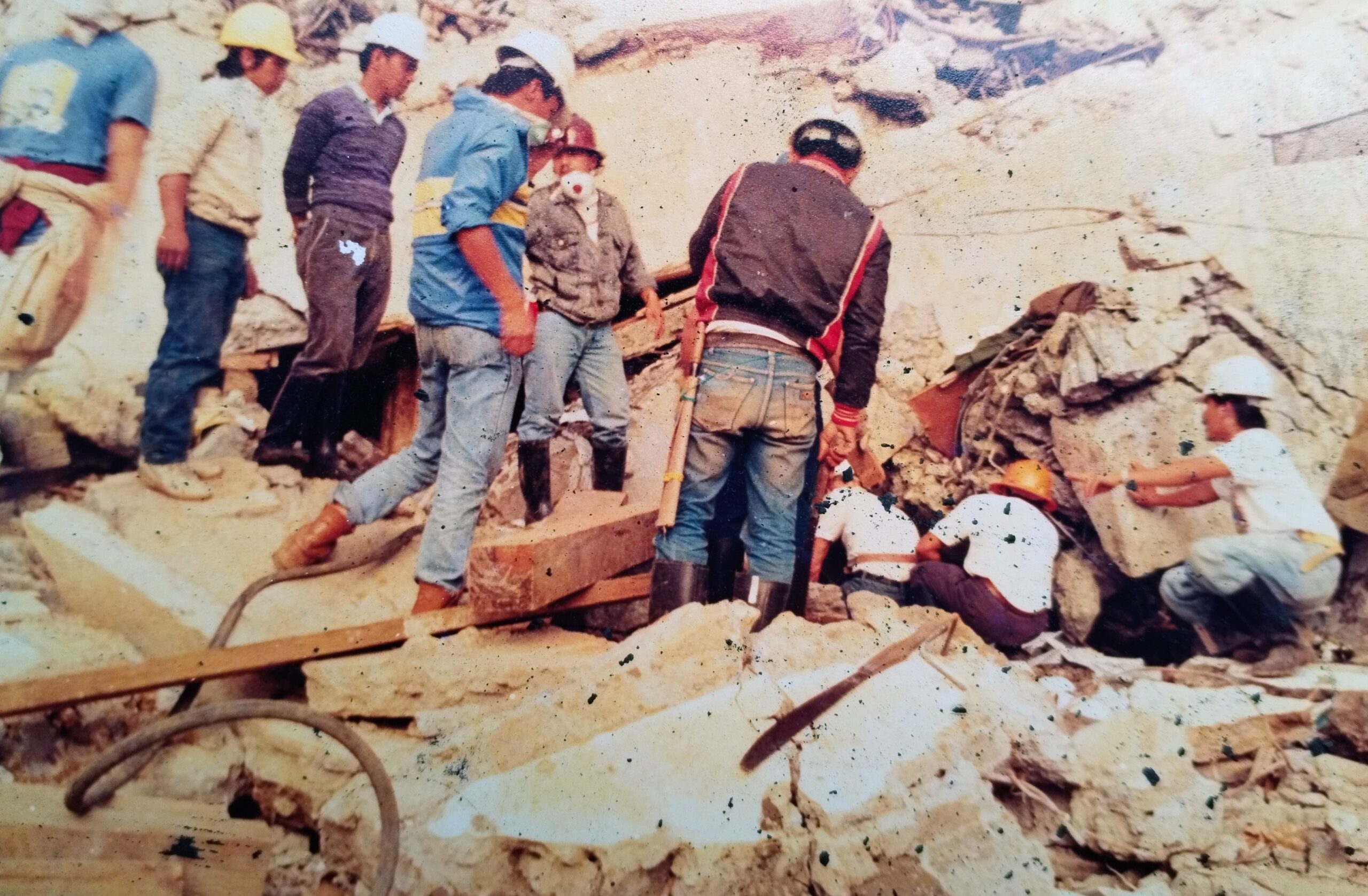
FIRST RESPONDERS In this photo taken by the late Inquirer correspondent Toots Soberano, mine workers, Philippine Military Academy cadets and residents volunteer to dig through the rubble of Hyatt Terraces Baguio to search for survivors after a magnitude 7.8 earthquake devastated Baguio City on July 16, 1990. BAGUIO CITY, Philippines — The city government is putting up a memorial recalling not just the destruction of Baguio but also to symbolize the community insights, ideas and reflections that helped it after the July 16, 1990, earthquake toppled buildings and injured or killed more than a thousand people, including students and tourists. Mayor Benjamin Magalong, who reinstated the city government’s annual earthquake commemoration on Thursday, marking the 36th year of the tragedy, led a groundbreaking ceremony for either a bust or a symbolic sculpture at the City Hall park. Article continues after this advertisement Magalong said the key message of the revival of a quake memorial is to demonstrate how community resilience can reshape society. READ: Lessons from 1990 Luzon quake Baguio’s public commemoration rites were stopped in 2013 to help residents heal instead of dwell on the tragedy that many young residents today have never experienced, said Councilor Peter Fianza, a former city administrator. That was the period when “resiliency” became a local buzzword to emphasize the public’s role in restoring Baguio, he said. Difficult rebuilding Despite the trauma in 1990, the community stepped up to plan for the restoration of this American-built city. Movement at the Digdig Fault triggered the magnitude 7.8 quake felt by residents at close to 4:30 p.m. on July 16 that year. The provinces of Pangasinan, Nueva Ecija and many other Luzon areas also felt the impact of the quake. READ: Grim memory of 1990 Luzon quake stays with survivor Article continues after this advertisement The 54-second ground rumbling tore off roads and destroyed houses and buildings, which was best represented by photos of the now-iconic collapse of Hyatt Terraces Baguio. Baguio’s rebuilding followed the cues of residents, civic leaders and even activists who participated in the congress convened by nongovernmental organizations that drew up a policy framework to control overdevelopment and to preserve Baguio’s natural resources. Article continues after this advertisement The rebuilding plan was so detailed it envisioned a garbage collection system, influenced people to form a no-gambling movement and a regreening crusade, and which advocated for a disaster response mechanism that now exists today. Baguio’s current redevelopment projects, such as the modernization of its wastewater system, continue many of the concepts for “building back properly” after the devastation as espoused during that congress. For a brief moment, everyone in Baguio including its government were shell-shocked and responders were initially composed of people who survived the calamity and who returned to help out, many Baguio officials recalled. Baguio Rep. Mauricio Domogan, now 79, said people at the time did not have smartphones nor access to the internet, and were literally isolated from each other at the time much as Baguio was cut off after massive landslides blocked all the major routes to the city. Only the Loakan runway was accessible for food aid and international rescue teams. But Benguet miners, cadets of the Philippine Military Academy, and residents made headways at locating survivors trapped in buildings. Relevance These accounts are what today’s youth still need in order to understand why the quake continues to be relevant to their generation, said Magalong, then a police officer and who was in downtown Session Road when the city was rocked by intense shaking. The earthquake helped promote an idea pushed by the late city architect Joseph Alabanza to combine Baguio with its Benguet neighbors, La Trinidad, Itogon, Sablan and Tuba (BLIST) into a metropolis so investments can be reallocated to these municipalities while easing overdevelopment and crowding in the city. This concept was turned by European experts into a draft urban development plan which has now become the economic collaboration called Metro BLISTT that includes Tublay town. It now functions under a metropolitan authority. The same experts drew up an urban master plan for Dagupan City which suffered liquefaction that sank or weakened many of its buildings following the 1990 earthquake. Your subscription could not be saved. Please try again. Your subscription has been successful. The quake also gave the late lawyer Damaso Bangaoet and his friends the idea to develop the Baguio Flower Festival in 1995 to attract tourists back. The festival, popularly known as “Panagbenga,” is still a major crowd-drawer. /cb
Memorial to 1990 quake soon to rise in Baguio
Full Article
Original Source
Read the full article at Newsinfo →KhanList aggregates and links to publicly available news content. We do not host full articles from third-party sources. Always verify important information with original sources.