
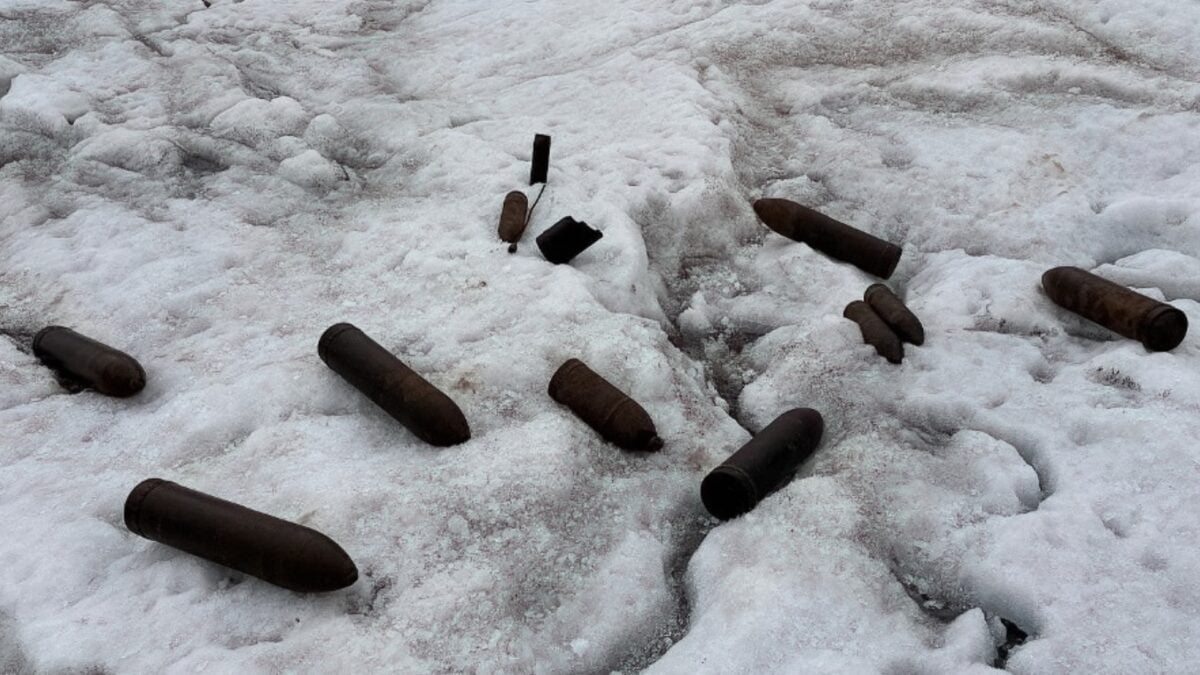
Glaciers in the Dolomites are rapidly retreating as the climate warms, and their disappearance is exposing historical artifacts long buried beneath the ice—including scores of unexploded bombs dating back to World War I. Over the summer, the Italian Army’s Julia Alpine Brigade removed and defused more than 250 explosives that resurfaced at high-altitude and glacial locations across the Trentino Alto Adige region, reports Italy’s leading news agency, the Agenzia Nazionale Stampa Associata (ANSA). In a statement released on September 10, the army shared several photos of personnel navigating treacherous terrain as well as some of the century-old bombs they had recovered. The ANSA report, translated from Italian into English, states that the weapons included 18 Italian 75-millimeter artillery shells and 37 French-made Thevetot mortar shells, which the Royal Italian Army also used at the time. According to The Guardian, the weapons were left in the mountains after the White War, a conflict fought between the Austro-Hungarian army and Italian troops from 1915 to 1918. An estimated 150,000 to 180,000 soldiers died, but only about one-third perished in combat. The rest succumbed to the harsh alpine conditions, dying as the result of avalanches, landslides, frostbite, or hypothermia. Members of the Italian Army’s Julia Alpine Brigade measure a resurfaced WWI warhead in the Dolomites. Image credit: Julia Alpine Brigade, Esercito Thawing out history In the late 1950s, the Dolomites hosted 33 glaciers, covering a total surface area of 3 square miles (8 square kilometers). Today, only 12 remain. From the 1980s to 2023, glacial area in this alpine region declined a staggering 56%, and it could disappear within the next few decades. Europe endured a historically warm summer this year—even at high altitudes. In Italy, the environmental protection agency for the Piedmonte Region, which covers much of the western Italian Alps, confirmed that summer 2026 was the region’s hottest on record. So did Trentino, which includes the western Dolomites. And in South Tyrol, which includes a significant portion of the rest of the Dolomites, summer 2026 tied the heat record set in 2003. It’s no wonder so many long-frozen warheads resurfaced in these mountains. But as The Guardian notes, rapid glacial retreat has been exposing WWI artifacts abandoned in the Dolomites since the 1990s, including other weapons, cave shelters, sleds, letters, diaries, and even uniformed corpses. “It is very much a consequence of global heating,” Stefano Morosini, a professor at the University of Bergamo and the coordinator of heritage projects at Stelvio National Park, where some of the explosives were also found, told the publication. “In recent years, at the end of each summer, these dangerous artifacts emerge and each year there is a higher number. They have been conserved by the ice for more than 100 years. Some had already exploded but many hadn’t, so now when they re-emerge, they are very, very dangerous.” Army personnel safely detonate these weapons so that they no longer pose a threat. They urge hikers not to touch them and to immediately report any they come across to the authorities. According to The Guardian, the artifacts will eventually go on display at a White War museum set to open in Bormio in June 2027.
Melting Glaciers Expose More Than 250 Unexploded WWI Bombs in the Dolomites
Full Article
Original Source
Read the full article at Gizmodo →KhanList aggregates and links to publicly available news content. We do not host full articles from third-party sources. Always verify important information with original sources.