
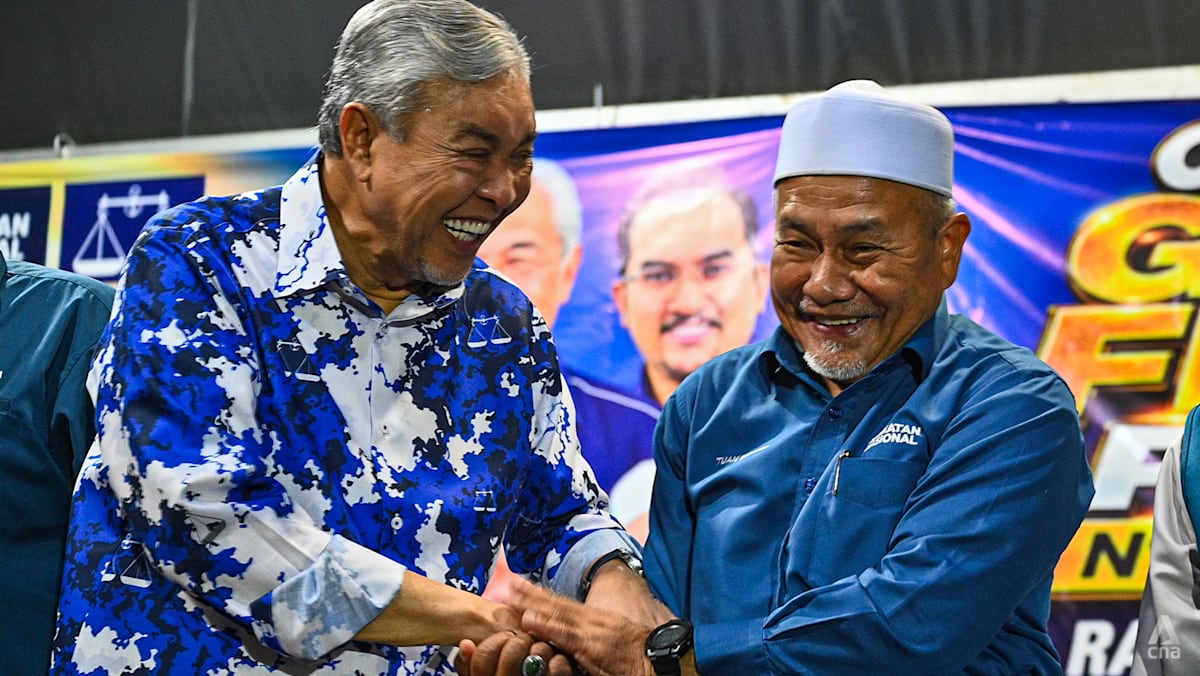
MELAKA: The commanding victory of the Barisan Nasional-Perikatan Nasional (BN-PN) alliance in the Melaka state election has highlighted its strong appeal among Malay voters and pointed the way to possible success at Malaysia’s next general election.But beyond the landslide victory, the results also point to an increasingly polarised electorate, with the Malay-Muslim unity narrative championed by the UMNO and PAS parties not only consolidating Malay support behind BN-PN but also appearing to drive non-Malay ethnic minority voters towards the Democratic Action Party (DAP).Analysts say the contrasting voting patterns could further entrench Malaysia’s ethnic political divide ahead of the next general election, the country’s sixteenth (GE16), creating a particularly difficult challenge for Prime Minister Anwar Ibrahim’s Pakatan Harapan (PH) coalition, which relies on a multiracial support base.Although Melaka accounts for only a small fraction of Malaysia's parliamentary constituencies, the result offers another test of a new electoral alliance that has already delivered victories in neighbouring states. BN and PN swept 24 of the 28 seats in the Melaka state assembly in Saturday’s (Nov 14) polls, with BN winning 21 and PN securing three, while PH retained just four seats, all won by DAP. BN and PH are allies in Anwar’s federal government, but the two coalitions have clashed in recent state polls following the former’s decision to work with PN under a Malay unity pact. Political analyst James Chin said the result exemplified a growing wave of support by the Malay community for BN-PN, adding that the "writing was on the wall" for PH ahead of subsequent electoral contests. The arrangement reflects Malaysia's increasingly fluid coalition politics: BN helps keep Anwar's government in power nationally, but it has joined forces with the opposition PN in state elections, putting it in direct competition with the prime minister's own PH coalition. Although the combined BN-PN tally represents a gain of only one seat from the 2021 election, when the two coalitions contested separately, larger winning margins in many Malay-majority constituencies suggest their electoral cooperation has paid dividends. Melaka Barisan Nasional chairman Ab Rauf Yusoh (left), Vice president of PAS (centre) Idris Ahmad and BN chairman Ahmad Zahid Hamidi celebrate as BN secures victory in the Melaka state election on Nov 14, 2026. (Photo: CNA/Zamzahuri Abas) The results, which largely matched pollsters’ predictions, underscore the effectiveness of the pact in consolidating Malay votes and avoiding the three-cornered contests that had previously benefited PH.The Malay-Muslim unity campaign seeks to bring together parties that have historically competed for the support of Malaysia's ethnic Malay majority, most of whom are Muslim. Supporters argue that political cooperation would strengthen Malay-Muslim representation, while critics fear it could deepen ethnic and religious divisions. However, the outcome presents a paradox: The same Malay-Muslim unity campaign that has strengthened BN-PN’s hold over Malay voters also appears to have reinforced non-Malay support for DAP, leaving Anwar’s Parti Keadilan Rakyat (PKR) and Parti Amanah Negara (Amanah) increasingly squeezed. The failure of PKR and Amanah to capture a single seat highlights the coalition’s difficulty in appealing to Malay voters, while the complete rout of former prime minister Muhyiddin Yassin’s Parti Pribumi Bersatu Malaysia (Bersatu) raises questions over whether its tentative cooperation with PH can offer any meaningful electoral advantage.Political analysts said that the Melaka results could intensify pressure on Anwar to call an early general election, although the prime minister has every incentive to delay the polls and allow BN-PN’s momentum to dissipate. GE16 must be called by February 2028. Azmi Hassan, who is senior fellow at the Nusantara Academy for Strategic Research, told CNA: “It will be some time yet before GE16. Even though BN and PN will want it to be held as soon as possible to bank on their momentum, the final word (on when) will be the prime minister’s.” The prime minister “will hold the fort for as long as he can as PH is in a weak position,” he added. BLUE WAVE ‘UNBEATABLE’ IN MALAY-MAJORITY SEATSThe analyst Chin said the outcome in Melaka was widely anticipated, describing the Malay electoral wave as further evidence of the formidable strength of the BN-PN partnership.Chin said the results demonstrated that votes were largely transferable between the two coalitions, with supporters for BN and PN likely casting ballots for each other’s candidates, making their electoral cooperation a potent weapon against PH.“They are unbeatable as a combo,” added Chin, who is Professor of Asian Studies at the University of Tasmania and Senior Research Associate at Malaysia’s Tun Tan Cheng Lock Institute of Social Studies. The Election Commission reported a voter turnout of 71.77 per cent, with political analyst Azmi attributing the relatively strong participation largely to Malay voters energised by the campaign’s emphasis on Malay-Muslim unity. The 2021 state polls saw an overall turnout of 65.85 per cent. According to data estimates released by ElectionData.MY, 78.1 per cent of the Malays came out to vote, while only 58.8 per cent of the Chinese and 58 per cent of the Indian community cast their ballots. For the 2021 polls, Malay turnout was 72.3 per cent, as published by Malaysia Dateline. Azmi said the mobilisation of Malay voters, compared with what he assessed to be weaker participation among non-Malays, was a key factor in the alliance’s victory. “The Malays came out in droves … and that made a difference,” he told CNA.The strength of the so-called “blue wave” was particularly evident in UMNO’s traditional rural strongholds, where several prominent leaders secured comfortable victories. Blue refers to the signature colours of both BN and PN flags. Melaka Barisan Nasional chairman Ab Rauf Yusoh (left) and BN chairman Ahmad Zahid Hamidi celebrate the coalition's victory in the Melaka state election on Nov 14, 2026. (Photo: CNA/Zamzahuri Abas) Melaka Chief Minister Ab Rauf Yusoh retained his Tanjung Bidara seat with an 8,615-vote majority, a dramatic increase from his razor-thin 364-vote majority in 2021.UMNO’s firebrand youth chief Muhamad Akmal Saleh won Merlimau by 8,724 votes, while the popular Mohd Noor Helmy Abdul Halem secured Duyong with a majority of 10,040 votes, having clinched the seat by just 200 votes in 2021. The alliance also demonstrated its strength in more ethnically mixed constituencies, with BN’s MCA candidate Lim Ban Hong winning Kelebang by 7,035 votes. Lim won by just 876 seats in 2021. Perhaps the most significant casualty was Amanah vice-president and former Melaka chief minister Adly Zahari, who lost Bukit Katil to PAS candidate Mohd Ridzuan Sarif by 6,607 votes. Parti Amanah Negara candidate for the Bukit Katil state constituency Adly Zahari delivers a speech during a Pakatan Harapan (PH) election campaign event in Melaka on Nov 10, 2026. (Photo: CNA/Zamzahuri Abas) His defeat was particularly telling given that Adly was among PH’s most recognisable Malay leaders in the state and that PM Anwar himself had campaigned for him on the ground on at least two occasions. Chin predicted that for the upcoming General Election, the BN-PN alliance could apply the same formula, and easily sweep Malay-majority constituencies in Peninsular Malaysia and secure between 100 and 105 parliamentary seats at GE16, putting it within striking distance of the 112 seats needed for a simple majority.Such a result would leave the pact well-positioned to seek the backing of parties from Sabah and Sarawak to form the next federal government.But analysts cautioned that the alliance’s greatest challenge will be when negotiations between UMNO and PAS begin over who should contest parliamentary seats in Malay heartland areas where the latter have been dominant. Syaza Shukri, a political scientist at the International Islamic University Malaysia, said the Malay community remained enthusiastic about penyatuan ummah, or the Muslim unity agenda, which could sustain support for the pact even if GE16 is held late next year.“(The) main concern is when it comes to seat negotiations. Yes, the people are happy to vote for them, but can the leaders agree to an acceptable seat arrangement, especially in SG4?”SG4 refers to the four PAS-led northern states of Kelantan, Terengganu, Kedah and Perlis, where negotiations could prove especially difficult as UMNO seeks to reassert its dominance within the partnership.Azmi similarly pointed out that seat negotiations in the Johor, Negeri Sembilan and Melaka state elections had been relatively straightforward because BN was clearly the stronger partner in those states.But the dynamics would be markedly different in PAS strongholds, as well as states such as Pahang and Perak, where both parties have substantial political interests.“A failure to reach an acceptable compromise could threaten the alliance’s cohesion and undermine the electoral gains it has made so far,” said Azmi. PH RETAINS NON-MALAY SUPPORT BUT BERSATU OFFERS LITTLE HELPFor PH, the retention of four seats by DAP offers some consolation, suggesting that the coalition continues to command significant support among non-Malay voters despite successive electoral defeats.DAP held Ayer Keroh, Kesidang, Kota Laksamana and Bandar Hilir, all of which are ethnic Chinese-majority seats, although its winning margins narrowed in some constituencies compared with 2021.But analysts say DAP’s ability to retain its traditional strongholds also reflects a growing unease among Chinese voters over the Malay-Muslim unity agenda advanced by BN-PN.Political analyst Oh Ei Sun of the Singapore Institute of International Affairs said concerns over the campaign’s emphasis on Malay unity, particularly the prominent role played by Islamist party PAS, had likely encouraged Chinese voters to rally behind DAP.“The grand Malay unity narrative has manifested excellently in Johor, Negeri Sembilan and now Melaka. These are UMNO strongholds, but PAS is also now making their presence felt, gaining footholds in these states where previously they struggled in constituencies along the west coast of Peninsula Malaysia,” said Oh. Oh further added that this presents a paradox for PH. While the Malay unity campaign may help DAP defend its strongholds by galvanising non-Malay voters, it simultaneously makes it harder for PKR and Amanah to win the Malay support needed to capture ethnically mixed constituencies.He also warned that some ethnic minorities might instead choose to vote for Bersama or elect not to cast their vote. “PKR and Amanah will struggle to gain any Malay votes in the upcoming election because the grand Malay narrative is taking hold …. It will lead to a more polarised Malaysia,” said Oh. Syaza said she saw few effective options for PH to overcome the appeal of Malay-Muslim unity, even if Anwar were able to deliver on promised reforms and improve economic conditions.“I don’t think it’s enough to counter the Malay unity agenda,” she said. Parti Pribumi Bersatu Malaysia (Bersatu) president Muhyiddin Yassin gestures during an interview with CNA in Muar, Johor on Jul 5, 2026. (Photo: CNA/Zamzahuri Abas) The poor performance of Bersatu has further complicated Anwar’s efforts to broaden PH’s appeal among Malay voters.Despite informal cooperation that saw PH avoid contesting four constituencies where Bersatu fielded candidates, Muhyiddin’s party failed to win any of the seven seats it contested, losing its deposits in five after failing to garner enough votes.Its strongest showing came in Pantai Kundor, where candidate Asmah Samat secured 6,112 votes against BN’s 8,864, but the party failed to make a meaningful impact elsewhere.In Bemban, Bersatu managed just 2,109 votes, finishing behind Bersama, which garnered 4,140 votes, and PN’s victorious candidate, who secured 11,881 votes.Azmi said Bersatu had failed to demonstrate that it could attract sufficient Malay support to become a “reliable electoral partner” for PH, casting doubt on the value of any future cooperation.Syaza, however, offered a more measured assessment, saying Bersatu could still target constituencies in states such as Selangor if it developed a clearer political identity.“Bersatu needs to figure out if they want to re-brand and aim for a wider pool of voters. This could work if it forms a pact with others, others its just splitting more votes and BN-PN will benefit,” she said. For Bersama, meanwhile, another election without a single victory represents a setback to its ambitions of emerging as a credible alternative to established political parties.The Rafizi-led party contested 16 seats but failed to win any, retaining its deposit only in Bemban, where it captured 22.5 per cent of valid votes.Chin said Bersama had damaged its credibility by contesting in the Johor and Melaka state elections without securing a victory, arguing that it should have concentrated its resources on GE16.“But they still have a chance because the core support of its leaders like Rafizi, Wong Chen and Lee Chean Chung is in the Klang Valley where they have established political bases,” he added. WHAT’S NEXT FOR BN-PN, PH? Attention will now turn to the timing of GE16, with BN-PN likely to seek an early election to capitalise on its string of victories in the Johor, Negeri Sembilan and Melaka state elections.But Anwar, whose government has been weakened politically by PH’s successive defeats, has little incentive to call a general election while the Malay unity wave remains strong.Chin said the prime minister was likely to delay the polls for as long as possible, forcing BN and PN to maintain their uneasy partnership for another year or longer.He added that the immediate electoral battleground will be Sarawak, which goes to the polls on Dec 12.But Chin stressed that the political landscape there is markedly different, with the state dominated by Gabungan Parti Sarawak (GPS), and UMNO and PAS have limited presence. The contest is therefore unlikely to provide a comparable test of the BN-PN alliance’s strength.For BN-PN, the coming months will instead be a test of whether it can preserve the momentum of its Malay unity campaign while resolving the potentially divisive question of seat allocations.Complicating matters is BN’s continued participation in Anwar’s federal unity government, even as it strengthens its electoral cooperation with opposition bloc PN in preparation for the next general election.Syaza told CNA that it is unlikely that BN would withdraw its support from Anwar to force an early election in the short term, as they have stopped short of doing this so far. “GE might still have a long way to go, and BN-PN will use the time to negotiate seats and consolidate their alliance,” added Syaza. “All the threats to pull support are just wayang (theatre),” she said.
Melaka result bolsters Malay political alliance, posing tougher challenge for Malaysia PM Anwar ahead of GE
Full Article
Original Source
Read the full article at Channelnewsasia →KhanList aggregates and links to publicly available news content. We do not host full articles from third-party sources. Always verify important information with original sources.