
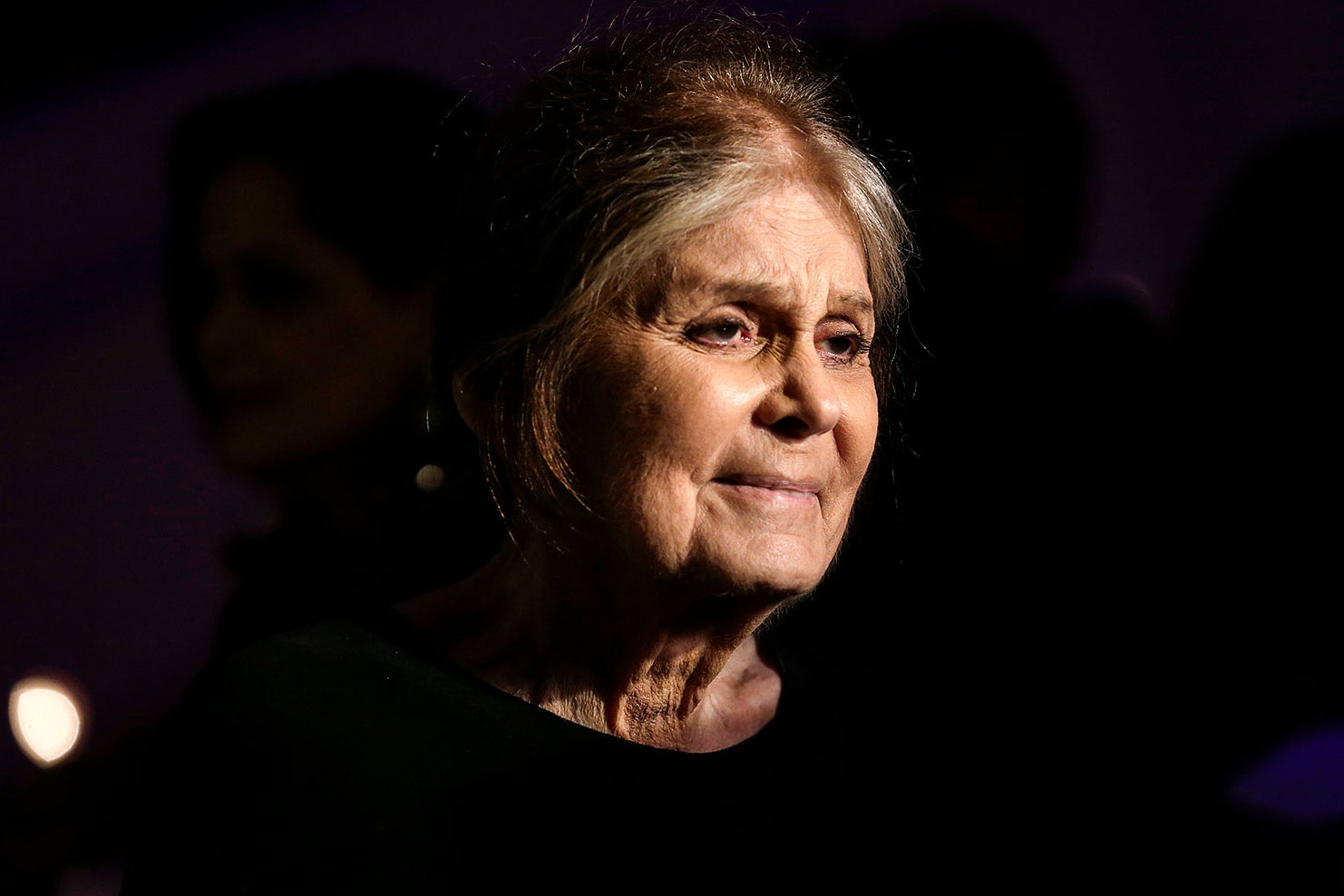
Politics What Meeting Gloria Showed Me Steinem was an icon. She also understood the movement. John Lamparski/Getty Images Sign up for the Slatest to get the most insightful analysis, criticism, and advice out there, delivered to your inbox daily. I am not the kind of person who does well meeting celebrities. Generally, I don’t recognize them. Alternatively, I embarrass myself. But there is one encounter that I remember as nothing but glorious: meeting Gloria Steinem. It was back in 2015 when she was touring her book, My Life on the Road, and I remember, after seeing her speak and buying a copy, the experience of taking a picture with her with some of my friends. What surprised me—delighted me in fact—is that it ended up not only being not bad, but actually veering toward good. I remember distinctly the way her body language seemed to convey what no words could: I know you’re getting a kick out of this, her smizing eyes showed, but just so you know, I get a kick out of you, too. It was a rare reciprocal relationship in an interaction otherwise distorted by fame—we loved her because she was Gloria Steinem, and she loved us because we were bright-eyed young women. Our smiles reflect the possibility of the time before Donald Trump beat two women to take and retake the presidency—her great and successful life’s work had been to make our lives less encumbered. In that moment, our eagerness must have seemed like her reward. The book I bought that day is dedicated to the doctor who helped Steinem get an abortion back in 1957, a decade before they were legal in the U.K., where it was performed. Steinem was on her way to India, and her doctor, she writes, made her promise two things: that she would keep his identity secret and that she would do what she wanted with her life. “I’ve done the best I could with my life,” she writes. “This book is for you.” A few years later, I found myself completely engulfed in researching the fight for abortion rights in the United States—it was the spring of 2022, and I was hosting a season of Slate’s narrative history podcast Slow Burn. It was a strange time to be reaching out to women who had been deeply involved in that fight—everyone knew that the Dobbs decision was coming that June, and even before the opinion leaked in May, most people correctly predicted it would overturn the right to abortion that Roe v. Wade had secured in 1973. As I spoke to the women who had worked, in the early 1970s, to organize and pursue the right to abortion, I realized something chilling. Their battle had played out just 50 years ago—it was close enough to me in time that I could call these people up, email with them, invite them into studios for interviews. When they had been doing this exact work, back in the 1970s, there was another landmark women’s rights battle that had been won just 50 years prior as well—that would be the suffragists’ fight for the right to vote. The experience of unpacking history often makes things feel more real, but this particular realization was simply uncomfortable. People talk all the time about the disturbing recency of the law that cleared the way for women to open their own credit cards (that one was 1974), but this leapfrog from the present—with Dobbs, and Trump, and the Tate brothers, and all the rest—through Roe and back to suffrage is the timeline that haunts me. I didn’t get to speak with Steinem for my project—her office politely declined due to her schedule, which even in her late 80s was packed to the brim. But she came up again and again in my research—her presence hung over everything. She was rumored to have shown up at court for the sentencing of the first woman convicted of manslaughter for having an illegal abortion (I never could confirm if she had). She was the journalist who had covered the first speak-out event in New York, in which women shared their abortion stories, a day that sparked similar ones all over the country and brought such conversations into the open. Her work directly inspired the women who sued their home state of Connecticut for the right to abortion, a case that preceded and informed Roe. Steinem passed away in her home in New York on Wednesday at the age of 92. Her life nearly spanned that remarkable 100 years between women getting the right to vote, gaining the right to abortion, and then losing the right to abortion. That story is officially 102 years long—with the right to vote having been secured just 14 years before Steinem’s birth in 1934 (her grandmother on her father’s side was a staunch suffragette who had worked on the issue). On this morning of learning the news of her death, it is impossible not to think about the unfathomable trajectory of the fight she dedicated most of her life to—and the turn it has taken over the past decade or so. It’s easy to feel like the loss of Steinem is just one more tragedy amid this nightmarish nationwide regression we’ve all been pulled through. Sure, she was, for decades, the name and face most synonymous with the women’s movement, and with radical—she insisted on qualifying it—feminism. But I think her attitude that day on her own book tour matches something she said about her place in the campaign to advance women’s rights: I think the fact that I’ve become a symbol for the women’s movement is somewhat accidental. A woman member of Congress, for example, might be identified as a member of Congress; it doesn’t mean she’s any less of a feminist but she’s identified by her nearest male analog. Well, I don’t have a male analog so the press has to identify me with the movement. I suppose I could be referred to as a journalist, but because it is part of a movement and not just a typical magazine, I’m more likely to be identified with the movement. There’s no other slot to put me in. We all put her in this role for so long, partly because she was a talented writer and organizer and speaker, and partly because her characteristic glamorous hair and glasses and belts made it easy to slot her into “leader of a movement.” We all needed her to be that leader and that symbol. She took it on with the aplomb of someone who knew how necessary the work was, and now we’ve lost her at one of the worst possible moments. Yet, she clearly believed that as necessary as she felt to us, it was us who were perhaps necessary to her. We young women standing in front of her fawning and asking for a photo were the future of her work. She had spent her life trying to ensure that we had the power to make our lives exactly what we wanted them to be. Now it’s up to us to shape the arc of the next century. Abortion Feminism History Women
Meeting Gloria Steinem Was the Best Celebrity Interaction I Ever Had. Now I Understand Why.
Full Article
Original Source
Read the full article at Slate →KhanList aggregates and links to publicly available news content. We do not host full articles from third-party sources. Always verify important information with original sources.