
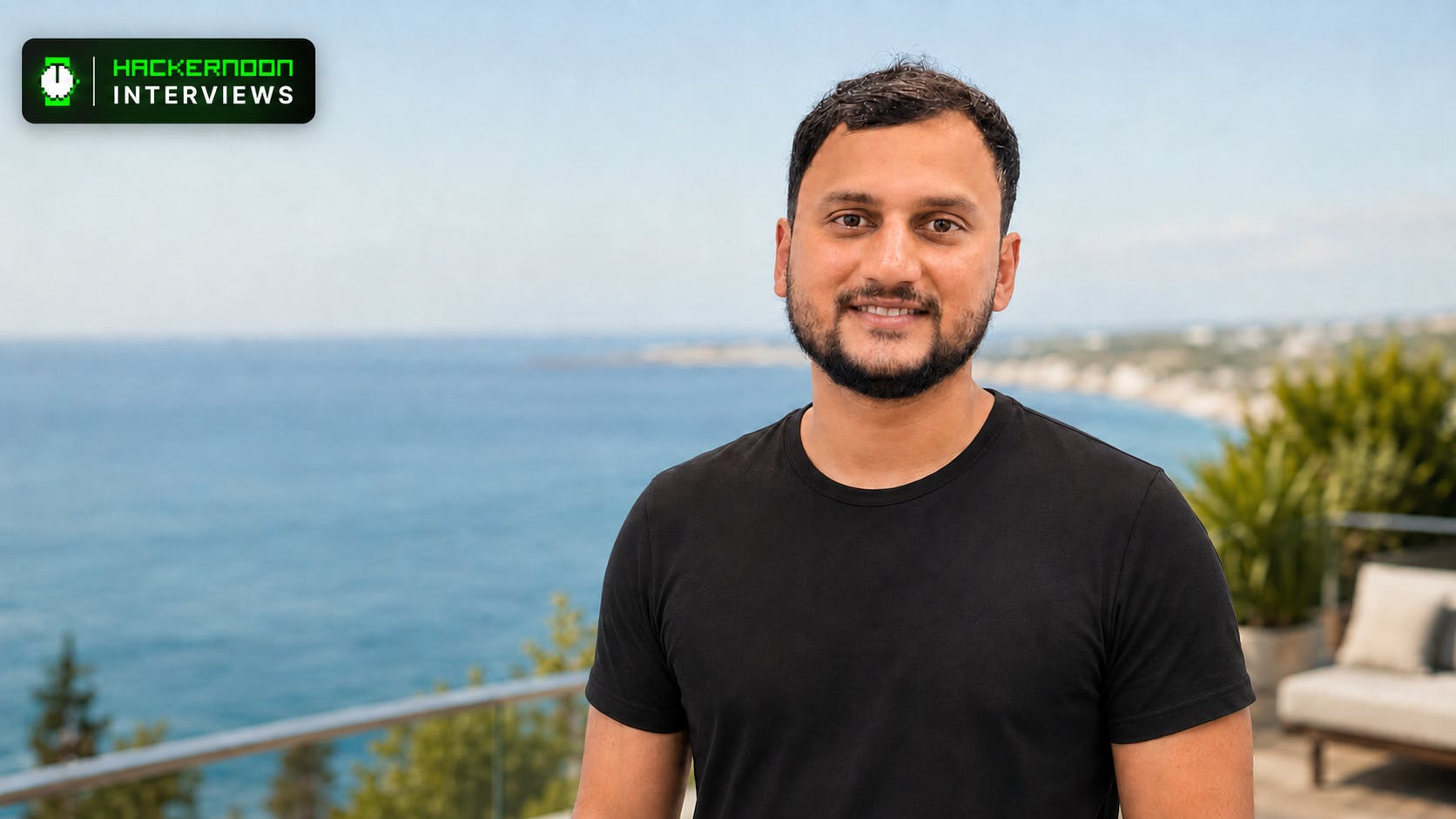
Welcome to HackerNoon’s Meet the Writer Interview series, where we learn a bit more about the contributors that have written some of our favorite stories. Let's start! Tell us a bit about yourself. For example, name, profession, and personal interests. I'm Veera Ravindra Divi, a technology lead on the Agentic AI and distributed systems side at Amazon. Day to day that means large-scale platforms — the kind where an outage gets measured in other people's money, which does a lot for your sense of humility. About eleven years in now. I started in investment banking writing low-latency trading systems, moved into enterprise retail and large-scale commerce platforms, and somewhere in the middle of that got pulled into agents and never really came back out. Outside the job I publish research, mostly on LLM orchestration and multi-agent systems — and I created Assevra AI, an open-source reliability scorecard for AI agents. What was your latest Hackernoon Top story about? It was "Stop Letting Your AI Agents Call Each Other Directly." The idea came from a very ordinary failure: a multi-agent workflow where each agent called the next and waited. It demoed beautifully — then one afternoon a single agent got stuck in a retry loop and just… sat there, holding everything upstream behind it. Throughput quietly went to zero, no errors on the dashboard, and when someone asked what the agents had actually said to each other, we had nothing but a stack trace. The piece argues that a synchronous agent mesh is really a distributed monolith in an LLM costume — the same tight coupling and cascading failures we learned to stop building a decade ago. The fix is old and boring: don't let agents call each other, put a log in the middle. They publish events, others subscribe, and durability, replay, and an audit trail basically fall out for free. What surprised me was that people connected with the 3 a.m. version of that story more than with the architecture argument underneath it. That told me something about how this stuff actually lands. Do you usually write on similar topics? If not, what do you usually write about? Yeah, that one's very on-brand for me. Almost everything I write circles the same question: how do you let AI agents actually do things, and still trust the result? So it's a lot of multi-agent systems, AI-assisted engineering, and the unglamorous parts — testing, guardrails, reliability, the plumbing. Basically the distance between a demo that wows everyone and something you'd actually put in front of real users. The agent-mesh piece is just one corner of that. The two that travelled furthest ask the same question through different doors — "Vibe Coding Gets You 80% There" asks it about code generation, and "Why Every AI Company Suddenly Wants a Forward Deployed Engineer" asks it about the last mile, about who makes the thing work inside one real business with real, messy data. Great! What is your usual writing routine like (if you have one?) For all the systems talk, my routine is refreshingly low-tech. Most of the writing happens early mornings or late nights, in the gaps around work. I'll sit with an idea for a few days and argue with it in my head, and I only start writing once I can say it in one sentence. First drafts are messy — I fix them the next morning. Usually a piece only clicks once I've found the small, concrete story to hang it on, like that 3 a.m. failure. Being a writer in tech can be a challenge. It's not often our main role, but an addition to another one. What is the biggest challenge you have when it comes to writing? The routine's the easy part — the hard part is cutting. I always want to add one more caveat, one more edge case, and the pieces that actually work say one thing clearly and trust the reader with the rest. The other honest challenge is time: writing isn't my main job, so every session has to earn its place, and some weeks it just doesn't happen. What is the next thing you hope to achieve in your career? Beyond the writing, the thing I really care about is making this reliability stuff real. I'd love for Assevra AI to become something teams genuinely reach for to check their agents before shipping, and to keep publishing and speaking in a way that nudges the field toward "measure it" instead of "hope it's fine." Nothing flashy — just useful. Wow, that's admirable. Now, something more casual: What is your guilty pleasure of choice? Ha, okay — casual. Comment threads. I'll lose forty minutes to two strangers arguing about a framework I am never going to use, and I'll tell myself it counts as research. The honest part is that I've usually picked a side by the second reply and I keep reading anyway. Sports, more or less all of it. Cricket first — that one's lifelong — and somewhere along the way in the US I picked up college football too, which I genuinely did not see coming. But the real answer is playing, not watching. I get a game of cricket in most weekends, and that's my reset button. A few hours where the furthest ahead I'm thinking is the next ball, and I come back with actual energy rather than just slightly less tiredness. And walks with my wife after dinner are just routine at this point. That's usually where the ideas turn up — the writing only catches up later. What can the Hacker Noon community expect to read from you next? More corners of that same map — how agents talk to each other, how you evaluate them honestly, and the security side, since an agent with tool access is basically an insider. Practical pieces you can use on Monday, with the occasional deeper one tied to my research. What's your opinion on HackerNoon as a platform for writers? It's the platform I keep coming back to, and I've thought about why, because it isn't only the reach. It doesn't flatten your voice. You can take a real technical position, argue it in your own words, and it comes out the other side still sounding like you instead of like a house style. The editing makes the piece better without making it generic — that's a much harder thing to pull off than it sounds, and most places don't manage it. There's no paywall between the writing and the reader. Whatever I publish reaches whoever needs it, including the engineer in another time zone who finds it at 2 a.m. debugging the same thing I was debugging. That matters more to me than any distribution number. And this one doesn't get mentioned enough: HackerNoon actually defends the people writing for it. Their crawler policy blocks unlicensed AI training outright, and asks anyone citing a story to name the author and link back to the original. In 2026, a platform quietly holding that line for its writers is not a small thing. Then there are the readers — technical, opinionated, and quick to tell you exactly where you're wrong. That's the fun part. It still feels like the writer's story rather than the platform's, and that's rarer than it should be. Thanks for taking the time to join our "Meet the writer" series. It was a pleasure. Do you have any closing words? Thanks to the HackerNoon team, and to everyone who read and argued with my work — genuinely, that's the best part of publishing here. If you're building with agents, I'll leave you with the question underneath "Stop Letting Your AI Agents Call Each Other Directly": when this hangs at 3 a.m. and someone asks what the agents were saying to each other, what will you actually have to read? Build it so the answer isn't a stack trace. And come disagree with me in the comments. I usually learn something.
Meet the Writer: Veera Ravindra Divi on Building AI Agents You Can Trust
Full Article
Original Source
Read the full article at Hackernoon →KhanList aggregates and links to publicly available news content. We do not host full articles from third-party sources. Always verify important information with original sources.