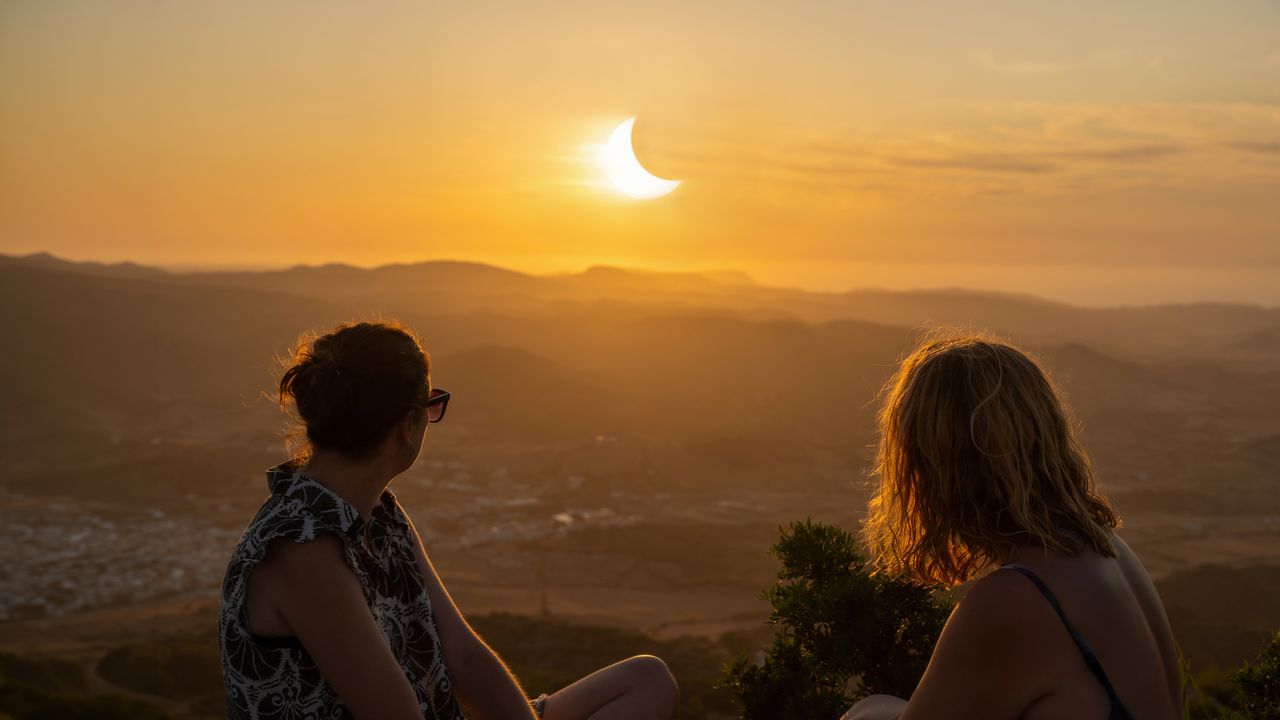
When Koh Joo Beng, an astronomy enthusiast from Singapore, first watched the moon slide between the earth and sun 18 years ago, he didn’t anticipate the impact it would have on his life. “It struck me that eclipses are not just scientific phenomena,” he says, recalling his initial glimpse of the August 2008 eclipse from China. “They are profoundly emotional and spiritual experiences.”Since then, Koh has traveled to see 14 solar eclipses around the world, and even co-authored a book, Chasing Totality: The Complete Handbook for the 2026 Total Solar Eclipse with his son Jared Koh.Umbraphiles chase solar eclipses in pursuit of awe and alignment. UnsplashThis transition from eclipse-curious to avid umbraphile (the name for a person who travels long distances to observe solar eclipses, literally translating to “shadow lover”) is quite common. As I learned after my own taste of totality in 2024, once you see one, you want to see them all.This week’s total solar eclipse on August 12, visible from east Greenland, west Iceland, and Spain, is proving to be no exception—despite its inconveniently slim path. Throngs of travelers—myself among them—are chasing the phenomenon to remote islands and rural towns, booking up flights, hotels, and even celestial-themed raves.Northern Spain alone is expecting an estimated 460,000 overseas tourists, with another 128,000 heading to Iceland. According to data from Amadeus Travel Intelligence, year-on-year flight bookings are up 25% for Spain and Iceland, with areas like Bilbao in northern Spain seeing the largest tourist uptick.I realize that, on paper, traveling overseas and into congestion for an experience that lasts mere minutes (from my northern Spain perch, just over 90 seconds) sounds absurd. To umbraphiles, though, there’s no question: those fleeting minutes under false dusk, when the moon covers all but our sun’s ethereal outer atmosphere, is worth every penny.“There’s nothing like it; you can’t truly understand it until you experience it,” says Minnesota-based astrophotographer Marc Rassel, who’s chased eclipses since 2017 and plans to watch this year’s spectacle from Spain. “The light is strange, everything gets darker, there’s a 360-degree sunset, and the temperature drops. The birds chirp. Once you see that first one, you’re like ‘yep, this is it.’”For those who haven’t experienced the indescribable magic of totality, I talked with numerous fellow umbraphiles to understand this specific sensation of awe—plus, gathered intel on where they’re planning to watch this week’s event, as well as the future eclipse trips they’re looking forward to.See the sun like you never haveMost of us enjoy the sun as it rises or sets, but totality introduces an eye-popping perspective. Once the moon’s disk slips in front of our bright star, it covers all but the fiery outer atmosphere, known as the corona. At this point, eclipse watchers can remove their safety glasses and stare at the phenomenon straight-on.Traveling for a solar eclipse often requires planning well in advance. Getty“It’s the most beautiful thing; that’s what you come to see,” says Cardiff-based astronomy journalist Jamie Carter, co-author of The Eclipse Effect: How to Seize Extraordinary Moments to Build Strong Communities. Since his first eclipse glimpse in 1999, he’s pursued these fleeting alignments all over the world, from Chile to Australia. This year, he’s lecturing aboard travel outfitter New Scientist Discovery Tours’ eclipse cruise to east Greenland, where he hopes to watch totality among the Arctic wilderness.With a sight this stunning, it’s instinctual to pull out your phone for a photo, but seasoned umbraphiles say it’s best for newbies to see it with their eyes. Rassel, a longtime astrophotographer, decided to put away his camera for the first eclipse he chased in Wyoming in 2017. “It was purely the experience,” he says. “There’s a saying that you should see the first one, then photograph the rest of them, and that’s so true.”Sharing the celestial aweWhile the astronomical side of eclipse chasing is extraordinary, umbraphiles value the human element just as highly. “There were people cheering, crying, their jaws dropped—it was emotional,” Massachusetts-based Allyson Bieryla, an astronomer in the center for astrophysics at Harvard, says of her first 2017 sighting in Wyoming. She has since pursued these alignments across the world while working to co-launch LightSound, an open-source device that uses sonification to turn the eclipse’s light shifts into sound. The project goal: make the magic of eclipses accessible to those in the blind and low-vision communities.For Chicago-based astrophotographer Jeff Pfaller, who leads global eclipse-chasing trips, the 2017 Great American Eclipse was a chance to share the awe with his children. “My kids missed their first day of school [for it],” he says, although the event, which they viewed in St. Louis, presented a real-life science lesson. “We watched from a bird sanctuary, so we saw the animals do all sorts of weird things.”Nurse practitioner Jessica Madow, who lives in Orlando, fell into eclipse chasing in 2017 through her astrophotographer husband. They’ve since brought their toddler daughter into the fun. During her first chase, the ring-of-fire annular eclipse in New Mexico 2023, “she enjoyed wearing the glasses and looking at the moon-shaped shadows,” says Madow, who’s pursuing the 2026 spectacle with her family in Spain. “We’ve been reading [our daughter] eclipse books to get her excited for this next one. I’m hoping she’ll finally start to understand it, but I know we’ll have a good trip regardless.”For Koh, eclipses are an all-out family affair. In 2023, he, his wife Janet, and their sons went to Exmouth, Australia, to watch the moon eclipse the sun—a trip that ended with one son proposing to his now-wife. “Today, our focus has expanded to outreach, to sharing this joy with extended family, friends, and first-timers,” he says. “Passing on that sense of wonder has become the most rewarding aspect of chasing.” This year, he’s witnessing the August eclipse aboard a cruise in the Bay of Biscay off of Spain’s northern coast with over a dozen family members and friends.A solar eclipse in Sydney, Australia GettyTravel to unexpected placesWhen an umbraphile plans a trip, totality is the main attraction—but eclipse chasing is about more than those short minutes. One benefit of the hobby is it takes awe-seekers to places they may have never considered, or inspires return trips to favorite destinations.For Madow and family, eclipse chasing inspired a dream trip. “For the 2027 eclipse, we plan to go to Sydney,” she says. “I’ve never been to Australia and this seems like such a great way to see it for the first time.”One of the most buzzed-about spots coming up for next year’s extravaganza, dubbed the “eclipse of the century” due to its over six-minute duration (the longest we’ll experience until the 22nd century) is Luxor, Egypt, a place with an ancient link to sun worship. Carter will pursue the phenomenon in this area as part of a New Scientist Discovery Tours trip, while his 2028 tours will go deep into another astrotourism hotspot, the Australian outback. Meanwhile, Rassel plans to visit northern Morocco for the marvel, and Pfaller is leading a group trip to southern Spain, with a tour to New Zealand for totality in 2028.People watching a total solar eclipse at sunset from the rocky coast of Menorca SirboumanHow—and where—to chase the next eclipseIf you’re hoping to see the 2027 or 2028 eclipse, get ahead of the buzz while you still can. “Usually when one eclipse finishes, there’s a rush of bookings for the next one,” says Carter, noting it’s especially important to prioritize reservations for group trips, flights, and hotels.For a DIY eclipse chase, Pfaller suggests reaching your destination several days early to beat the crowds and traffic congestion. Also, “book a stay within the path [of totality] so you don’t need to drive on eclipse day.”Weather can make or break these kinds of astronomical experiences, so “target a spot with as few clouds as possible,” suggests Pfaller. He recommends looking at past cloud-coverage averages for the eclipse date—although remember: Mother Nature has the final say.“All we can do is put ourselves in the right place along the path of totality,” says Koh, who has missed not one but three of the 14 eclipses he’s chased due to unpredictable weather. Still there's always a silver lining. “Even a clouded-out eclipse offers a unique, surreal experience. The sudden plunge into darkness, the rapid drop in temperature, and the eerie quiet that sweeps over the landscape are still memorable.”
Meet the Umbraphiles Who Chase Eclipses Around the World
Full Article
Original Source
Read the full article at Cntraveler →KhanList aggregates and links to publicly available news content. We do not host full articles from third-party sources. Always verify important information with original sources.