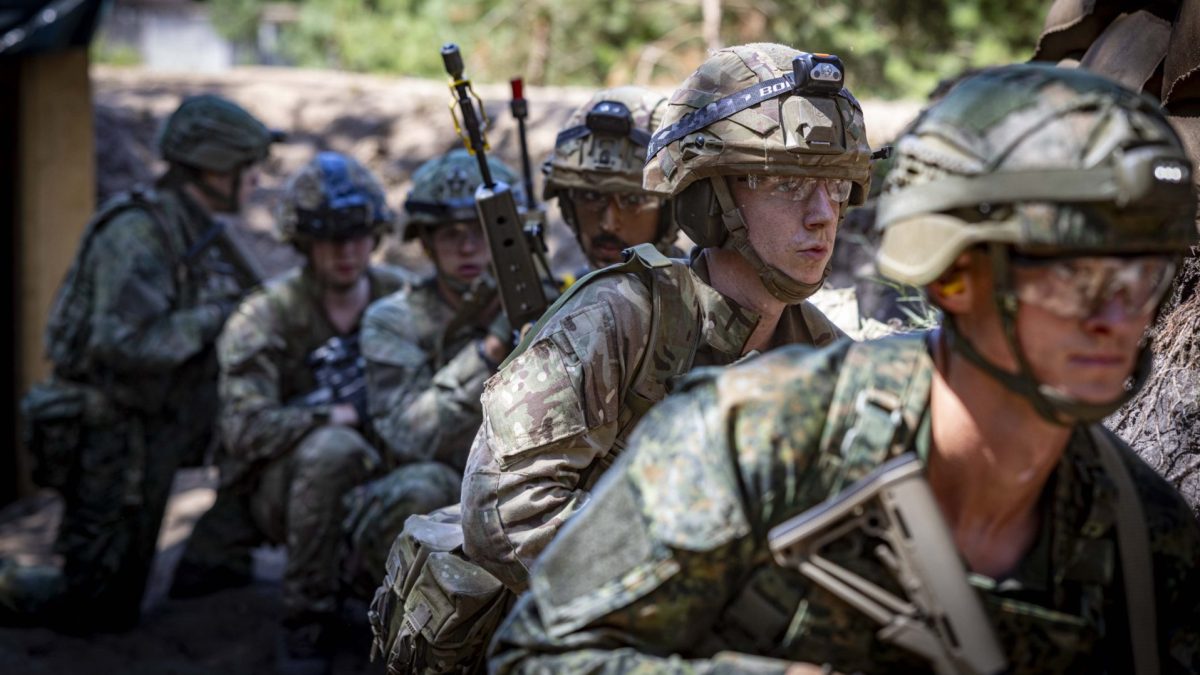
PUTTEN, THE NETHERLANDS – While many UK university students are more used to dancing late into the night, some are getting up before dawn to train part-time with the British Army. Esme Beckly, 21, spends most of her time reading English literature, but she is also one of around 1,400 young people who join the University Officer Training Corps (UOTC) every year. The scheme, which is run at over 50 universities, sees undergraduate students undertake 38 annual days of Army training alongside their degree. In return, they receive a nominal £1,600 a year, new skills and a potential career path. The goal for the military is to have a ready group of potential UK officers in case war breaks out. This has become increasingly important as fighting continues in Ukraine and violence flares in the Middle East. Shorts “Before I came to university, I was dead set against joining the Army. Full stop. I didn’t want anything to do with it,” Beckly told The i Paper during exercises in the Netherlands this month. “I didn’t want to die in a warzone.” But the course has “made me realise that it is something that I want to do in the future,” she said, “maybe not for the rest of my life, but as long as I can.” Officer cadets spend around one afternoon a week with the military, as well as five weekends and a two-week exercise each year. They learn everything from firing rifles to battlefield first aid, planning operations to surviving in the wild. Esme Beckly, 21, is going to Sandhurst to become a British Army officer following her time on the scheme (Photo: Molly Blackall/The i Paper) While around 40 per cent of recruits join the regular or reserve force after completing the scheme, the primary purpose is to serve as a backup training facility for officers, enabling the military to dramatically scale up its numbers if war breaks out. However, it is the personal development that Lieutenant Colonel Simon Pollitt, who leads the Yorkshire UOTC, sees most, with the scheme turning students from “nervous or reticent” cadets into confident third years who help lead and run the exercises. “What we’re really doing is investing in the next generations that are going to lead our country,” he told The i Paper. Around 30 per cent of the scheme’s intake are women, more than double the proportion in the UK regular forces, which stands at around 12 per cent. The number of officer cadets from ethnic minority backgrounds is roughly in line with the proportion in the regulars, at 12.5 per cent. “There is everything that you would expect from people from very poor socio-economic backgrounds through to private schooling, and we manage to get them all to the same level, and I think that’s what’s key to me,” Pollitt said. Dylan Cromarty, 19, says he has changed completely on the programme (Photo: Molly Blackall/The i Paper) Dylan Cromarty, a 19-year-old international relations student from Hull, had applied, unsuccessfully, for early placement at Sandhurst military academy, with recruiters telling him he needed to increase his confidence and return later. Sandhurst trains around a thousand officers a year. Cromarty spent his last birthday on exercise “being shot at” by the Highland Regiment. “It’s not really just the military training; it’s the camaraderie with it,” he said. He now wants to join the Reserves as an officer and become a war analyst. Computer science student Dylan Bengi, 24, said no one in his family had been in the military, “so each experience I’ve had has been really eye-opening”. “As a black person, a part of me was like, am I going to be able to fit in? Are people going to be rude, racist, mean? But so far, my experience with my instructors, UOTC, the regiment, is that they’ve all been welcoming, wonderful people.” He now hopes to go to Sandhurst to join up as a Reserves officer, while studying for a Master’s. Dylan Bengi, 24, is planning to become an Army Reserves officer (Photo: Molly Blackall/The i Paper) Bengi said the scheme has made him a better decision-maker. “You might fail 1000 different times, but you get the confidence of letting yourself fail, and being humble enough to be instructed on how to do it before having a go again.” While the scheme trained tens of thousands of officers during the First and Second World Wars, its multimillion-pound price tag and a long-standing agreement that graduates can’t be called up to fight unless they join a reservist or regular military unit have raised questions over its future. Its contribution to British security is not easily quantified, and at a time when defence funding is stretched, some are questioning its value. However, Sir Julian Brazier, a former minister for the reserves and reservist officer, believes that the scheme is vital to the UK’s ability to sustain a long-term fight. “The whole of the expansion of the British Army, in the event of war, has a single point of potential failure, which is Sandhurst,” he told The i Paper. Monty Walker grew up in a military family but is still deciding on his career (Photo: Molly Blackall/The i Paper) Some of those taking part are still working out whether they want to dedicate their careers to the military. Monty Walker, 20, who grew up in a military family in Reading before studying accounting and finance at York University, is weighing up his options. “I finish this exercise on Sunday, and then on Monday I’m in London starting an internship. It’s a switch into a different life,” he told The i Paper. Walker took part in a training exercise this month, in partnership with Dutch university officers, that focused on clearing urban areas, navigating trenches and battlefield first aid. He said he enjoyed learning both British and Dutch tactics – and trialling a general purpose machine gun. “I’m quite a small bloke. I’m only five foot six – don’t tell anybody that – so it was just shaking me around,” he said. But the biggest takeaway has been that the weapons training won’t necessarily benefit him as much as “the soft skills” he has learned: “It’s more being around people that are bright, like-minded, like the outdoors, and want to push themselves.” Olivia Hutchison, 20, moved around every two years as a military child (Photo: Molly Blackall/The i Paper) Olivia Hutchison, a 20-year-old global development student at the University of York, also comes from an Army background. “When you’re a military child, you either want to go into it, or you [really] don’t,” she said. “I was put off.” But by university, she had heard enough recommendations to give UOTC a go, and has enjoyed it enough that she is now reconsidering. It helps that, when she returns to university in the autumn, her housemates will be friends she met through the scheme. “You don’t have to be a particular type of person,” Hutchison said. “You just have to want to push yourself and get through.”
Meet the UK university students preparing for war
Full Article
Original Source
Read the full article at Inews →KhanList aggregates and links to publicly available news content. We do not host full articles from third-party sources. Always verify important information with original sources.