
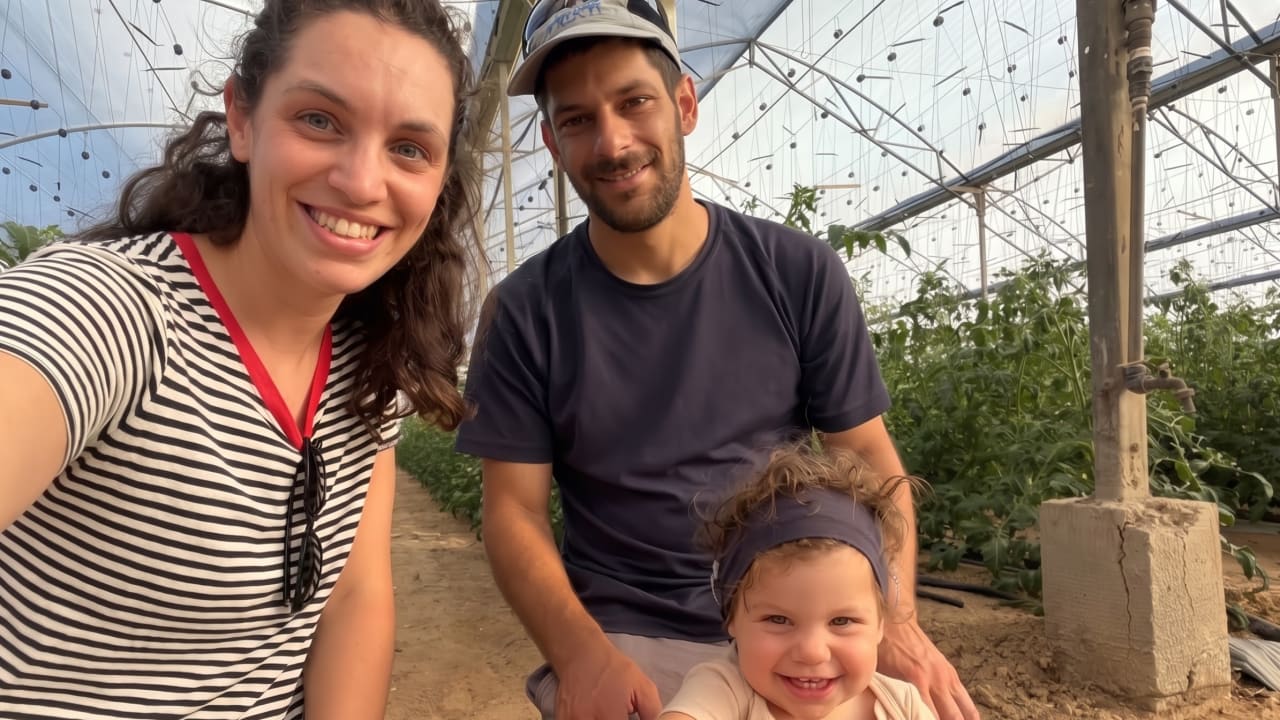
SEPTEMBER 18, 2026 18:50As Israel’s largest regional council, Ramat HaNegev is home to approximately 10,500 residents spread across communities, kibbutzim, and farms covering 22% of Israel’s landmass. Few choose to live in the remote Negev highlands, especially in the Nitzana region of the council, which has five small, remote agricultural communities near the Egyptian border, including Kadesh Barnea (officially known as Nitzanei Sinai), which is only 300 meters away. But nearly four years ago, Noam Efrat, 33, chose to return to his roots and raise his own family in Kadesh Barnea. He handles the bright red, deliciously sweet cherry tomatoes from his family’s farm carefully before they are transported and sold in boutique shops in Tel Aviv.An isolated moshav of 87 families, Noam, his wife, Noa, and their young son, Negev, enjoy the quiet that defines the desert landscape. The young family moved to the south from Metula in 2022.‘DVAR’ ARTICLE on the early years of Kadesh Barnea. The photo shows president Yitzhak Navon visiting the moshav in 1981 and attending the brit of the first baby boy born there. (credit: NOAM EFRAT)Working on his father’s cherry tomato farm today, Efrat recalled that, as a teenager, he dreamed of living as far away as possible from the Egyptian border community.“I didn’t think as a teenager that I would end up working on my father’s farm as an adult. When you live in a rural area, you just want to escape and see the world,” Efrat told the Jerusalem Post Magazine in a recent interview.While his childhood was filled with the freedom of roaming sand dunes with friends and learning to grow and take care of tomatoes in his family’s greenhouses, Efrat believed that life was waiting to happen in the fast-paced cities. After completing his army service, Efrat chose to live in central Israel.“I lived in Florentin in Tel Aviv, but after a while, I understood that I did not like city life, so I moved to Metula in the north,” he said.Efrat studied for a combined degree in computers and environmental sciences and met his wife at Tel Hai College.Eventually, the couple moved back to Kadesh Barnea, and Efrat continued to his master’s degree in agroinformatics at Ben-Gurion University’s Sde Boker campus in Midreshet Ben-Gurion.AS A TOMATO farmer who has also served over 300 days in IDF reserve duty since October 7, Efrat wakes up each day at 5:30 a.m. and drives five minutes away to his family’s meshek (farm).CHERRY TOMATOES grown on the Efrat farm in Kadesh Barnea. (credit: NOAM EFRAT)“The advantage is the short distance to work and no traffic along the way,” he said of living in Kadesh Barnea. “After two hours of early morning work, I get home by 8 so that I can take my son, Negev, to daycare, and then go back to work again until noon.”In the afternoon, Efrat returns to work in the greenhouses when it is less hot. “Our schedules are determined by the hours of sunlight – the moment the sun sets and it gets dark, we head back home.”Efrat said that living in Kadesh Barnea as a farmer is living the dream. But both his parents, Iftach and Celia, had no background in farming when they first moved from Beersheba to Kadesh Barnea over 30 years ago.Efrat’s mother, Celia, had made aliyah from São Paulo, Brazil. “She didn’t know that there were areas in the world as quiet as Kadesh Barnea, let alone in Israel. She had lived all her life in the city,” he recalled with a smile. “This quiet of the Negev desert was a bit of a shock for her.”Today, in addition to agricultural opportunities, residents of the Nitzana region also work in local tourism and education, and some even travel an hour to Beersheba for work. The Nitzana region is also known for its ancient Nabataean and Byzantine archeological and historical sites.Farmers experimented with growing different vegetablesWhen Efrat’s parents moved to the Nitzana region in 1995, the only employment opportunities were agricultural: “So my father learned how to grow cherry tomatoes, which was popular at the time. Farmers today mostly grow cucumbers, wine grapes, peppers, and salicornia (a succulent edible plant also known as sea asparagus).”Efrat also pointed out that over time, the farmers in his region experimented with growing different vegetables: “At first it wasn’t known if tomatoes could grow well in the Negev desert. In fact, tomatoes grow amazingly in greenhouses thanks to the desert temperatures. The cool desert nights really help with their growth.”In addition, the Nitzana region depends on brackish geothermal desert groundwater, as well as desalinated water, for agriculture and farming. The brackish water originates from local water sources around the Kadesh Barnea area. Water doesn’t have to be transported from far away, which saves money.“The salinated water actually makes for sweeter cherry tomatoes,” added Efrat.Tomato knowledge farming extends into another areaBUT EFRAT’S vast knowledge in Negev tomato farming also extends to another area: the history of the Nitzana region. Besides working on the family’s tomato farm, Efrat also helps run a project called Gesher L’Dorot (A Bridge for Generations), which documents the history and development of the Nitzana region.Efrat and several other locals are working to set up a digital archive that will be accessible online and include interviews with the original pioneers of the communities as well as photographs, videos, timelines, and other media documentation of the people who helped make this remote region thrive.“The idea for this archive began when I was living in the north, in Kibbutz Hagoshrim. I had an academic scholarship and one of the requirements was that I visit a senior citizen in the kibbutz once a week. His name was Itzhak, and he was one of founders of the kibbutz, and he was also very active with the kibbutz archive,” explained Efrat.“I thought that it was amazing that I could visit the Kibbutz Hagoshrim’s website and gain access to a wealth of information and photos about its history. It made me realize that I knew very little about the history of my own home and community, just the date of Kadesh Barnea’s establishment.”The original community of Kadesh Barnea, named after the site where the Israelis camped and from where Moses sent out the 12 spies to scout the Land of Israel in the Bible, was established in Sinai in the 1970s.When the moshav was dismantled following the Egypt-Israel peace treaty, the original garin (group) of the founders wanted to remain together. They moved around several times in the Ramat HaNegev regional council, first settling in Nitzana, then Ashalim, and finally settling along the Egyptian border in 1986.Efrat explained that the original residents wanted to continue to use the name Kadesh Barnea for their new community, but a government committee in charge of naming cities and small communities refused, citing that there was only one Kadesh Barnea and th at it had been in Sinai. So while Nitzanei Sinai became the official postal address, the residents continue to use Kadesh Barnea as the community’s name to this day.“Thanks to the Gesher L’Dorot project, I really got to know the elderly founders of the communities in the Nitzana region,” said Efrat. “It was a great opportunity to interview people in Ezuz, Be’er Milka, Nitzana, Kmehin, and of course my home community of Kadesh Barnea.”WHILE THE BEAUTY and wholesome lifestyle of the western Negev is striking, Efrat does not overlook the challenges of living in the Nitzana region. Following the construction of Israel’s hi-tech border fence, dozens of drones fly over from Egypt to Israel, sometimes even dozens a day, carrying ammunition, drugs, and weapons, like M16 rifles, to Bedouin cartels in the south.“There are drones and arms smuggling coming from the Egyptian border,” he noted. “Although this is considered a peaceful border, there are tensions because of the smuggling.”Another challenge is access to quality medical care.“Our son Negev was born with a hearing disability. He needed specialized medical care and medical checkups that were not available to us in the south or in Beer Sheva,” explained Efrat. “We had to do Negev’s ear surgery in Jerusalem, where he was able to get the medical care he needed. You have to be prepared for a lot of time on the road if you’re in this kind of situation.”But despite the challenges, Efrat and his wife are content raising Negev in Kadesh Barnea with grandparents Iftach and Celia next door.“All the traveling I did when I was younger to get as far away as possible from my moshav made me understand and appreciate how much I needed to get back home. We’re happy here,” Efrat concluded.■The writer lives with her family in Midreshet Ben-Gurion in Ramat HaNegev, where she works as an English teacher and writes in her free time. She made aliyah from Calais, Maine, in 2004.Follow us on Google
Meet the second-generation Israeli farmer and reservist who grows tomatoes on the Egyptian border
Full Article
Original Source
Read the full article at Jpost →KhanList aggregates and links to publicly available news content. We do not host full articles from third-party sources. Always verify important information with original sources.