
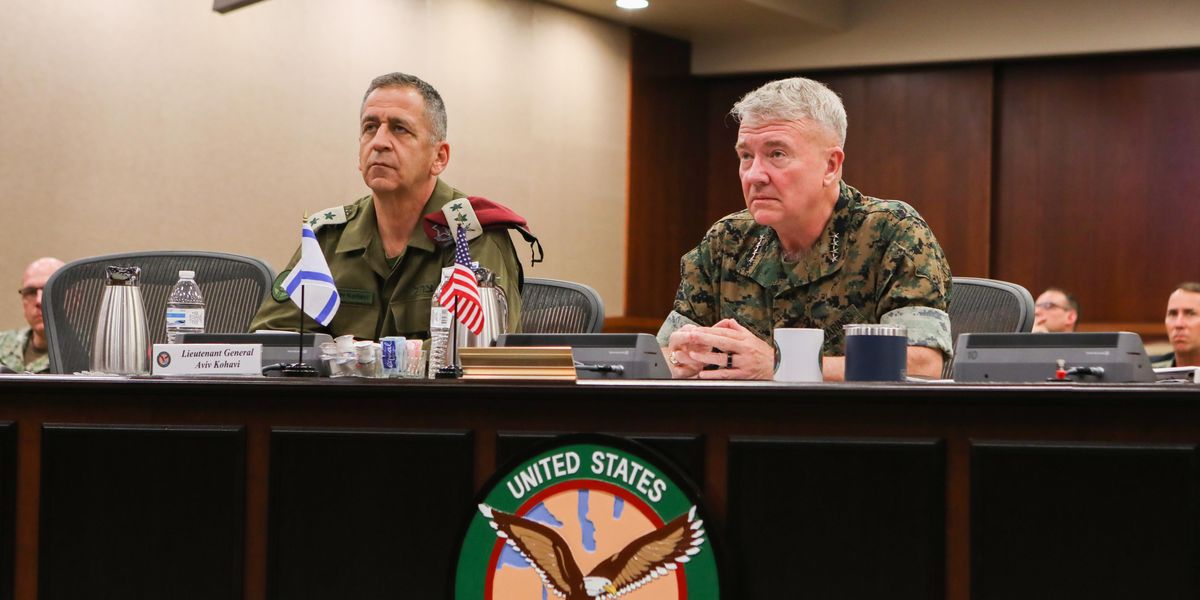
In August, the Jewish Institute for National Security of America (JINSA) publicly took credit for shaping “multiple provisions” now in this year’s defense policy bill, stating that many were “impacted by prior JINSA policy recommendations,” including “proposals to strengthen U.S.-Israel defense industrial base integration” and “renew pre-existing joint U.S.-Israel programs.”Among the provisions JINSA takes credit for is the controversial Section 219. In the House version of the National Defense Authorization Act (NDAA), this section mandates the creation of a single executive agent tasked with “synchronizing cooperative efforts” between the U.S. and Israel across nine basket categories, including AI, quantum technology, biotechnology, and virtually every category of weapons. Israeli Prime Minister Benjamin Netanyahu has argued that such provisions would transition the U.S.-Israel security relationship from aid to partnership. But pro-Israel advocates have emphasized the leverage it would provide over Washington’s military policy.Mark Dubowitz, the CEO of the pro-Israel Foundation for Defense of Democracies, appeared to reference this provision in an article arguing that the U.S. and Israel must “deepen their military, technological, intelligence and economic integration to such an extent that inflicting financial harm on Israel would also carry a significant cost for Washington.” Other initiatives JINSA has advocated for likewise read like an Israeli government wishlist. They include a pending provision to “extend the existing War Reserve Stockpile Authority for Israel,” which provides a secretive and high-speed pathway for funneling weapons to Israel, as well as Abraham Accords provisions including “Improvements to Air and Missile Defense Acquisition” and a “United States-Abraham Accords Defense Cooperation Initiative.”The policy wins JINSA is trumpeting are a result of its strong foothold within the military-industrial complex, and are perhaps one of the most overlooked aspects of the pro-Israel lobby. The group says it achieves these goals “by conducting both educational programs that build ties among American, Israeli and other Middle Eastern partner military leaders, along with in-depth research and actionable recommendations to influence U.S. policy.” JINSA’s “Our People” webpage includes a long roster of retired U.S. military officials.One of JINSA’s most important programs, which has existed for more than four decades, is its “Generals and Admirals Program.” The initiative involves flying recently retired U.S. military officials to Israel. Many of the trip’s participants were already sitting on defense-industry boards when they went, while others joined soon afterward. At least 55 of the 83 alumni from the 2019–2026 G&A program cohorts (about 66%) have held or currently hold positions in the defense industry spanning board seats, executive jobs or advisory roles at defense contractors and defense-tech firms, or posts at defense-focused investment funds, consultancies and lobbying shops.JINSA hopes that, when these former military officials return from Israel, they will use their credentials and defense industry power to become Israel’s advocates.JINSA describes the program, founded in 1981, as “designed to ensure that the delegation is well briefed on the security concerns of Israel, as well as the key role Israel plays as a friend and ally of the United States.” The Helmsley Charitable Trust, which provided a 13 month grant for the program in 2017 worth $237,846, similarly says the purpose of the program is in part for participants to “return home to share publicly what they learned.”The itinerary for the Generals and Admirals program includes meetings with Israel’s prime minister, defense minister, IDF chief of staff and the Director of Mossad. According to JINSA, after completing the program, “participants often engage on important policy initiatives through JINSA’s Gemunder Center for Defense and Strategy that strengthen…the U.S.-Israel security relationship.” JINSA CEO Michael Makovsky highlighted the program’s influence in 2014, calling U.S. generals and admirals “America’s most admired leaders, who remain very influential even after retirement.” The JINSA program trains retired military leaders, many of whom go on to work in the defense industry, to be advocates for Israeli interests, both in their public writing and in their work behind the scenes.A 2023 Quincy Institute report found that 80% of four-star officers who retired between June 2018 and July 2023 went on to work for the defense industry. Of the 32 officers tracked in the report, nine appear on JINSA’s participant lists, and seven of those nine retired officers hold industry lobbying or defense-tech roles. Gen. Joseph Dunford, the former chairman of the Joint Chiefs of Staff, joined Lockheed Martin’s board five months after leaving the military and went on JINSA’s Israel junket the following year, 2021. Adm. Michael S. Rogers, the former NSA director and head of U.S. Cyber Command, retired in 2018, became a senior adviser at the lobbying and public relations firm Brunswick Group in 2019 and went on the JINSA trip in 2021. Gen. Hawk Carlisle participated in the 2019 delegation while serving as president and CEO of the National Defense Industrial Association, the war lobby’s leading trade group, and has served on the board of the U.S. subsidiary of Israel’s largest defense contractor, Elbit Systems of America, which was renamed Twenty-Six Defense in September. Some participants, such as retired Gen. Robert Magnus and Gen. Duncan McNabb, joined the board of Elbit America after their JINSA trips. Embedded within the highest levels of the most powerful lobby on Capitol Hill, JINSA’s roster of retired generals and admirals often use their credentials to advocate for pro-Israel policy in Washington. In 2010, when then-head of U.S. Central Command Gen. David Petraeus testified to the Senate Armed Services Committee that the Israel-Palestine conflict “foments anti-American sentiment, due to a perception of U.S. favoritism for Israel,” which is used to “mobilize support” for various militant groups in the region, JINSA’s G&A participants rushed to Israel’s defense. Responding to Petraeus, 30 ex-military leaders associated with the program put out an ad claiming that “a strong, secure Israel is an asset,” labeling the country, which has been deemed an apartheid state by numerous human rights groups, as “a democracy” that “shares our commitment to freedom, personal liberty and rule of law.” In May 2018, a JINSA task force of retired senior officers chaired by Adm. James Stavridis released “Atlas Supported,” urging Washington to elevate Israel to “a top-tier ally” and invest jointly in next-generation military technology — the latter now a central purpose of Section 219. JINSA says the report was also the first to recommend moving Israel from the U.S. European Command to U.S. Central Command, which Trump then ordered on January 15, 2021. JINSA celebrated the fifth anniversary of Israel’s shift into CENTCOM this January by noting that the “Wall Street Journal recognized” it as “the only organization promoting this move,” and by featuring glowing tributes from JINSA G&A participants.JINSA’s roster of retired military officials was once again mobilized in October 2026 to deny the findings of a trifecta of human rights groups and the U.N. that Israel committed a genocide in Gaza, praising what it called a “pattern of law-abiding IDF conduct in Gaza.” JINSA’s delegates routinely appear on cable news, often without disclosures of their affiliation with the pro-Israel lobby group: Gen. Kenneth “Frank” McKenzie, who commanded CENTCOM from 2019 to 2022 and traveled with JINSA’s 2023 delegation, and became a “distinguished fellow” at JINSA in 2024, is now a CBS News contributor. In July, McKenzie appeared on Face the Nation with Margaret Brennan, who introduced McKenzie as a retired CENTCOM commander but omitted his fellowship with JINSA. In that appearance, McKenzie recommended Washington consider seizing Kharg Island. Ret. Vice Admiral Robert Harward, a member of JINSA’s “Iran Policy Project,” frequently appears on Fox News too, though his affiliation is generally disclosed.One of the group’s most consequential efforts was to push the Trump administration to start a war with Iran, with a group of JINSA-aligned military leaders writing a March 2025 letter arguing that “U.S. support for Israeli action to prevent a nuclear Iran should be a top priority,” adding that “time is running out to stop its march to the bomb.” Sixty-six of the 79 signers of that letter appear on JINSA’s Generals and Admirals participant lists. Members of JINSA’s roster of retired military officials subsequently wrote open letters of support for the 12-Day War and the current months-long Iran War.
Meet the retired US top brass now working to advance Israeli policy
Full Article
Original Source
Read the full article at Responsiblestatecraft →KhanList aggregates and links to publicly available news content. We do not host full articles from third-party sources. Always verify important information with original sources.