
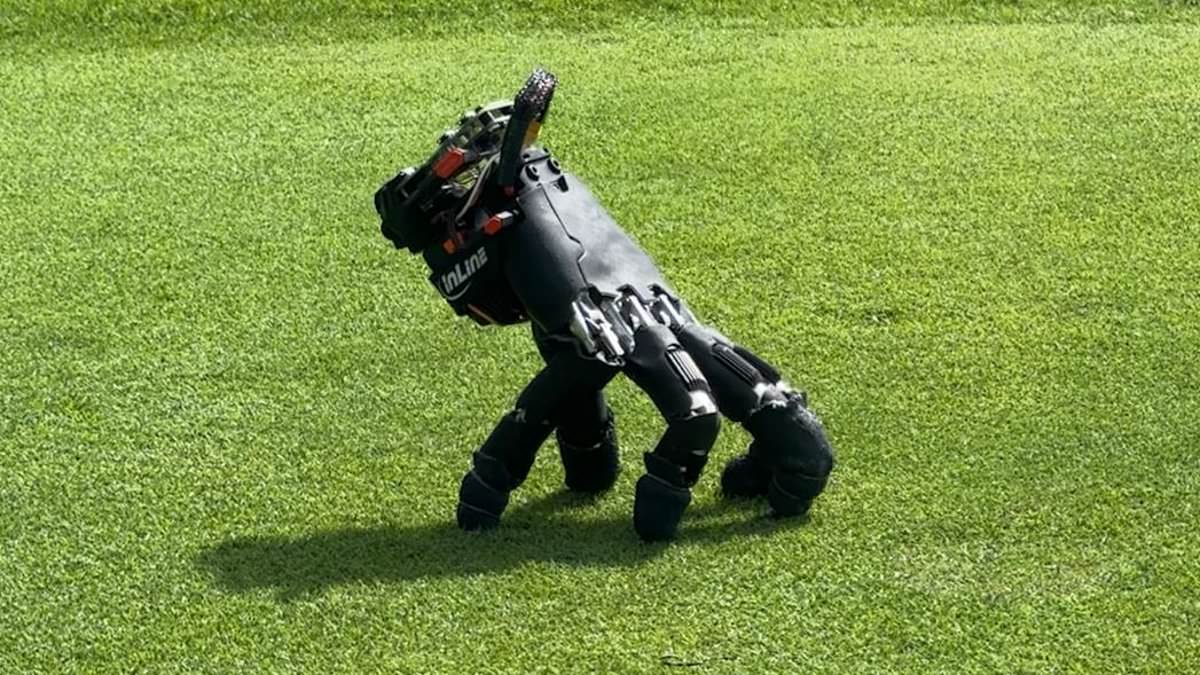
While it might look just like 'Thing' from The Addams Family, this scuttling hand isn't the product of any special effects wizardry or Hollywood magic. Scientists from ETH Zurich have created a real-life copy of the creepy character by teaching a robotic hand to walk by itself. The crawling robot is able to walk upright on its fingertips, tapping its way across a range of different surfaces and terrains.The 1.8lb (818g) bot can even pick itself up after a fall, push objects around, and press buttons on a keyboard while staying balanced.In the future, this could give humanoid robots a way of reaching spaces that are too small for their bulky bodies by popping off their limbs and sending them on ahead. Lead author Mr Amirhossein Kazemipour told the Daily Mail: 'Imagine a robot reaching a narrow opening that its body or arm cannot enter. 'A future version could detach its hand, let it crawl inside to inspect the space, operate a control or move something, then retrieve it afterwards.'Scientists from ETH Zurich have created a robotic walking hand that can detach from an arm and scuttle by itself The robot has an eerie similarity to Thing, the animated hand from The Addams Family (pictured)Robotic hands are already incredibly impressive pieces of technology, capable of subtle manoeuvres and careful manipulation.However, as Mr Kazemipour explains, their biggest drawback is that they generally need to be attached to bulky robots. 'A robotic hand normally depends on an arm and the rest of the robot to get it where it needs to work,' he said.'We wanted to give it more independence.'What makes this particularly impressive is the fact that it isn't a custom-built machine but an off-the-shelf robotic hand.The researchers wanted to see if they could give this existing tech an entirely new function with a few modifications and some clever coding. The researchers started with a WUJI robotic hand, before adding a battery, a small computer, and a motion sensor.The result is a self-contained clambering hand that carries all of its own power and computing equipment with it. Instead of building a specialised robot, the researchers took an existing robotic hand and modified it so that the device could move under its own power Besides walking around, the robotic hand is also able to hold itself up while pressing buttons on a keyboardHowever, while Thing might make it look supernaturally simple, teaching a hand to crawl by itself is far from easy.'The fingers have different lengths and ranges of movement, with the thumb off to one side,' says Mr Kazemipour.'Every time a finger lifts to take a step or interact with an object, the hand's support changes.'To get around this, the researchers used a process called reinforcement learning, allowing the computer controlling the robot to practice through trial and error in a simulation.Rather than programming every movement individually, this allowed the hand to figure out the best ways to move its fingers on different surfaces before physical testing even started.To transfer that digital experience to the real world, the computer simulations were combined with measurements of how the hand's 20 moving joints react and where its fingers slide over the ground.The result is a robotic hand with a surprisingly versatile set of abilities.The hand is able to 'walk' over 14 different types of surfaces, including grass, gravel, hardwood floors and stone. The robotic hand learned to walk through a process called reinforcement learning, practising motions over thousands of computer simulations The hand is able to 'walk' over 14 different types of surfaces, including metal sheeting, gravel, hardwood floors, and stoneIt can pick itself up after a fall, successfully righting itself 21 out of 25 times during testing.With the help of an overhead camera providing spatial information, the hand can also push blocks around on the floor, dropping them within 17mm of their intended destination. Most excitingly, the researchers also taught the robot hand to remotely operate a keyboard, pressing buttons with one finger while holding itself up with the other four.The researchers were even able to play a simple video game remotely, sending their directions to the hand to tap out on a separate keyboard – hitting the right keys 29 times out of 32.Currently, the hand is remotely controlled by an operator who sends commands that the onboard computer translates into finger movements.But in the future, technology like this could help build more complex autonomous robotic systems.Mr Kazemipour says: 'I'm interested in robots whose specialised parts can work both independently and together. 'Each part could have its own sensing, control and mobility, separating when useful and reconnecting when a task needs the whole body.'
Meet the real-life 'Thing': Scientists develop a robotic hand that walks on its fingers - just like the creepy Addams Family character
Full Article
Original Source
Read the full article at Dailymail →KhanList aggregates and links to publicly available news content. We do not host full articles from third-party sources. Always verify important information with original sources.