
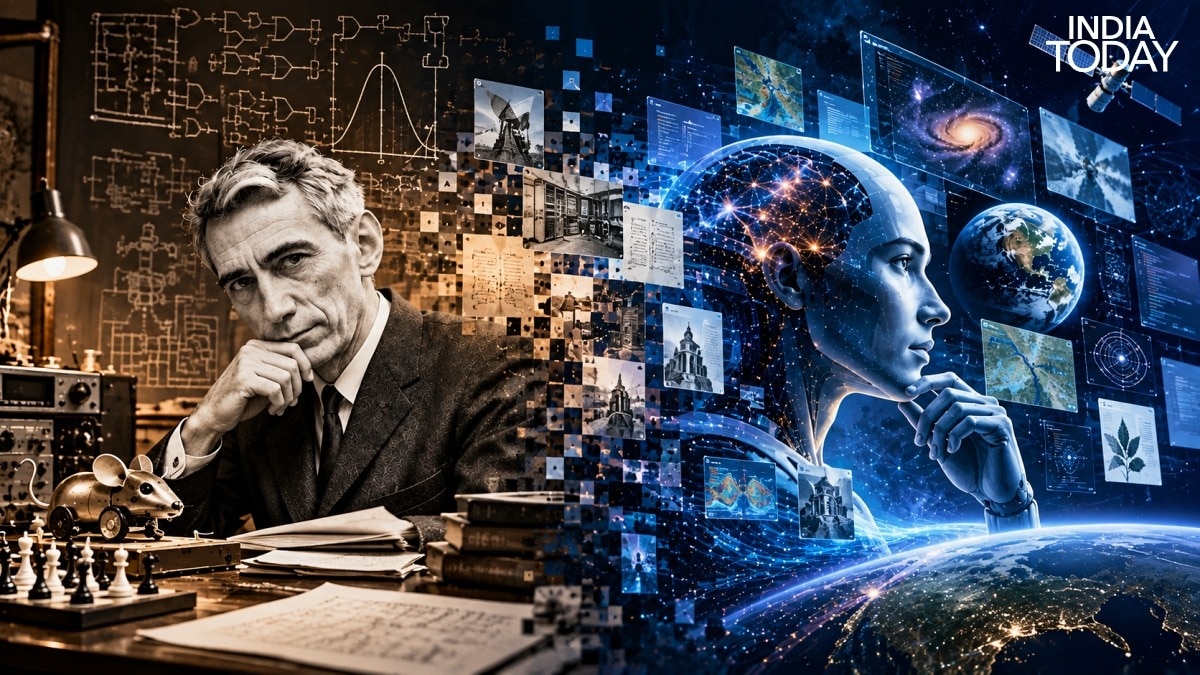
You know Claude the AI chatbot. But who was Claude Shannon? Meet the mathematician whose ideas helped lay the foundations of the digital world.Claude Shannon was a man whose extraordinary scientific contributions were matched by an equally unusual personality. (Photo: India Today)New Delhi,Sep 25, 2026 15:46 ISTEvery day, millions of people turn to Claude for help writing emails, analysing research papers, generating code and answering questions.The AI chatbot has become part of everyday life. But how many of you know that Claude is also the name of a real person whose mathematical ideas helped make the digital world possible?Meet Claude Elwood Shannon, the legendary American mathematician, electrical engineer and MIT professor widely regarded as the father of information theory. He theorised that information could be transmitted using ones and zeros.While Anthropic's naming story is often associated with Shannon, the company has not publicly confirmed the connection in its original launch announcement. Born on April 30, 1916, in Petoskey, Michigan, Shannon was a man whose extraordinary scientific contributions were matched by an equally unusual personality.He died in 2001, aged 84. An image of Claude Shannon. (Photo: MIT) THE MAN WHO GAVE INFORMATION A MATHEMATICAL LANGUAGEClaude Shannon's most influential contribution came in 1948, when he published A Mathematical Theory of Communication while working at Bell Laboratories.At the time, engineers were struggling to understand how to transmit information reliably through telephone lines, radio signals and other communication systems.Shannon demonstrated that information could be represented mathematically using bits, the fundamental units of digital information, and established the principles underlying data compression and reliable communication over noisy channels.His ideas laid the foundations for technologies ranging from computers and mobile phones to the internet and digital communication networks.He earned his master's degree in electrical engineering and PhD in mathematics from MIT in 1940. After working at Bell Labs, he returned to MIT in 1956, where he taught until his retirement in 1978.A UNICYCLING, JUGGLING INVENTORAway from equations, Shannon was an enthusiastic tinkerer who delighted in building unusual machines.At Bell Laboratories, he was remembered for riding through corridors on a unicycle while juggling three balls. He also built a motorised pogo stick, a juggling machine and a mechanical mouse called Theseus that could navigate a maze.Theseus is particularly significant in computing history. Developed in the 1950s, the mouse could learn to navigate a maze and remember its route, making it an early experiment in machine learning and artificial intelligence.Shannon also explored chess-playing computers decades before IBM's Deep Blue defeated world champion Garry Kasparov.His curiosity extended beyond communication theory into cryptography, artificial intelligence and mathematical puzzles. During World War II, he worked on secrecy systems, helping establish the mathematical foundations of modern cryptography.In 2001, Shannon's death marked the end of an extraordinary scientific life. But his ideas continue to underpin the digital systems billions of people use today.The next time someone opens Claude, they may be interacting with an AI assistant whose name evokes a man who helped explain how information itself travels through the world.- Ends
Meet the quirky MIT professor behind AI. His name is Claude too
Full Article
Original Source
Read the full article at Indiatoday →KhanList aggregates and links to publicly available news content. We do not host full articles from third-party sources. Always verify important information with original sources.