
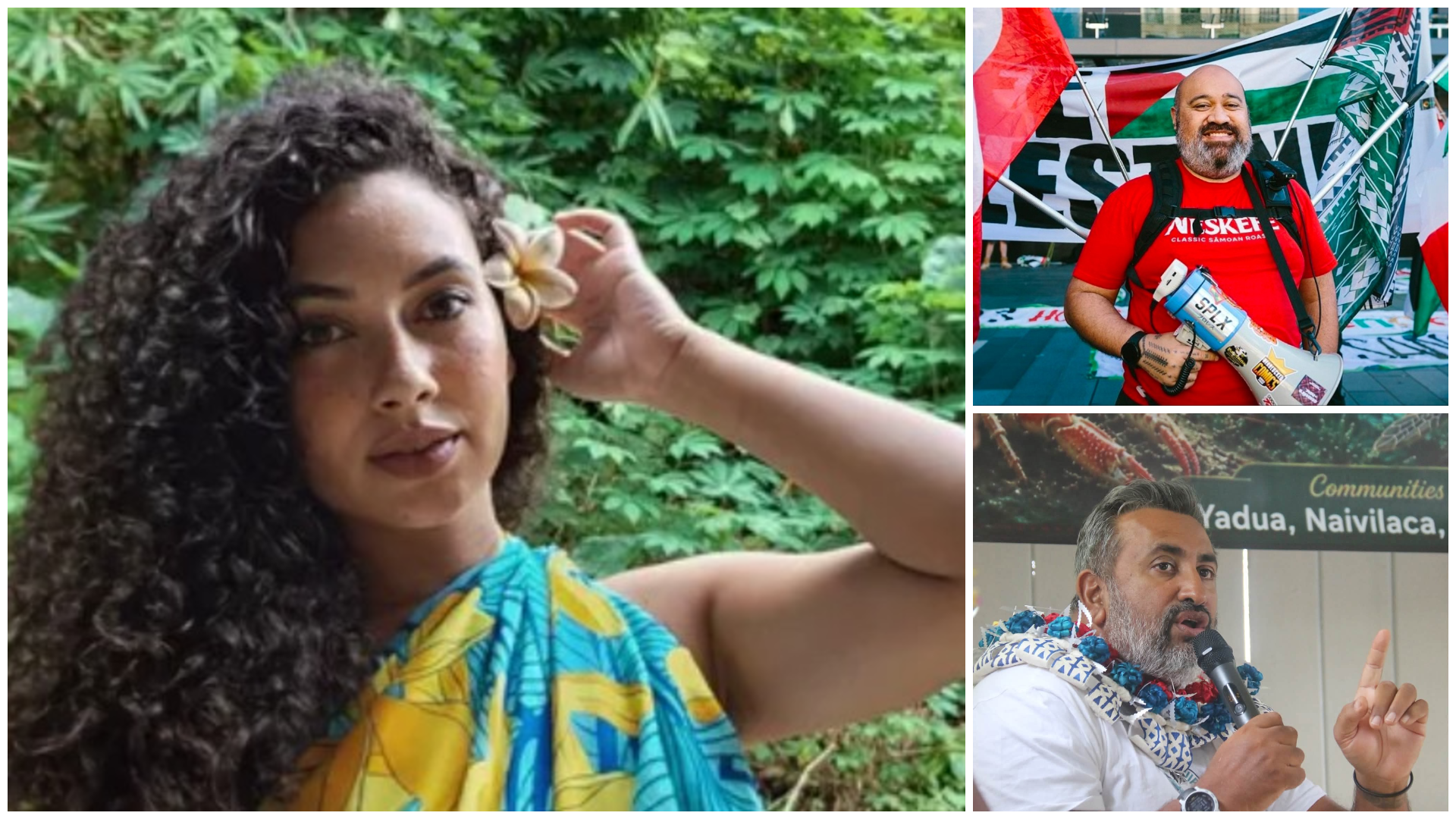
Michel Mulipola is a comic book artist and former professional wrestler. He’s also an activist for indigenous self-determination in Palestine and across the Pacific Islands, as well as a former Green Party candidate in New Zealand. It’s in keeping with his family history. Mulipola’s great-grandfather, Mataʻutia Karauna Solomona, was a Samoan resistance leader and secretary of the Mau movement, which sought to free Western Samoa of colonial rule in the 1920s and 1930s. Solomona’s arrest resulted in a massacre of unarmed protesters by the New Zealand military and police. “So, I guess activism or even just fighting for freedom, for sovereignty, is in my blood,” says Mulipola, who has received media attention for his customised image of the Palestinian flag using traditional Samoan petroglyphs. The artwork, which incorporates symbols drawn from Samoan cultural traditions, became a way for Mulipola to explain why he believed his people should stand with Palestinians. New MEE newsletter: Jerusalem Dispatch Sign up to get the latest insights and analysis on Israel-Palestine, alongside Turkey Unpacked and other MEE newsletters Samoans around the world grew more curious, and have carried the flag at Palestine demonstrations. But the response was not all positive. “Christian Zionism has got quite a strong stranglehold on Samoans and other people of the Pacific,” Mulipola tells Middle East Eye in a video call interview. A self-described atheist, Mulipola was accused of not being truly Samoan, just because he did not support Israel. 'Christian Zionism has got quite a strong stranglehold on Samoans and other people of the Pacific' - Michel Mulipola, comic book artist and activist These reactions exposed a deeper tension present in the Pacific islands since even before the start of Israel’s genocide in Gaza. A small but growing number of mainly young Pasifika intellectuals, theologians, and activists are pushing back against decades of deep missionary and elder evangelical conditioning. This conditioning, heavily influenced by Christian Zionists from the United States, saw support for Israel become intertwined with local cultural identity, so that questioning someone’s political beliefs came to feel like questioning one’s own people. Across the Pacific, a region with diverse Indigenous cultures, histories and Christian traditions, activists and church leaders' arguments are not simply about Palestine. They are also about how communities understand colonialism, Indigenous identity, religious authority and the right of peoples to determine their own futures. Colonial Christianity The Pacific's relationship with Christianity is complex. Missionaries arrived in many islands from the late 18th century onwards, and the religion became deeply embedded in the social and cultural life of many communities. But the growth of Christian Zionism in the region is something different. According to Reverend James Bhagwan, general secretary of the Pacific Conference of Churches (PCC), which represents churches of mixed Indo-Fijian and other heritages, the more recent growth of Christian Zionism has taken place alongside the expansion of newer evangelical and Pentecostal movements. Reverend James Bhagwan says 'Christian Zionism is not a new thing' in the Pacific Islands (Supplied) “Christian Zionism is not a new thing. It has been slowly creeping into different spaces over the last 40 years,” he says. Bhagwan’s ecumenical organisation brings together 35 national denominations and 11 national councils of churches across 20 Pacific Island states and territories. Its work includes advocating for Indigenous self-determination in places such as West Papua, New Caledonia (Kanaky) and French Polynesia. For Bhagwan, that work creates a moral obligation to engage with Palestine, too. “We cannot pick and choose what self-determination we support,” he said. The Methodist minister believes that some Pacific Christians have difficulty distinguishing between the Israel described in biblical texts, the modern state of Israel, Judaism and Zionism. In his view, this can lead to political positions being formed through religious identification rather than a fuller understanding of the realities facing Palestinians. Along with Bhagwan, Mulipola points to a lack of awareness about Palestinian Christians. He told a story about Brian Tamaki, the leader of Destiny Church, a conservative Pentecostal movement founded in New Zealand. Tamaki has led pro-Israel rallies in New Zealand. “I remember they were counter-protesting a Palestine action, and he was spouting off his hateful Christian rhetoric,” Mulipola recalls. “My good friend Rand Hazel jumped on the megaphone and said: ‘I’m a Palestinian Christian, born in Jerusalem, my people spoke Aramaic, the language of Jesus…’ and Tamaki was gobsmacked.” Some communities, he says, have been taken in by Eurocentric propaganda portraying all Palestinians as Muslims and demanding unconditional support for the gathering of all Jews in the holy land. Growing up on myths In Fiji, journalist and activist Mara Mahoney says the connection between religious belief and national identity can be particularly difficult to challenge. Mahoney grew up in the village of Savusavu on evangelical Christian Bible study, church attendance and Christian schooling, which shaped her understanding of the world from an early age. 'When you're trying to speak facts with people… you're trying to talk about the Nakba… people will just be like, well, who are we to question God?' - Mara Mahoney, Fijian writer She recalls being taught that Israel was home to God's chosen people, and that some Fijians descended from the lost tribes of Israel, a belief that could make questioning support for the modern Israeli state feel like questioning one’s own faith. Mahoney’s own political awakening came when she left her hometown to study at the University of Hawaii at Manoa. It was there that she learned about colonialism and Indigenous struggles in the Pacific, including those in Hawaii, West Papua and New Caledonia (Kanaky). She says missionaries had used Fijian oral storytelling and pseudo-genealogical traditions to construct narratives connecting Fijian origins to Israel. These stories, Mahoney argues, were subsequently presented to communities as accounts of their own ancestry. The historical question is significant, but it requires careful treatment. Research by anthropologist Lynda Newland documents how missionary ideas about Fijian origins and the lost tribes of Israel developed between 1835 and Fiji's cession to Britain in 1874. Newland's research establishes that these ideas have a historical basis in missionary discourse and that they became influential among some Indigenous Fijian clans and church groups. Mara Mahoney is a writer and activist from Fiji (Supplied) For Mahoney, these narratives help explain why some Fijians find it harder to question political positions associated with that connection. “When you're trying to speak facts with people… you're trying to talk about the Nakba… people will just be like, well, who are we to question God?” she says. The issue is not simply that people hold a religious belief, Mahoney argues. It is that questioning the belief can mean confronting an entire system of education, family expectations and identity. The cost of challenging the narrative “The Christianity that was kind of brought to our shores was built on fear,” Mulipola says. “You hear people calling themselves God-fearing people, and I'm like, I've never liked that term because ruling through fear is dangerous. “It's manipulative. It's not a loving relationship. It's an abusive one. And so many people fear the repercussions of speaking up or speaking against it.” Mulipola describes the Samoan concept of fa'aaloalo, often associated with respect and deference, as one factor shaping how people respond to authority and adhere to Christian Zionism. Michel Mulipola pictured at a Palestine demonstration (Supplied) In his interpretation, the expectation to respect elders and authority figures can reinforce a reluctance to question religious leaders or teachings. Mahoney says a similar dynamic exists in Fiji. Mulipola believes this dynamic has been compounded by forms of Christianity introduced through colonial rule, in which obedience and unquestioning faith can become closely linked. Pasifika-Palestinian solidarity The connection between the former wrestler's family history and the Palestinian struggle is not merely symbolic. He sees both as struggles over sovereignty, dignity and the right of a people to determine their future. 'You hear people calling themselves God-fearing people, and I'm like, I've never liked that term because ruling through fear is dangerous' - Michel Mulipola Pacific concerns for family and community, he argues, are not incompatible with supporting Palestinians. Mulipola’s artwork attempts to make that connection visible: using Samoan symbols to tell a Palestinian story and inviting viewers to recognise the similarities between different histories of dispossession and resistance. Mahoney uses social media, particularly TikTok, to share information and encourage discussion. She’s trying to build it into traditional practice. “There's this concept in a lot of Pacific islands called talanoa, which is just meaningful dialogue - it’s not an interrogation trying to prove I'm right… it's just sitting down and being curious about what the other person has to say,” she says. At times, Mahoney acknowledges, she has struggled to maintain this, especially with family members who hold opposing views. Mulipola, agrees, saying, “the wrong approach would be... aggressiveness, as much as they irritate and piss me off… it's about the energy you put out there... You've got to meet them with the facts and a measured response, but in ways that resonate.” He refers to an encounter where he shocked a fellow Samoan by showing a Gaza Health Ministry report documenting entire families being wiped off the register. Just as in many Middle Eastern and Palestinian cultures, tight-knit and large extended family networks are sacred to Pacific Islanders. “Tell me more about that,” is the kind of response Mahoney admires in friends who can engage with relatives who have strongly pro-Israel views. ‘Appalling’: Samoa to open Israel embassy in Jerusalem, sparking criticism Read More » Mahoney says that, when people are given room to speak, some privately acknowledge that the killing of civilians is wrong, even if they don’t challenge the wider ideology. She also acknowledges that many people in Fiji, which alongside Papua New Guinea and Nauru opened embassies in Jerusalem, have never met a Palestinian and have limited awareness of the existence of Palestinian Christians. Bhagwan similarly believes that stronger engagement between Palestinian Christians and Pacific churches could help broaden the discussion, and suggests building relationships between people working on self-determination in Palestine and across the Pacific, particularly by involving younger generations. Mulipola, meanwhile, sees art as one way of creating such human connections and shared cultural concepts: the Samoan word mau, associated with steadfastness and resistance, and the Palestinian concept of sumud, or steadfastness. From solidarity to political change The Pacific's diplomatic positions on Palestine are varied, and voting records at the United Nations show that most governments in the region either vote against, abstain or are absent during UN votes concerning Palestine. In mid-November, votes on Palestinian self-determination, refugee aid, and illegal settlements were more varied. Several traditional allies of Israel - including the Marshall Islands, Samoa, and Tuvalu - quietly softened their stance from outright opposition to abstentions or absences, even as Micronesia, Palau, and Nauru held firm alongside Israel, while Fiji, Tonga, and Papua New Guinea split their votes across the resolutions. Palestine solidarity has been cracked down on, especially in Fiji. “Those who organise gatherings and demonstrations, it's all illegal; they're not allowed,” Mahoney says. “Whenever they try to apply for march permits, they're denied. Whenever they try to do demonstrations, they are met with warnings from police…” Bhagwan argues that international diplomacy is often shaped by pragmatism, not just religious dogma: Pacific governments face urgent development and climate challenges and seek partnerships, investment and assistance, where Israel and the US, he says, have the upper hand. “I think when it comes to the global space and the multilateral systems and international politics, the reality is that it's deeply pragmatic,” the minister says. ‘Britain can stop this’: The East Jerusalem yeshiva taking UK charity money and planning expansion Read More » “And that places Palestine in a vulnerable space because Israel has more to offer than you do, right? And that's what it comes down to. We are a region, for example, that is affected by climate change and every other kind of development issue.” “Israel knows this," Mulipola says, "so they'd be making huge plays in the Pacific by offering monetary support and being part of the Pacific Leaders Forum next year… They have utilised Christian Zionism and the Christian ties to push their case.” Palestine, in contrast, “doesn’t have the resources, doesn’t have the political power to be in those spaces”, says Mulipola. He believes political change has historically come from the bottom up, and Mahoney, too, sees hope in younger Fijians who are increasingly willing to question beliefs they once accepted uncritically. They acknowledge, though, the change in attitudes won't happen overnight, and some minds are too rigid to change. “There are lots of people who have closed minds and closed hearts and don't want to hear anything else because the fear inside them is so strong,” Mulipola says. “But for the ones who you know are listening actively, there's hope.”
Meet the Pacific Islanders standing for Palestine against Christian Zionism
Full Article
Original Source
Read the full article at Middleeasteye →KhanList aggregates and links to publicly available news content. We do not host full articles from third-party sources. Always verify important information with original sources.