
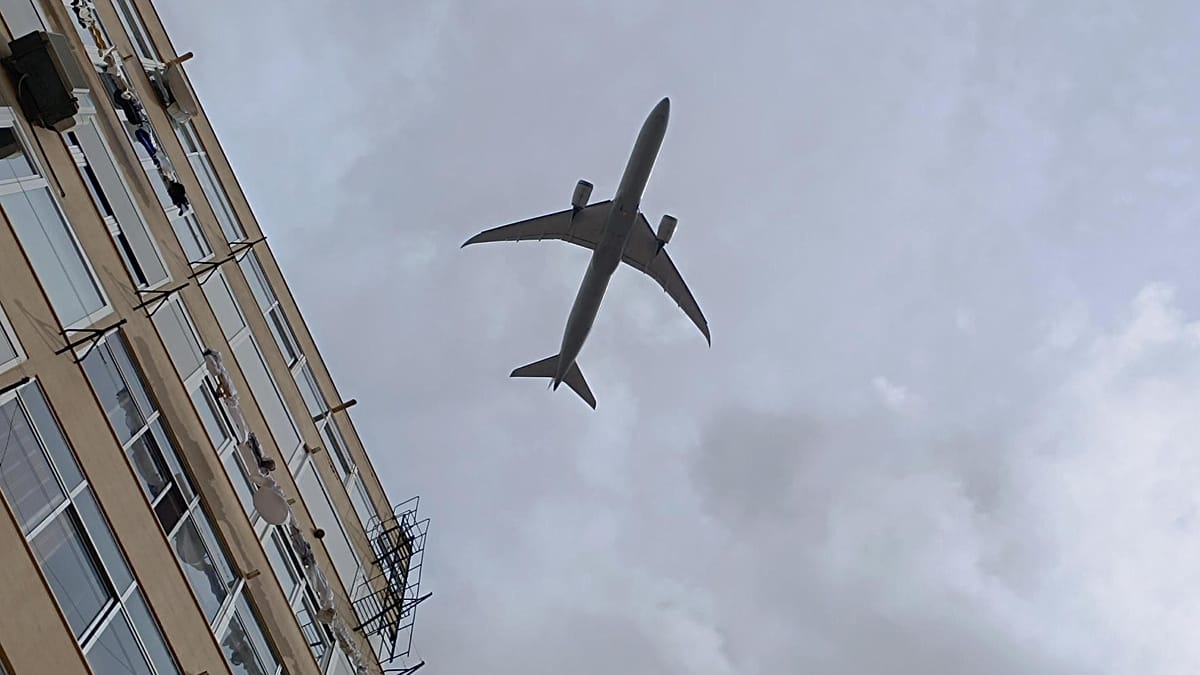
Planes roar over Lisbon almost constantly, a direct result of an airport wedged into the city centre, surrounded by homes. For thousands of residents, it is nothing new — and for many, it barely registers as a problem anymore. ADVERTISEMENT ADVERTISEMENT "I've got used to it and, honestly, my grandparents had a house in Alvalade, so since I was a kid I've been watching the planes go by," said António Boaventura. A resident of the Portuguese capital, Boaventura has a terrace that offers a privileged view of these "giant metal birds". One after another, they rhythmically interrupt his conversation with Euronews. "The number of planes flying over Lisbon is increasingly high, but I've gotten used to it. I think all Lisbon residents have gotten used to having planes flying overhead," he explained. This was the starting point for the creation of Lisbon Finals, an online platform that counts the flights crossing the skies over Lisbon and beyond the Portuguese capital. "I realised we could go much further, measuring the aircraft and recording not only the decibels but also the vibrations on the walls, so I started building the system bit by bit," Boaventura said, adding that it is still constantly evolving and has room to grow. "The system is open so that several measuring stations can be integrated." With a background in business management and years spent living abroad, Boaventura was driven by his passion for aviation and curiosity about the flights crossing overhead. "This almost started out as a bit of fun," he said. With the help of artificial intelligence, he set up a station on the terrace that collects and measures variables such as speed, altitude, noise and vibration, before aggregating and sharing the data through an online platform that makes it freely available. "That is the goal: information that is available to everyone. Associations, citizens, aviation enthusiasts. To know what is flying across the sky, above my terrace and above Lisbon," he said. In addition to numerical data, the platform also shows other information, such as flight numbers and the airlines operating them, as well as images shared on the platform and on an associated Instagram page. Everything is automated. "The whole system is completely autonomous, it works on its own," Boaventura explained. The initial investment was around €1,000, spent on the equipment needed to set up the physical station. "It took me roughly a month and a half to build the station," he said, adding that the platform took "a bit longer to programme" and that the project remains a work in progress. "I'm always working a bit to improve it and make adjustments based on the data, because we can always make new correlations," he told Euronews. The station made its first measurement on 3 May and has already logged more than 39,000 flights in a project that aims to remain neutral and free of any stance. "I like aviation. The aim of the platform is precisely to remain neutral and give the data to people who need it and who want it," he said. "The measurements are completely neutral and I think the figures speak for themselves." Night-time violations continue Although used to the noise, Boaventura knows the passage of aircraft can be a real ordeal for some people, especially during rest hours, something he was unaware of before moving to the Portuguese capital. "I was surprised to see planes flying at night over the skies of Lisbon," he said. Boaventura, who grew up in France, always knew there were "tight restrictions" on aircraft movements at night there. At Humberto Delgado Airport, night-time traffic is restricted between midnight and 6am. The legislation currently in force sets a limit of 91 weekly movements, with a maximum of 26 movements per night-time period, along with criteria relating to aircraft noise. One of the indicators available on the project's website is the number of alleged breaches of these restrictions. A search on the site shows that in July alone there were 1,477 night-time flights, monitored between 11pm and 6:59am. Of these, according to the platform, 397 constituted violations of the period regulated by ANAC (the National Civil Aviation Authority), and at least 207 represent "critical violations" under the site's criteria, meaning flights with noise data above 98.9 decibels. ZERO urges swift closure Environmental associations such as ZERO warn of the impact of aircraft noise in the Lisbon metropolitan area and the potential harmful effects on the population. In April, the association assessed the 2024-2029 Noise Action Plan for Humberto Delgado Airport, a document drawn up by ANA – Aeroportos de Portugal to comply with the European directive on noise, focused on keeping levels within the limits Lden ≤ 65 dB(A) and Ln ≤ 55 dB(A). According to ZERO, the plan "reveals a situation of profound ineffectiveness and inadequacy of the measures proposed". According to the plan 63,879 people in the area affected by Lisbon Airport are exposed every night, between 11pm and 7am, to levels above 55 dB(A), which, according to ZERO, "affects 35 times more people than Madrid Airport," highlighting the need for mitigation measures for a much larger number of buildings. The organisation wants the Noise Action Plan reviewed to develop a "properly scaled programme". Among the measures proposed is speeding up the renegotiation of the airport concession contract to allow the closure of Humberto Delgado Airport, something that can only happen after the new airport in the Lisbon metropolitan area opens. The new Luís de Camões Airport, to be built at the Alcochete firing range, is expected to enter operation in 2037, which will mean the simultaneous closure of air operations at Humberto Delgado Airport.
Meet the man tracking 39,000 flights over Lisbon from his terrace
Full Article
Original Source
Read the full article at Euronews →KhanList aggregates and links to publicly available news content. We do not host full articles from third-party sources. Always verify important information with original sources.