
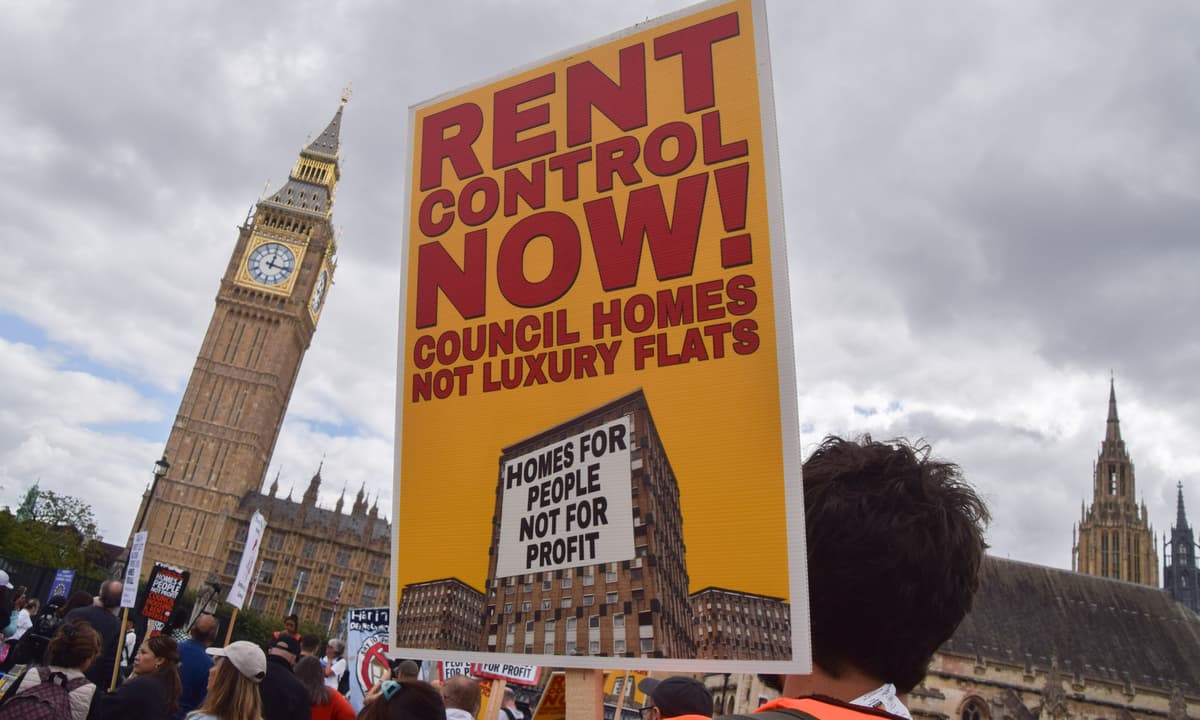
When Jenny Taylor moved from Leeds to London she was scandalised by how expensive life was. “In Leeds I was a student and I was paying £300 rent, all in,” she says. “In London I was paying £600 a month and every single year I have been here it has gone up and up. I would just wonder, when is it ever going to end?” The answer could be now. Last year Taylor, 30, and her boyfriend Ben Persaud, 28, an animator, started hunting for their first home together. In May last year they moved into a modest flat above a parade of shops in Crouch Hill. The one-bedroom property is on a main road, next to a chicken shop, and cost them £1,700pcm. This May their estate agent got in touch with bad news. Their rent, he informed them, was going up to £1,800 per month. “My gut reaction was: no way,” says Persaud. “It would have had a really bad effect on us,” agrees Taylor, who already augments her salary working as an account manager for a tech consultancy with a side hustle as a pet sitter to pay for extras like holidays. “I don’t want to pay all this money to live in London and then not be able to do anything,” she says. A protest organised by London Renters Union in September 2026AFP/GettyFortunately, a friend of the couple is a member of the London Renters’ Union, which campaigns to improve the situation for tenants, and she told them that their timing was perfect. The Renters’ Rights Act had just come into force, allowing private tenants to challenge rent increases through a tribunal. The couple were in the first wave of tenants eligible to use the new system, which involved filling in a form online and providing evidence of other similar homes recently let in the area. Their estate agent, acting for their landlord, was allowed to respond with his own examples. In September they were thrilled to learn that their bid to keep their rent at £1,700 had been upheld, saving them £1,200 a year. Taylor and Persaud found the tribunal process efficient — and much needed. “Landlords know that there will always be someone else willing to pay whatever they ask, “...so they just ask for more and more,” says Persaud. “It really seems unfair.” The couple have never met or spoken to their landlord, who lives overseas, and their dealings with the estate agent have remained cordial since the decision. They do not rule out using the tribunal again if their rent is hiked in the future and they would like to encourage other renters to make use of the system too. “London is so expensive to live in and it feels a bit sad that it is going to start pushing away talent because talent can’t afford it,” says Persaud. Since the Renters’ Rights Act became law, the First-tier Tribunal has supported renters in 70 per cent of decisions made, either reducing or rejecting landlords’ proposed rent increases. “Landlords know there will always be someone willing to pay whatever they ask, so they ask for more”Ben PersaudIn the other cases the landlords’ demands were approved, but the tribunal is not empowered to suggest a rent which is higher than the landlords’ requested level. And now and then landlords’ attempts to drive up rents have backfired on them in spectacular fashion. Davide Martinelli lives in a purpose-built tower block in Elephant & Castle. His home is a “build to rent” flat, in this case managed by Get Living. These tend to be more expensive than regular private rentals because they include extras such as free wi-fi and concierge services. But when Martinelli’s rent was increased from £2,560pcm to £2,577pcm he decided enough was enough and complained to the tribunal. It found the rent he was paying was already too high, even without the increase, and set a rent level of £2,350. This will save Martinelli — and potentially all of his neighbours if they are also confronted with similar rent increases and decide to follow his lead — more than £2,500 over the course of a year. A spokeswoman from Get Living said: “We support the Renters’ Rights Act and its aim of improving the standard and experience of private renting, and we respect tenants’ rights to challenge a proposed rent increase. “We remain confident that the rents we propose are consistent with the market and with the quality of service and amenities provided. This is the only instance since the act came into force in which a tribunal has set a rent below the level Get Living has proposed.” Olga Kondaurova decided to challenge the increaseOlga KondaurovaOlga moved into her newly built one-bedroom apartment in Shadwell five years ago, initially agreeing to pay £1,550 a month in rent. Over the years the rent went up and up. By last year she was paying £1,950pcm, a jump of 26 per cent over four years, partly thanks to the massive post-pandemic demand for rental homes which caused prices to spike in 2024. At the start of this summer the landlord informed Olga, who is in her early forties and works in construction consulting, that they wanted to increase her rent to £2,075pcm, a change which would cost her an extra £1,500 per year. “Each time they introduce rent increases there is no negotiation,” she says. “They just say you are welcome to leave, or you pay the new rent. They don’t treat us like humans, when we communicate with them we have to talk to Chat GPT.” Adding to her frustration, life in the flat had not been trouble free. Olga lives on the eighth floor and the lift is frequently out of order, sometimes for weeks and months at a time. “At least I get my steps in,” she says. The almost-new building is afflicted by leaks and mould and security is lax, which means parcels regularly get stolen and, alarmingly, rough sleepers have been found in the block. “When they introduce rent increases there is no negotiation. They say you are welcome to leave, or you pay the new rent”Olga KondaurovaOlga was aware of the Renters’ Rights Act and, after researching her options online, decided to challenge the increase. “It felt like it was the first time in five years that I had the legal right to challenge the increase, and that was very unfair,” she says. “I felt like if you don’t ask you don’t get. What did I have to lose?” Olga paid the £47 fee, submitted her evidence about local rent levels and the buildings’ problems, and in September the tribunal ruled that her rent should be frozen at £1,950. She is now spreading the word on her building’s WhatsApp group in the hope that others will follow in her footsteps. Her landlord has not, as yet, exercised its rights to appeal the decision. Taylor and Persaud’s landlord also appears to have accepted the ruling. Although Olga has not noticed any particular frostiness from her landlord or managing agent following the ruling, equally she says nothing has been done to resolve the building’s many problems. Which raises the question of why she wants to stay? “I like my views across the city, it is a unique location and an easy commute for me,” she says. “And in London it is so hard to find a place to live.”Under the Renters’ Rights Act landlords are allowed to propose rent increases once per year, giving at least two months’ notice. Rent increases are allowed, but must be in line with the local market rent level. If a tenant appeals to the First-tier Tribunal, a panel made up of experienced surveyors will assess what this level is by looking at evidence about the condition, size and location of the property as well as about other comparable local rentals. Landlords can’t evict tenants who exercise their right to challenge a rent increase, whatever the ruling. For information about the Renters’ Rights Act check out the London Renters’ Union: londonrentersunion.org Housing charity Shelter also offers a guide to the act and the tribunal system: england.shelter.org.uk To contest a rent rise go to: gov.uk/guidance/apply-for-an-open-market-rent-determination
Meet the Londoners fighting rent increases — and winning
Full Article
Original Source
Read the full article at Standard →KhanList aggregates and links to publicly available news content. We do not host full articles from third-party sources. Always verify important information with original sources.